Table of Contents
Nani is a charming name with fascinating multi-cultural roots that span from the Pacific Islands to South Asia and Europe. While often perceived as a simple name, Nani carries deep meanings in different linguistic traditions, from Hawaiian beauty to Greek grace. This name’s versatility across cultures makes it a unique choice that connects diverse heritages. Whether you’re drawn to its melodic sound or its positive connotations, Nani offers rich cultural resonance.
Meaning of Nani
The name Nani derives from several distinct linguistic traditions, each with its own meaningful interpretation. In Hawaiian, Nani comes from the Polynesian language and means ‘beautiful,’ ‘glorious,’ or ‘splendid,’ reflecting the islands’ appreciation for natural beauty. In Greek, Nani serves as a diminutive or affectionate form of Anna, which itself comes from the Hebrew name Hannah meaning ‘grace’ or ‘favor.’ In South Asian languages including Hindi, Urdu, and Bengali, Nani means ‘maternal grandmother,’ representing familial love and respect. Additionally, in Pashto and Balochi languages spoken in Afghanistan and Pakistan, Nani can mean ‘charming’ or ‘beautiful woman,’ showing how similar positive attributes appear across different language families.
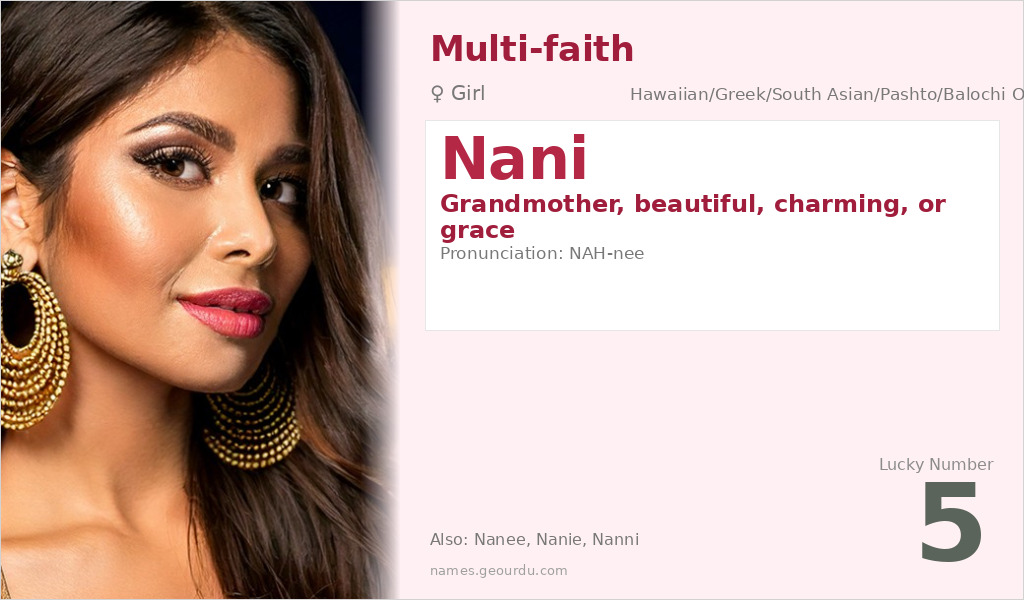
| 📛 Name | Nani |
| 💎 Meaning | Grandmother, beautiful, charming, or grace |
| 👤 Gender | Girl |
| 🕌 Religion | Multi-faith |
| 🌍 Origin | Hawaiian/Greek/South Asian/Pashto/Balochi |
| 🗣 Pronunciation | NAH-nee |
| ✍️ Urdu | نانی |
| ✍️ Arabic | ناني |
| 🔢 Numerology | 5 |
| ✨ Spellings | Nanee, Nanie, Nanni |
Origin & Cultural Significance
Nani’s origins are truly global, reflecting migration and cultural exchange across continents. The Hawaiian usage dates back to Polynesian settlement of the islands, where it described natural beauty. The Greek version emerged as a pet form of Anna in Mediterranean cultures. In South Asia, the term for maternal grandmother became used affectionately as a personal name. The name gained international recognition through famous bearers like Portuguese footballer Nani (born Luís Carlos Almeida da Cunha) and Indian actress Nani, though these are typically nicknames rather than legal names. This cross-cultural adoption demonstrates how simple, melodic names can transcend linguistic boundaries while maintaining positive associations.
Personality Traits
People named Nani often embody the positive qualities associated with their name’s meanings across cultures. They may display the beauty and grace suggested by the Hawaiian and Greek origins, or the warmth and familial connection implied by the South Asian meaning. Numerologically associated with the number 5, Nani suggests adaptability, curiosity, and social energy. These individuals often thrive in creative or communicative fields where they can express their charm and connect with diverse people.
Similar Names
If you like Nani, consider: Naina, Nadia, Nia, Nina, Ani
Famous People Named Nani
- Nani (Portuguese footballer) — Professional footballer born Luís Carlos Almeida da Cunha
- Nani (Indian actress) — South Indian film actress known for Telugu and Tamil cinema
Frequently Asked Questions About Nani
What does Nani mean?
Nani has multiple meanings depending on origin: 'beautiful' in Hawaiian, 'grace' in Greek (as a diminutive of Anna), 'maternal grandmother' in South Asian languages, and 'charming' in some Pashto/Balochi contexts.
Is Nani a boy or girl name?
Nani is predominantly used as a girl's name across all its cultural origins, though it can occasionally be a nickname for males (like the footballer Nani) in specific contexts.
What is the origin of Nani?
Nani has multiple origins: Hawaiian (Polynesian), Greek (as diminutive of Anna), South Asian (Hindi/Urdu/Bengali), and Pashto/Balochi. It's truly a multi-cultural name with different etymological paths.