
Table of Contents
Naraka is a profound Sanskrit term with deep religious significance across multiple South Asian traditions. While sometimes mistakenly listed as a baby name, it actually refers to the concept of the underworld or hell in Hindu, Buddhist, and Jain cosmology. This article explores the true meaning, etymology, and cultural context of this important religious concept. Understanding Naraka provides insight into ancient Indian philosophies of karma, punishment, and the afterlife.
Meaning of Naraka
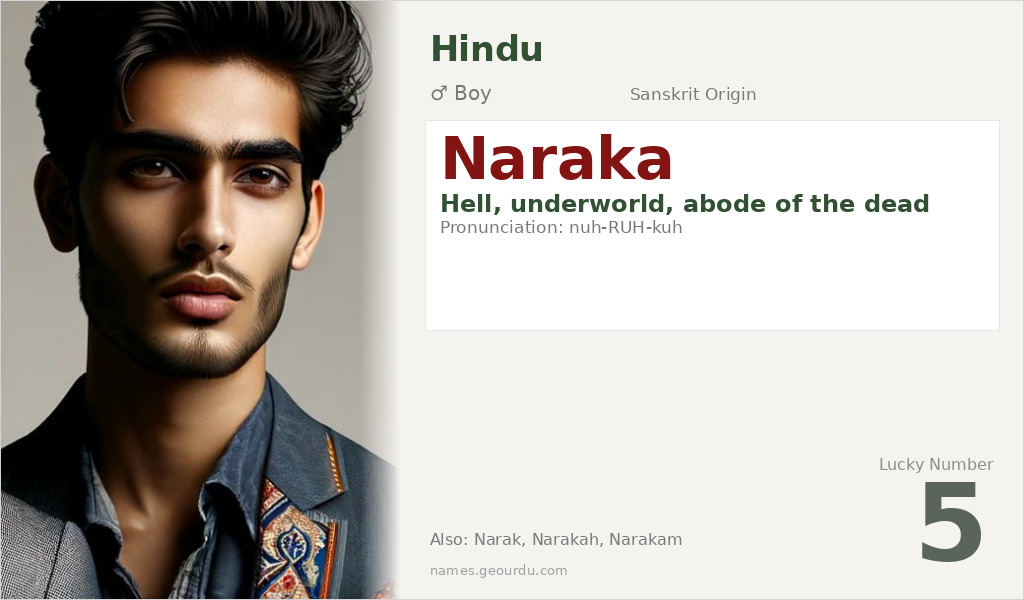
Naraka (नरक) is a Sanskrit word meaning ‘hell’, ‘underworld’, or ‘abode of the dead’. The term derives from the Sanskrit root ‘nṛ’ (man, mortal) with the suffix ‘-ka’, essentially meaning ‘place of mortals’ or specifically ‘place where mortals suffer for their misdeeds’. In Hindu scriptures, Naraka is described as having multiple levels, with Yama as its ruler, where souls undergo punishment according to their karma before rebirth. Buddhist texts similarly describe Naraka as one of the six realms of samsara, characterized by intense suffering. Jain cosmology also includes various Narakas where souls experience the consequences of negative karma. The concept appears in ancient texts including the Mahabharata, Puranas, and various Buddhist sutras.
| 📛 Name | Naraka |
| 💎 Meaning | Hell, underworld, abode of the dead |
| 👤 Gender | Boy |
| 🕌 Religion | Hindu |
| 🌍 Origin | Sanskrit |
| 🗣 Pronunciation | nuh-RUH-kuh |
| ✍️ Urdu | نرک |
| ✍️ Arabic | ناراكا |
| 🔢 Numerology | 5 |
| ✨ Spellings | Narak, Narakah, Narakam |
Origin & Cultural Significance
Naraka originates from ancient Sanskrit literature and religious texts of the Indian subcontinent. The concept developed within early Hindu cosmology and was subsequently adopted and adapted by Buddhist and Jain traditions. In the Mahabharata (circa 400 BCE-400 CE), detailed descriptions of various hells appear, while the Puranas (300-1500 CE) elaborate on different types of Narakas and their punishments. The term spread throughout South and Southeast Asia with the expansion of Hinduism and Buddhism, appearing in Pali as ‘Niraya’ and influencing concepts in Tibetan, Thai, and other Buddhist traditions. Despite its religious significance, Naraka has never been adopted as a personal name in Hindu culture due to its negative connotations.
Personality Traits
As Naraka is not used as a personal name in Hindu naming traditions, assigning personality traits would be inappropriate and culturally inaccurate. Hindu naming conventions carefully select names with positive meanings, auspicious associations, and divine connections to bless the child with favorable qualities. Names are typically chosen from deities, virtues, natural elements, or auspicious concepts. Naraka, meaning ‘hell’, contradicts these principles entirely and would not be chosen by Hindu parents for their children.
Similar Names
If you like Naraka, consider: Yama, Kubera, Varuna, Kala, Mrityu
Famous People Named Naraka
- No notable historical or contemporary figures are named Naraka, as it's not used as a personal name in Hindu tradition due to its meaning of 'hell'.
Frequently Asked Questions About Naraka
What does Naraka mean?
Naraka means 'hell', 'underworld', or 'abode of the dead' in Sanskrit. It's a religious concept in Hindu, Buddhist, and Jain traditions, not typically used as a personal name.
Is Naraka a boy or girl name?
Naraka is not used as a personal name in Hindu culture. As a Sanskrit word, it's grammatically masculine but refers to a place (hell) rather than a person. No Hindu parents would name their child Naraka due to its negative meaning.
What is the origin of Naraka?
Naraka originates from Sanskrit and ancient Indian religious texts. It appears in Hindu scriptures like the Mahabharata and Puranas, and was adopted into Buddhist and Jain cosmologies as well.





