
Table of Contents
Naseeb is a profound name that resonates across cultures, carrying the weight of destiny and divine apportionment. Rooted in classical Arabic, it has traveled through Persian, Urdu, Pashto, and beyond, becoming a cherished choice for boys in diverse communities. Whether in poetry, scripture, or daily life, Naseeb encapsulates the idea that each person has a unique share in the tapestry of existence. This name invites reflection on fate, fortune, and the mysterious ways life unfolds.
Meaning of Naseeb
Naseeb (نصيب) originates from the Arabic root ن-ص-ب (n-ṣ-b), which conveys the act of assigning, allotting, or establishing. As a masculine noun, it literally means ‘portion,’ ‘share,’ or ‘lot,’ but its semantic range extends to ‘fate,’ ‘destiny,’ and ‘fortune.’ In Islamic theology, it often refers to what God has preordained for an individual, blending material and spiritual dimensions. The word appears in the Quran, classical poetry, and everyday speech, emphasizing that everyone receives a unique naseeb. Linguistically, it is distinct from but related to ‘nasib’ (نصيب), a variant spelling with identical meaning, and should not be confused with names like Naseem (breeze) or Naseer (helper).
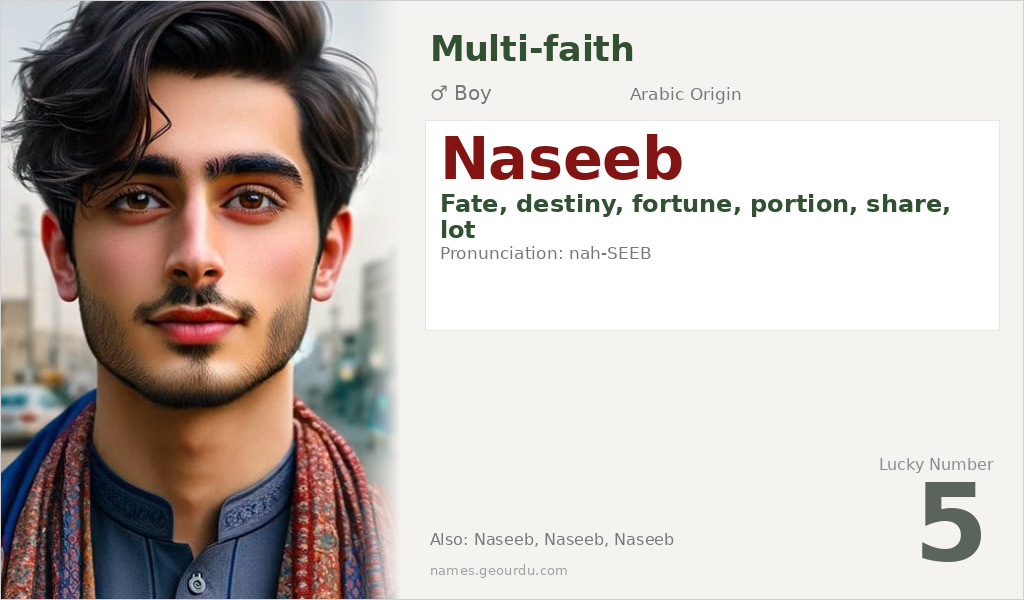
| 📛 Name | Naseeb |
| 💎 Meaning | Fate, destiny, fortune, portion, share, lot |
| 👤 Gender | Boy |
| 🕌 Religion | Multi-faith |
| 🌍 Origin | Arabic |
| 🗣 Pronunciation | nah-SEEB |
| ✍️ Urdu | نصیب |
| ✍️ Arabic | نصيب |
| 🔢 Numerology | 5 |
| ✨ Spellings | Naseeb, Naseeb, Naseeb, Naseeb, Naseeb |
Origin & Cultural Significance
The name Naseeb emerged in pre-Islamic Arabia, where tribal poets used it to describe one’s allotted portion in life, whether in love, war, or wealth. With the advent of Islam, it gained theological depth, appearing in the Quran and Hadith to discuss divine decree (qadar). It spread via Arabic to Persian, then to Urdu, Punjabi, Sindhi, Pashto, Balochi, and other languages of South Asia and the Middle East. In these regions, it is used by Muslims, Hindus, Christians, and Sikhs, reflecting a shared cultural appreciation for concepts of fate. Historical figures like the Pashtun poet Naseeb Khan helped popularize it, and it remains common in Afghanistan, Pakistan, India, and the Arab world today.
Personality Traits
Those named Naseeb are often seen as individuals who embrace life’s twists and turns with grace, believing in a larger plan. They may display a calm, accepting demeanor, coupled with a drive to make the most of their ‘share’ in life. In many traditions, the name is associated with luck and generosity, suggesting a personality that attracts and shares good fortune. This blend of resilience and optimism makes Naseeb a name that inspires both introspection and action.
Similar Names
If you like Naseeb, consider: Nasib, Naseem, Naseer, Naseem, Naseem
Famous People Named Naseeb
- Naseeb Khan — 18th-century Pashtun poet and warrior from the Khattak tribe, known for his Persian and Pashto poetry
- Naseebullah — Afghan cricketer who played for the national team in the 2010s
Frequently Asked Questions About Naseeb
What does Naseeb mean?
Naseeb means 'fate,' 'destiny,' 'fortune,' or 'portion' in Arabic, derived from the root ن-ص-ب (n-ṣ-b) meaning 'to allot.'
Is Naseeb a boy or girl name?
Naseeb is traditionally a masculine name in Arabic and most cultures where it is used, though rare feminine usage exists in some regions.
What is the origin of Naseeb?
Naseeb originates from classical Arabic and has spread to Persian, Urdu, Pashto, and other languages across the Middle East and South Asia.





