
Table of Contents
Nasra is a beautiful and meaningful name with deep roots in Arabic language and Islamic culture. Carrying connotations of victory, triumph, and divine assistance, this name has been cherished across Muslim communities for generations. Whether you’re considering it for your child or exploring its linguistic heritage, Nasra offers both historical significance and contemporary appeal. Let’s explore the rich tapestry behind this elegant name.
Meaning of Nasra
Nasra originates from the classical Arabic root ن-ص-ر (n-ṣ-r), which fundamentally means ‘to help, assist, or grant victory.’ As the feminine form of Nasr, it directly translates to ‘victory’ or ‘triumph.’ This root appears extensively in Islamic texts, including the Quran, where derivatives like ‘nasr’ (help/victory) and ‘ansar’ (helpers) carry significant religious weight. The name also connects to the Arabic word for ‘eagle’ (nasr), symbolizing strength, vision, and supremacy. Across various Muslim cultures from the Middle East to South Asia and Africa, Nasra has maintained its core meaning while adapting to local linguistic nuances.
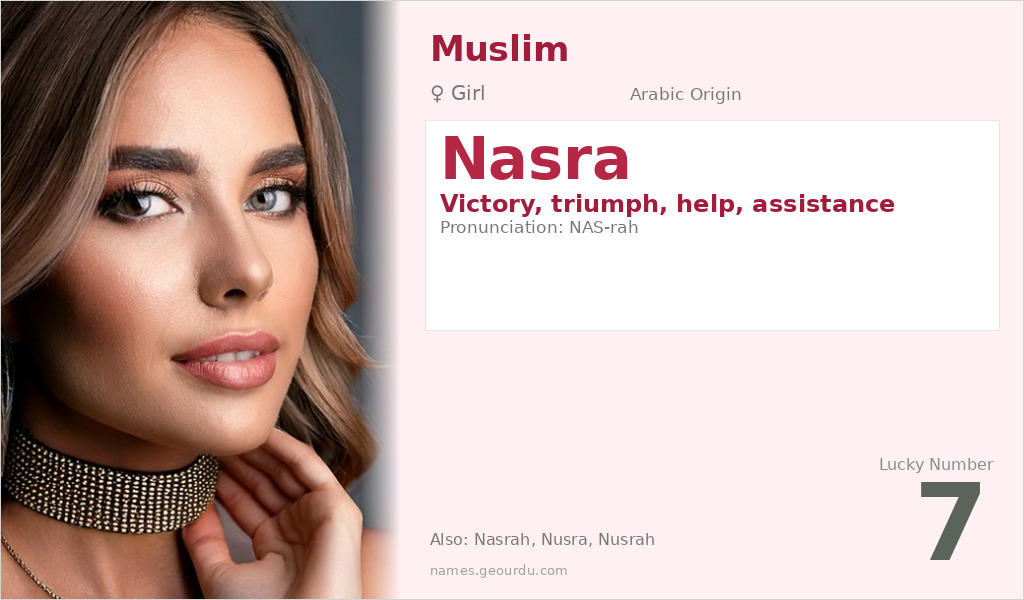
| 📛 Name | Nasra |
| 💎 Meaning | Victory, triumph, help, assistance |
| 👤 Gender | Girl |
| 🕌 Religion | Muslim |
| 🌍 Origin | Arabic |
| 🗣 Pronunciation | NAS-rah |
| ✍️ Urdu | نصرہ |
| ✍️ Arabic | نصرة |
| 🔢 Numerology | 7 |
| ✨ Spellings | Nasrah, Nusra, Nusrah |
Origin & Cultural Significance
Nasra has its primary origins in pre-Islamic and classical Arabic, where it was used both as a personal name and in poetic expressions. With the spread of Islam, the name gained religious significance through Quranic concepts of divine assistance and was adopted widely across the Muslim world. It appears in historical records from Al-Andalus to the Mughal Empire, often given to girls in hopes they would embody strength and righteousness. While the name exists in Swahili and other African languages through Arabic influence, and in Persian/Urdu as نصره, its core remains firmly Arabic. Regional variations in pronunciation and spelling reflect local adaptations while preserving the original meaning.
Personality Traits
Those named Nasra are often associated with qualities of resilience, compassion, and leadership. The name’s meaning of ‘victory’ and ‘assistance’ suggests someone who supports others while overcoming challenges with grace. In many cultures, Nasra is seen as embodying both strength and nurturing characteristics, making it a name that balances determination with empathy.
Similar Names
If you like Nasra, consider: Nasrin, Naseem, Nazira, Nusaybah, Nasreen
Famous People Named Nasra
- Nasra al-Hariri — Syrian poet and writer known for her literary contributions in the early 20th century
- Nasra Hassan — Somali women's rights activist and educator working on gender equality initiatives
Frequently Asked Questions About Nasra
What does Nasra mean?
Nasra means 'victory,' 'triumph,' or 'assistance' in Arabic, derived from the root ن-ص-ر (n-ṣ-r) meaning 'to help or grant victory.'
Is Nasra a boy or girl name?
Nasra is primarily a feminine name in Arabic and Muslim naming traditions, though masculine forms like Nasr exist.
What is the origin of Nasra?
Nasra originates from classical Arabic and has been used across Islamic cultures for centuries, with presence in regions from the Middle East to South Asia and Africa through cultural diffusion.





