
Table of Contents
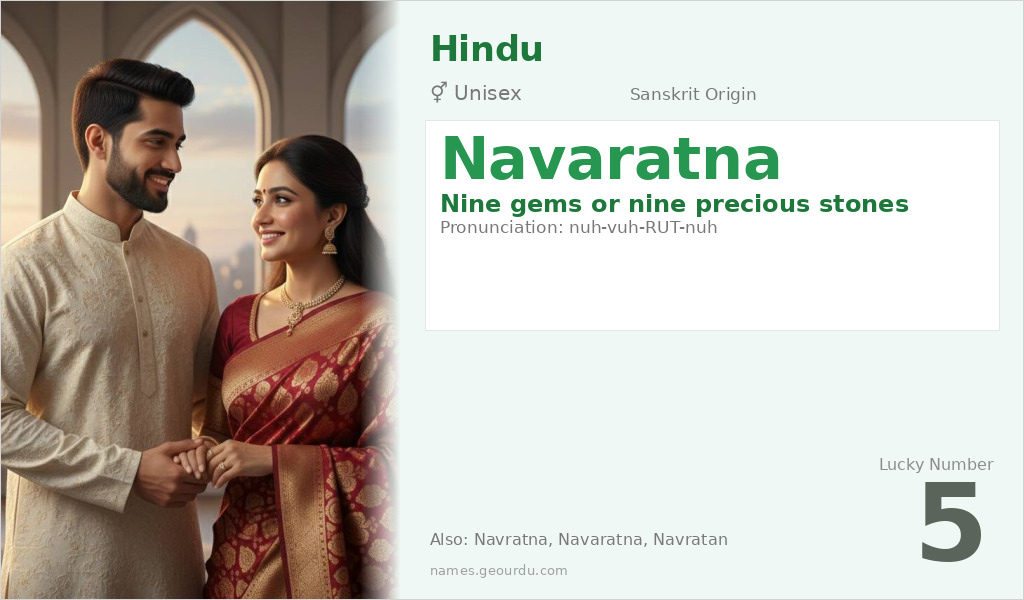
Navaratna is a beautiful Sanskrit name that carries deep cultural and spiritual significance in Hindu tradition. Meaning ‘nine gems’ or ‘nine precious stones’, this name evokes images of completeness, prosperity, and divine protection. Unlike many names that reference single qualities, Navaratna represents a harmonious collection of virtues and blessings. Whether chosen for a boy or girl, this name connects the bearer to ancient Indian wisdom and astrological traditions.
Meaning of Navaratna
Navaratna derives from the Sanskrit words ‘nava’ (नव), meaning ‘nine’, and ‘ratna’ (रत्न), meaning ‘gem, jewel, or precious stone’. The complete term specifically refers to the nine sacred gemstones recognized in Hindu astrology and royalty: ruby (representing the Sun), pearl (Moon), coral (Mars), emerald (Mercury), yellow sapphire (Jupiter), diamond (Venus), blue sapphire (Saturn), hessonite (Rahu), and cat’s eye (Ketu). This concept appears in ancient texts like Varahamihira’s Brihat Samhita (6th century CE), where the navaratna arrangement is described for both astrological and architectural purposes. The name symbolizes not just material wealth but spiritual completeness, as each gem represents different planetary energies that, when combined, create balance and protection.
| 📛 Name | Navaratna |
| 💎 Meaning | Nine gems or nine precious stones |
| 👤 Gender | Unisex |
| 🕌 Religion | Hindu |
| 🌍 Origin | Sanskrit |
| 🗣 Pronunciation | nuh-vuh-RUT-nuh |
| ✍️ Urdu | نورتن |
| ✍️ Arabic | نافاراتنا |
| 🔢 Numerology | 5 |
| ✨ Spellings | Navratna, Navaratna, Navratan |
Origin & Cultural Significance
Navaratna originates from Sanskrit, the classical language of ancient India, and has been used in Hindu culture for centuries. The concept of navaratna (nine gems) appears in multiple contexts: as a royal court comprising nine exceptional scholars or artists (like the Navaratnas of Emperor Akbar’s court), as an astrological arrangement of nine gemstones for planetary harmony, and as an architectural motif in Hindu temples. As a personal name, it reflects the Hindu tradition of naming children after auspicious concepts, objects, or divine attributes. While more commonly used in India and among Hindu communities, the name carries universal appeal through its symbolism of completeness and harmony. The term has also entered other Indian languages with similar meanings, maintaining its cultural significance across regions.
Personality Traits
Those named Navaratna are often perceived as individuals who embody balance and completeness in their character. Like the nine gems that represent different planetary influences, they may display versatility and the ability to harmonize diverse qualities. There’s often an association with prosperity, not just materially but in terms of rich inner life and spiritual depth. The name suggests someone connected to tradition yet capable of integrating various aspects of life into a cohesive whole.
Similar Names
If you like Navaratna, consider: Navin, Ratna, Navneet, Navya, Naval
Famous People Named Navaratna
- Navaratna Rajaram — Indian mathematician and author known for his work on the Indus script and Vedic mathematics
- Navaratna S. R. Rao — Indian archaeologist who served as Director General of the Archaeological Survey of India
Frequently Asked Questions About Navaratna
What does Navaratna mean?
Navaratna means 'nine gems' or 'nine precious stones' in Sanskrit. It specifically refers to the nine sacred gemstones of Hindu astrology: ruby, pearl, coral, emerald, yellow sapphire, diamond, blue sapphire, hessonite, and cat's eye.
Is Navaratna a boy or girl name?
Navaratna is a unisex name in Hindu tradition, though it has been used more frequently for boys in recent times. Historically, the concept of navaratna (nine gems) is gender-neutral in Hindu culture.
What is the origin of Navaratna?
Navaratna originates from Sanskrit, the classical language of ancient India. It combines 'nava' (nine) and 'ratna' (gem), and has been used in Hindu culture for centuries in contexts ranging from astrology to royal courts to personal names.