
Table of Contents
Nawab is a name steeped in history and nobility, originating as an Arabic title that evolved into a mark of aristocracy across South Asia. More than just a personal name, it carries centuries of cultural and political significance, representing authority, governance, and social status. Today, it remains a powerful choice for parents seeking a name with historical depth and regal connotations.
Meaning of Nawab
The name Nawab derives from the Arabic root ‘n-w-b’, meaning ‘to deputize’ or ‘to represent’. The original Arabic term ‘na’ib’ (نائب) refers to a deputy or representative, particularly in political or religious contexts. Through Persian influence as ‘nawwāb’, it specifically came to mean ‘deputy governor’ or ‘viceroy’ during the Mughal Empire. In South Asian languages, it expanded to denote Muslim nobles and rulers, especially during the 18th-19th centuries when Nawabs governed provinces under Mughal and later British authority. The term thus encapsulates both administrative function and aristocratic status.
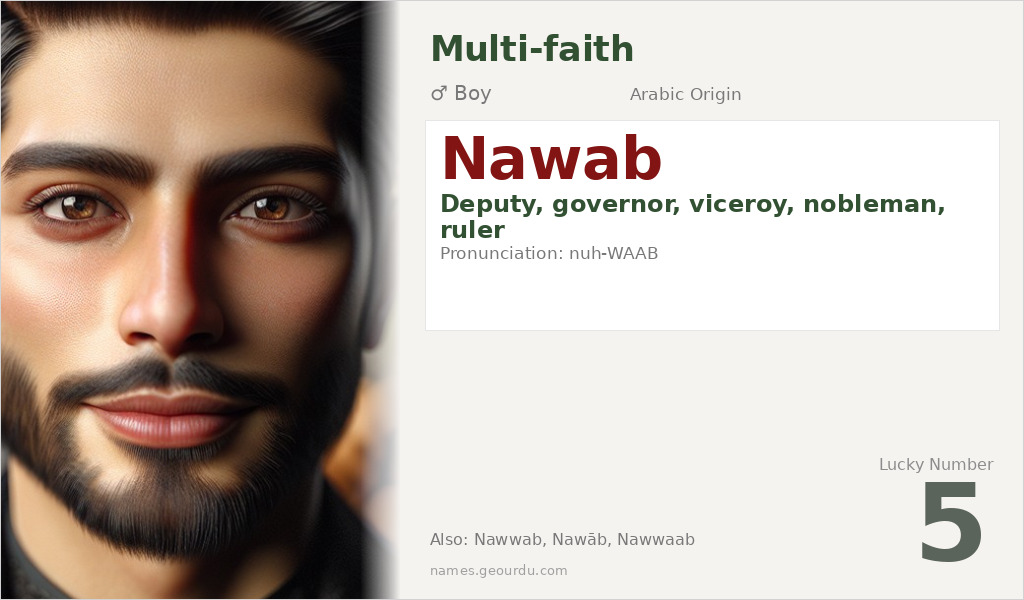
| 📛 Name | Nawab |
| 💎 Meaning | Deputy, governor, viceroy, nobleman, ruler |
| 👤 Gender | Boy |
| 🕌 Religion | Multi-faith |
| 🌍 Origin | Arabic |
| 🗣 Pronunciation | nuh-WAAB |
| ✍️ Urdu | نواب |
| ✍️ Arabic | نواب |
| 🔢 Numerology | 5 |
| ✨ Spellings | Nawwab, Nawāb, Nawwaab |
Origin & Cultural Significance
Nawab’s journey begins in classical Arabic, where ‘na’ib’ was used for deputies in various contexts. It gained prominence in Persian during the Mughal era (1526-1857) as a formal title for provincial governors. The British East India Company adopted the title during colonial rule, conferring it upon loyal Indian rulers. Historically, Nawabs governed regions like Bengal, Awadh, and Arcot, making the name particularly associated with Muslim aristocracy in the Indian subcontinent. While primarily used by Muslims, the title was also held by some Hindu and Sikh rulers, reflecting its cross-cultural administrative role.
Personality Traits
Named after a title of governance and nobility, individuals called Nawab often embody leadership, dignity, and a sense of responsibility. They may naturally assume authoritative roles, guided by strategic thinking and diplomatic skills. The historical weight of the name can inspire a connection to tradition and cultural heritage, while its administrative origins suggest organizational ability and fairness in dealing with others.
Similar Names
If you like Nawab, consider: Naib, Wazir, Sultan, Amir, Shah
Famous People Named Nawab
- Nawab of Bengal — Historical title for rulers of Bengal in the 18th century, most notably Siraj ud-Daulah
- Nawab Kapur Singh — Sikh leader and founder of the Singhpuria Misl in 18th century Punjab
Frequently Asked Questions About Nawab
What does Nawab mean?
Nawab means 'deputy', 'governor', 'viceroy', or 'nobleman'. It originates from Arabic 'na'ib' (نائب) meaning 'deputy', evolving through Persian into a title for Muslim aristocrats in South Asia.
Is Nawab a boy or girl name?
Nawab is exclusively a boy's name, as it historically refers to male rulers and nobles. There is no feminine equivalent in common usage.
What is the origin of Nawab?
Nawab originates from Arabic, entering Persian as 'nawwāb', and became prominent in South Asian languages like Urdu, Hindi, and Bengali during the Mughal and colonial periods as a title for Muslim nobility.





