Table of Contents
Nawwaab is a distinguished Arabic name with deep historical roots in Islamic governance and nobility. As the plural form of ‘Nawab,’ this name carries connotations of leadership, authority, and administrative excellence. Primarily used in Muslim communities, particularly in South Asia, Nawwaab evokes images of historical rulers and provincial governors from the Mughal era. Understanding this name requires exploring its linguistic origins and cultural context.
Meaning of Nawwaab
Nawwaab derives from the Arabic root N-W-B (ن و ب), which conveys meanings related to representation, deputization, and standing in place of others. The singular form ‘Nawab’ literally means ‘deputy’ or ‘representative,’ specifically referring to someone who acts on behalf of a higher authority. In practical usage during the Mughal Empire and other Islamic states, Nawab became the title for provincial governors and viceroys. The plural form Nawwaab therefore means ‘rulers,’ ‘governors,’ or ‘noblemen’ collectively, emphasizing the concept of multiple authorities or a ruling class.
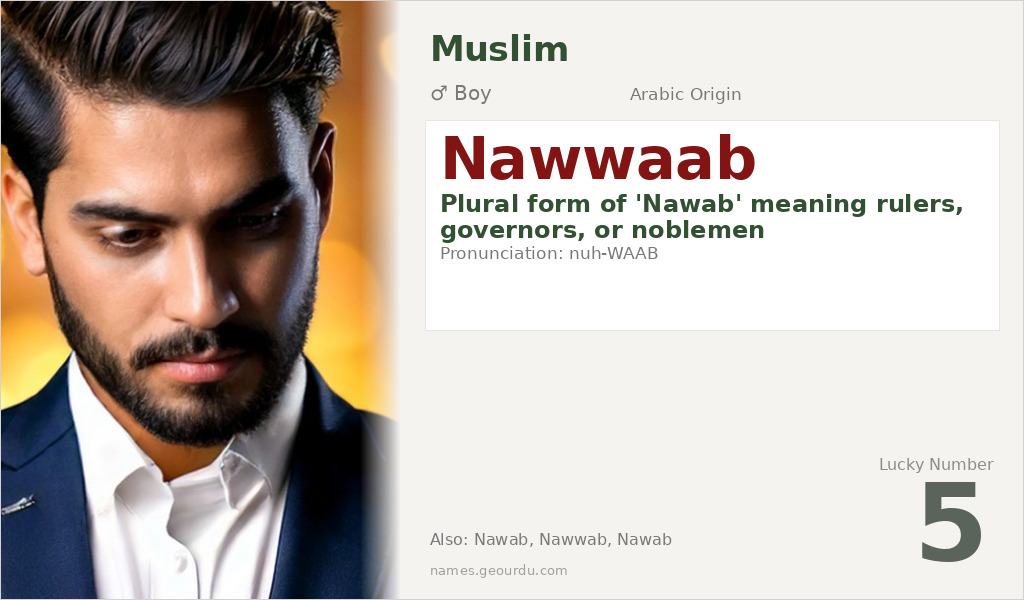
| 📛 Name | Nawwaab |
| 💎 Meaning | Plural form of 'Nawab' meaning rulers, governors, or noblemen |
| 👤 Gender | Boy |
| 🕌 Religion | Muslim |
| 🌍 Origin | Arabic |
| 🗣 Pronunciation | nuh-WAAB |
| ✍️ Urdu | نواب |
| ✍️ Arabic | نواب |
| 🔢 Numerology | 5 |
| ✨ Spellings | Nawab, Nawwab, Nawab, Nawwaab |
Origin & Cultural Significance
The name Nawwaab originated in Arabic but gained prominence through its adoption into Persian and subsequently Urdu during the Mughal period in South Asia (1526-1857). As the Mughal Empire expanded, the title ‘Nawab’ was bestowed upon regional administrators who governed provinces on behalf of the emperor. The plural form Nawwaab became used both as a title for collective rulership and occasionally as a given name, particularly among Muslim families with connections to administrative or noble lineages. While primarily associated with Islamic cultures, the term has historical connections across regions where Arabic influence spread, including parts of Africa and Southeast Asia.
Personality Traits
Given its meaning of ‘rulers’ or ‘governors,’ the name Nawwaab is associated with leadership qualities and administrative competence. Those named Nawwaab are often expected to demonstrate responsibility, authority, and the ability to manage complex situations. The historical context suggests traits of diplomacy, governance, and representation. While personality varies by individual, the name carries cultural expectations of dignity and capability in leadership roles.
Similar Names
If you like Nawwaab, consider: Nawab, Wali, Amir, Sultan, Hakim
Famous People Named Nawwaab
- Nawwaab of Awadh — Historical title for rulers of the Awadh region in India
- Nawwaab of Bengal — Historical title for Mughal governors of Bengal
Frequently Asked Questions About Nawwaab
What does Nawwaab mean?
Nawwaab means 'rulers,' 'governors,' or 'noblemen' in Arabic. It is the plural form of 'Nawab,' which derives from the Arabic root meaning 'to represent' or 'to deputize.'
Is Nawwaab a boy or girl name?
Nawwaab is exclusively a boy's name in all cultural contexts where it is used. The name's meaning related to rulership and governance has historically been masculine in the cultures where it originated.
What is the origin of Nawwaab?
Nawwaab originates from Arabic, specifically from the root N-W-B. It gained prominence through Persian and Urdu during the Mughal period in South Asia, where it was used as a title for provincial governors and administrators.