
Table of Contents
The name Nehru carries historical weight and political significance far beyond its linguistic origins. While not commonly used as a first name today, it remains instantly recognizable due to its association with one of modern India’s most influential families. This exploration delves into the possible meanings, origins, and cultural impact of this distinctive name that shaped a nation’s destiny.
Meaning of Nehru
The etymology of Nehru is not definitively documented but appears connected to water-related terms. Most sources suggest it derives from the Persian/Arabic word ‘nahr’ (نهر), meaning ‘river’ or ‘canal’, which was adopted into Urdu and Hindi as ‘nahar’. In this context, Nehru might mean ‘of the canal’ or ‘canal dweller’. The Nehru family themselves traced their name to their ancestral home in Delhi, which was situated near a canal (‘nahar’). Some linguistic analyses suggest it could be a Kashmiri Pandit surname with similar aquatic connotations. The name’s meaning remains somewhat speculative due to its transition from descriptive location-based surname to prominent political identifier.
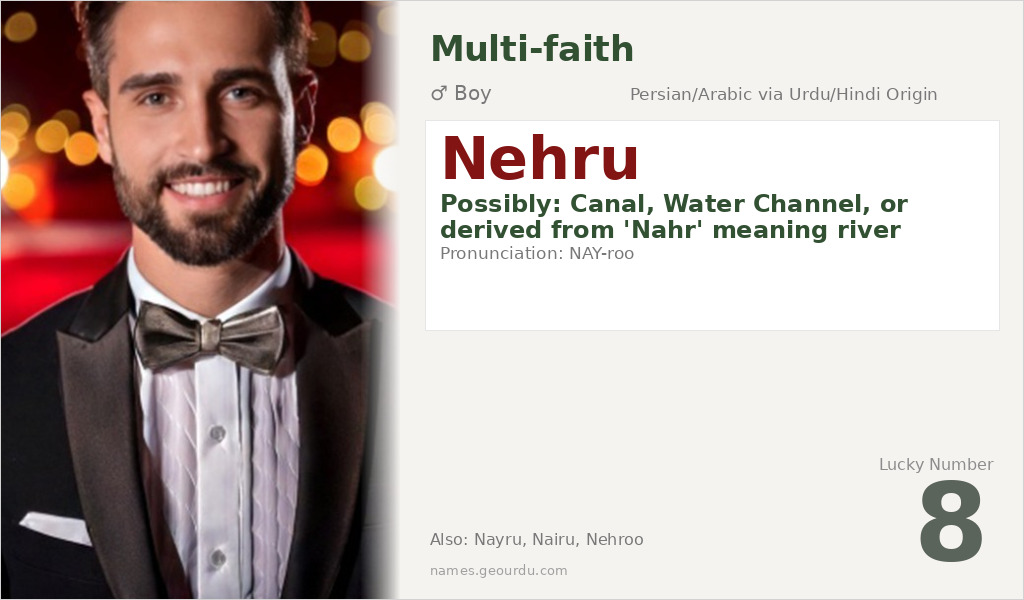
| 📛 Name | Nehru |
| 💎 Meaning | Possibly: Canal, Water Channel, or derived from 'Nahr' meaning river |
| 👤 Gender | Boy |
| 🕌 Religion | Multi-faith |
| 🌍 Origin | Persian/Arabic via Urdu/Hindi |
| 🗣 Pronunciation | NAY-roo |
| ✍️ Urdu | نہرو |
| ✍️ Arabic | نهرو |
| 🔢 Numerology | 8 |
| ✨ Spellings | Nayru, Nairu, Nehroo |
Origin & Cultural Significance
Nehru originated as a surname among Kashmiri Pandit communities who migrated to the plains of North India. The name gained national and international prominence through the Nehru-Gandhi political dynasty that led India’s independence movement and governed the nation for decades. While the name has Persian/Arabic linguistic roots via Urdu influence in North India, it transcends specific religious associations. Today, it’s recognized globally as a surname rather than a given name, with its cultural significance deeply tied to modern Indian history and the legacy of Jawaharlal Nehru, India’s first Prime Minister.
Personality Traits
While personality traits aren’t inherent to names, the historical associations with the Nehru name suggest qualities of intellectualism, progressive vision, and leadership. Those bearing this name might be perceived as thoughtful, reform-minded individuals with strong communication abilities. The legacy connected to this name emphasizes education, secular values, and nation-building—associations that could influence how people perceive someone with this distinctive surname.
Similar Names
If you like Nehru, consider: Nahar, Nehar, Nair, Narayan, Narendra
Famous People Named Nehru
- Jawaharlal Nehru — First Prime Minister of India, central figure in Indian independence movement
- Motilal Nehru — Prominent Indian lawyer and politician, father of Jawaharlal Nehru
Frequently Asked Questions About Nehru
What does Nehru mean?
Nehru likely derives from Persian/Arabic 'nahr' meaning 'river' or 'canal', possibly indicating 'canal dweller'. However, the etymology isn't definitively documented.
Is Nehru a boy or girl name?
Nehru is primarily a surname/family name rather than a given name. When used, it's typically masculine due to its association with male historical figures.
What is the origin of Nehru?
The name has Persian/Arabic linguistic roots via Urdu, but it originated as a Kashmiri Pandit surname in North India. It gained prominence through India's Nehru political dynasty.





