Table of Contents
Nida is a beautiful and meaningful Arabic name for girls that resonates with clarity and purpose. Derived from the Quranic root meaning ‘to call out,’ it symbolizes a voice that commands attention—whether in prayer, poetry, or daily life. Popular across the Muslim world from Pakistan to the Middle East, Nida carries a rich linguistic heritage that transcends mere superstition. This guide explores its verified etymology, cultural usage, and why it remains a timeless choice for parents.
Meaning of Nida
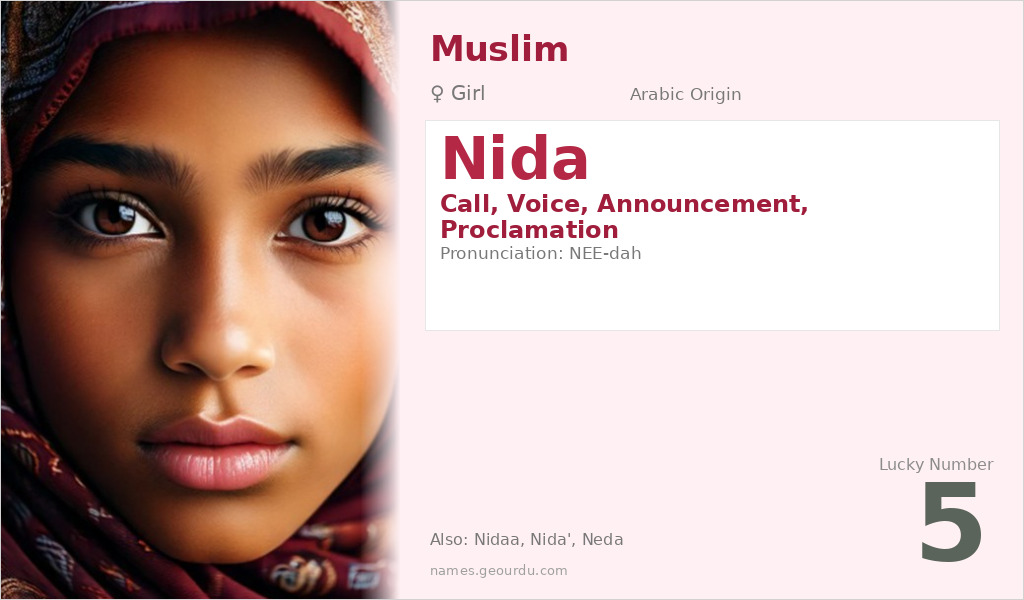
Nida (نداء) is an Arabic feminine name meaning ‘Call, Voice, Announcement, or Proclamation.’ It originates from the triliteral root N-D-ʾ (ن-د-ء), which conveys the act of calling loudly or summoning, often in a public or divine context. In Islamic tradition, this root is sacred; for example, the call to prayer (adhan) is a form of nida’, and the Quran uses it in Surah Al-Qasas: ‘Yawma yunādīhim’ (On the Day He will call to them). Unlike some names with ambiguous origins, Nida’s meaning is well-documented in classical Arabic lexicons like Lisān al-ʿArab, confirming its semantic core as a clear, resonant voice. This makes it distinct from similar-sounding names in other languages, such as the Persian ‘Neda’ (voice or call), which shares semantic overlap but different etymological roots.
| 📛 Name | Nida |
| 💎 Meaning | Call, Voice, Announcement, Proclamation |
| 👤 Gender | Girl |
| 🕌 Religion | Muslim |
| 🌍 Origin | Arabic |
| 🗣 Pronunciation | NEE-dah |
| ✍️ Urdu | ندا |
| ✍️ Arabic | نداء |
| 🔢 Numerology | 5 |
| ✨ Spellings | Nidaa, Nida', Neda, Nidah |
Origin & Cultural Significance
Nida has its origins in Classical Arabic, with deep roots in pre-Islamic and Islamic literature. It gained prominence as a given name in the early Islamic period, reflecting the value placed on eloquence and communication in Arab culture. The name spread across the Muslim world through the expansion of Islam, becoming common in regions like South Asia (e.g., Pakistan, India), the Middle East, and Southeast Asia, often retaining its original Arabic form. While it is primarily used by Muslims, its linguistic appeal has led to occasional use in multi-faith contexts, though it remains firmly associated with Islamic heritage. Contrary to some speculation, it is not derived from Pashto, Balochi, or other regional languages—these may have similar names due to Arabic influence, but Nida itself is authentically Arabic.
Personality Traits
Those named Nida are often seen as articulate and confident, with a natural gift for expression that draws people to them. They may excel in fields requiring communication, such as teaching, writing, or public speaking, and are often perceived as leaders who can mobilize others with their words. Their personality is frequently described as warm yet assertive, balancing sociability with a strong sense of purpose that aligns with the name’s meaning of a clear call or proclamation.
Similar Names
If you like Nida, consider: Nadya, Nadiyya, Nadira, Naima, Noor
Famous People Named Nida
- Nida Fazli — Renowned Indian Urdu poet known for his ghazals and Bollywood lyrics
- Nida Yasir — Pakistani television host and actress popular for morning shows
Frequently Asked Questions About Nida
What does Nida mean?
Nida means 'Call, Voice, Announcement, or Proclamation' in Arabic, derived from the root N-D-ʾ (ن-د-ء) meaning to call out loudly.
Is Nida a boy or girl name?
Nida is predominantly a girl's name in Arabic and Muslim cultures, though in some regions like Turkey, it can be unisex; its feminine form is standard in most contexts.
What is the origin of Nida?
Nida originates from Classical Arabic, with documented usage in the Quran and pre-Islamic poetry, and is widely used across the Muslim world.