Table of Contents
Nilakantha is a profound Sanskrit name rich with mythological significance and spiritual depth. Primarily used for boys in Hindu communities, this name carries the powerful imagery of ‘blue-throated’ and connects directly to one of Hinduism’s most important deities. Beyond its literal meaning, Nilakantha represents sacrifice, protection, and divine resilience. This name has been borne by scholars, freedom fighters, and continues to inspire parents seeking a name with deep cultural roots.
Meaning of Nilakantha
Nilakantha derives from classical Sanskrit, combining ‘nīla’ (blue, dark blue, sapphire-colored) and ‘kaṇṭha’ (throat, neck). The ‘blue’ specifically refers to the deep blue of sapphire or the dark blue of a storm cloud, not just any blue shade. In linguistic terms, it’s a tatpurusha compound (determinative compound) where ‘blue’ modifies ‘throat’. The name appears in ancient texts like the Mahabharata (where Shiva is called Nilakantha) and various Puranas. In the Bhagavata Purana and Shiva Purana, the story is detailed of Shiva drinking the poison halāhala during the churning of the ocean, which stained his throat blue but he held it there without swallowing, earning him this epithet meaning ‘the blue-throated one’.
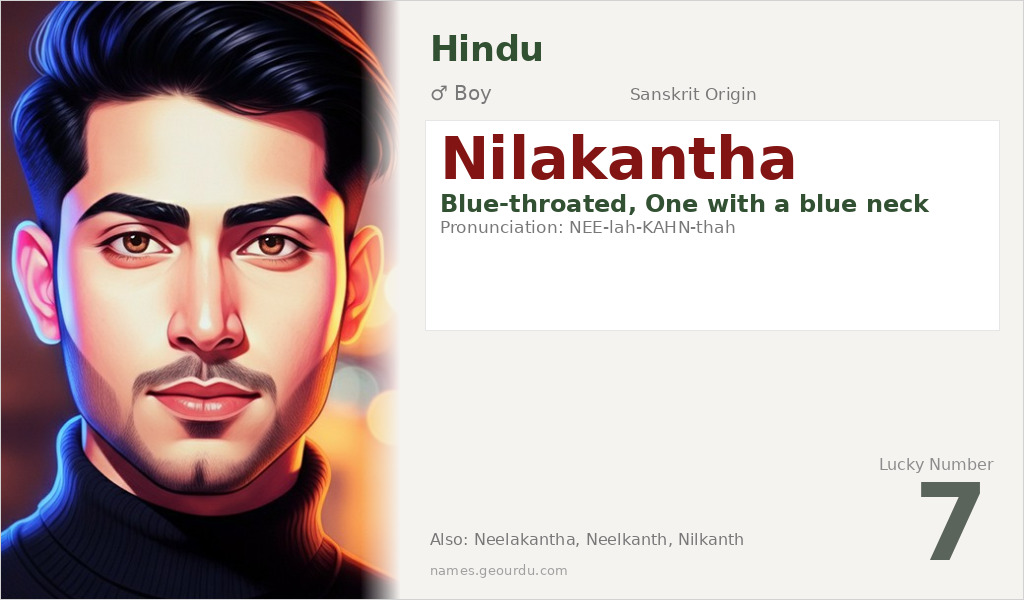
| 📛 Name | Nilakantha |
| 💎 Meaning | Blue-throated, One with a blue neck |
| 👤 Gender | Boy |
| 🕌 Religion | Hindu |
| 🌍 Origin | Sanskrit |
| 🗣 Pronunciation | NEE-lah-KAHN-thah |
| ✍️ Urdu | نیل کنٹھ |
| ✍️ Arabic | نيلاكانثا |
| 🔢 Numerology | 7 |
| ✨ Spellings | Neelakantha, Neelkanth, Nilkanth |
Origin & Cultural Significance
Nilakantha originates from ancient Sanskrit literature and Hindu mythology, specifically from the pan-Indian tradition centered on Lord Shiva. The name first appears in Vedic and post-Vedic texts, becoming particularly prominent in Puranic literature (circa 300-1000 CE). Culturally, it’s used predominantly in Hindu communities across India, Nepal, and the diaspora, especially among Shaivites (devotees of Shiva). Historically, the name has been adopted by several notable figures, including medieval scholars like Nilakantha Somayaji who contributed to mathematics and astronomy. The name reflects the syncretic nature of Hindu mythology where physical attributes symbolize deeper spiritual truths.
Personality Traits
Drawing from its mythological origins, Nilakantha suggests a personality marked by extraordinary resilience and protective instincts. Like Shiva who consumed poison to save the world, individuals with this name may demonstrate the ability to transform challenges into strengths. They often exhibit calmness in crisis, deep spiritual insight, and a philosophical approach to life. The blue throat symbolizes both the burden carried and the grace under pressure, suggesting someone who can handle difficult situations while maintaining inner peace.
Similar Names
If you like Nilakantha, consider: Shiva, Neel, Kanth, Neelambar, Neeladri
Famous People Named Nilakantha
- Nilakantha Das — Indian freedom fighter and politician from Odisha
- Nilakantha Somayaji — 15th century Indian mathematician and astronomer from Kerala who wrote important astronomical texts
Frequently Asked Questions About Nilakantha
What does Nilakantha mean?
Nilakantha means 'blue-throated' or 'one with a blue neck' in Sanskrit. It specifically refers to the Hindu god Shiva, who drank poison during the churning of the ocean, which turned his throat blue.
Is Nilakantha a boy or girl name?
Nilakantha is traditionally a masculine name given to boys in Hindu culture. It originates as an epithet for the male deity Shiva and has historically been used for males.
What is the origin of Nilakantha?
Nilakantha originates from Sanskrit and Hindu mythology. It comes from ancient Indian texts where it describes Lord Shiva after he drank poison to protect the universe, with the name literally meaning 'blue-throated'.