
Table of Contents
Nirmal is a beautiful name with deep roots in Sanskrit language and Hindu culture. Meaning ‘pure’ or ‘without blemish’, it carries connotations of spiritual clarity and moral integrity. While commonly used in India and Nepal, its universal appeal has made it recognizable across South Asian communities worldwide. This name embodies values of cleanliness—both physical and spiritual—that resonate across generations.
Meaning of Nirmal
The name Nirmal originates from the Sanskrit language, where it is composed of two elements: ‘nir’ (meaning ‘without’ or ‘free from’) and ‘mala’ (meaning ‘dirt, impurity, or stain’). Together, they create a word that literally translates to ‘without impurity’ or ‘spotless’. In Hindu philosophical texts, ‘nirmal’ describes not just physical cleanliness but also purity of mind, heart, and soul. The concept appears in scriptures like the Bhagavad Gita where Krishna speaks of ‘nirmala buddhi’ (pure intellect). This linguistic construction is common in Sanskrit names, with similar formations including Niranjan (without blemish) and Nityanand (eternal bliss).
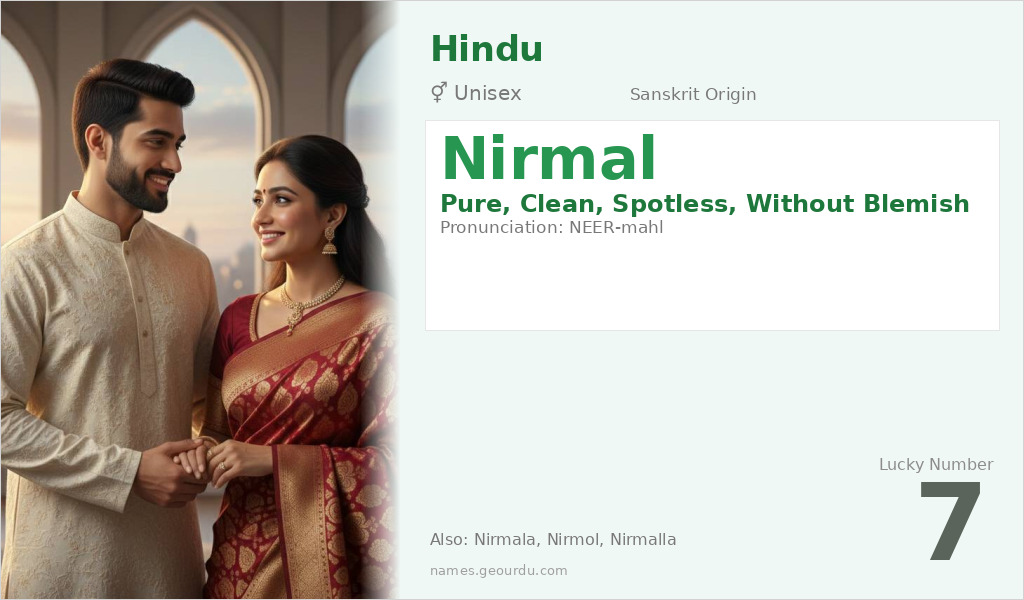
| 📛 Name | Nirmal |
| 💎 Meaning | Pure, Clean, Spotless, Without Blemish |
| 👤 Gender | Unisex |
| 🕌 Religion | Hindu |
| 🌍 Origin | Sanskrit |
| 🗣 Pronunciation | NEER-mahl |
| ✍️ Urdu | نرمل |
| ✍️ Arabic | نيرمال |
| 🔢 Numerology | 7 |
| ✨ Spellings | Nirmala, Nirmol, Nirmalla |
Origin & Cultural Significance
Nirmal has its origins in ancient Sanskrit, the classical language of Hinduism, Buddhism, and Jainism. As a concept, purity (nirmalatā) holds significant importance in Dharmic traditions, where spiritual cleanliness is considered essential for enlightenment. The name appears in historical Indian literature and continues to be popular across India, Nepal, and the South Asian diaspora. While primarily associated with Hindu culture, the name’s meaning has universal appeal and is sometimes adopted by people of other faiths who appreciate its linguistic beauty and positive connotations. Regional variations include Nirmala (feminine form) in many Indian languages.
Personality Traits
People named Nirmal are often associated with qualities of integrity, clarity, and spiritual awareness. They tend to approach life with a clean conscience and straightforward demeanor, valuing honesty in all interactions. Their name’s meaning frequently influences how they’re perceived—as individuals who strive for moral purity and transparent relationships. While personality varies by individual, the name carries expectations of ethical behavior and thoughtful decision-making.
Similar Names
If you like Nirmal, consider: Niranjan, Nishant, Naveen, Nikhil, Nityanand
Famous People Named Nirmal
- Nirmal Verma — Renowned Hindi writer and novelist from India
- Nirmal Shekar — Indian sports journalist and columnist
Frequently Asked Questions About Nirmal
What does Nirmal mean?
Nirmal means 'pure', 'clean', 'spotless', or 'without blemish' in Sanskrit, combining 'nir' (without) and 'mala' (impurity).
Is Nirmal a boy or girl name?
Nirmal is traditionally a unisex name in Hindu culture, though it's more commonly given to boys. The feminine form is typically Nirmala.
What is the origin of Nirmal?
Nirmal originates from Sanskrit, the ancient language of India, and is deeply rooted in Hindu philosophy and Dharmic traditions where purity is a central spiritual concept.