Table of Contents
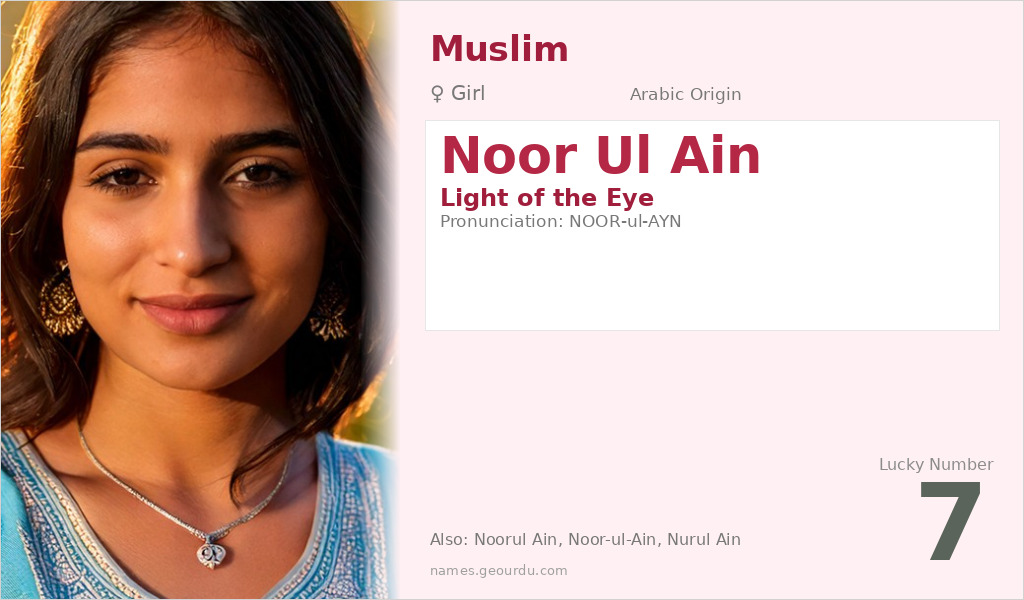
Noor Ul Ain is a beautifully poetic Arabic name that has been cherished in Muslim communities for centuries. Meaning ‘Light of the Eye,’ this name carries deep emotional and cultural resonance, symbolizing someone who brings joy and brightness to one’s life. As a compound name with roots in classical Arabic literature, it represents both literal and metaphorical illumination. Today, it remains a popular choice for girls across South Asia, the Middle East, and diaspora communities worldwide.
Meaning of Noor Ul Ain
Noor Ul Ain is a compound Arabic name with two distinct components that together create a meaningful whole. The first element, ‘Noor’ (نور), comes from the Arabic root N-W-R, which relates to light, illumination, and radiance—appearing in words like ‘munawwar’ (illuminated) and ‘nur’ (divine light). The second element, ‘Ain’ (عين), derives from the root ‘-Y-N meaning eye, spring, or source. When combined as ‘Noor ul-Ain,’ the phrase literally translates to ‘Light of the Eye,’ a classical Arabic expression used to describe someone precious who brings happiness and brightness to one’s sight. This metaphorical usage appears in pre-Islamic and Islamic poetry, where beloved individuals are described as illuminating the eyes of their admirers. The name thus carries connotations of beauty, value, and emotional significance beyond its literal translation.
| 📛 Name | Noor Ul Ain |
| 💎 Meaning | Light of the Eye |
| 👤 Gender | Girl |
| 🕌 Religion | Muslim |
| 🌍 Origin | Arabic |
| 🗣 Pronunciation | NOOR-ul-AYN |
| ✍️ Urdu | نور العین |
| ✍️ Arabic | نور العين |
| 🔢 Numerology | 7 |
| ✨ Spellings | Noorul Ain, Noor-ul-Ain, Nurul Ain, Nur-ul-Ain, Noor al-Ayn |
Origin & Cultural Significance
Noor Ul Ain originates from classical Arabic language and literature, with deep roots in Islamic cultural traditions. The phrase appears in historical Arabic poetry and texts as a term of endearment and admiration for beloved individuals. As a given name, it gained particular popularity in South Asian Muslim communities (Pakistan, India, Bangladesh) during the Mughal era, where Persian and Arabic names were highly valued. The name reflects the Islamic appreciation for light symbolism, connecting to concepts like ‘Nur’ (divine light) mentioned in the Quran. While primarily used in Muslim communities, the name’s linguistic beauty has made it appreciated across cultural boundaries, though it remains most common in Arabic-speaking regions and South Asia.
Personality Traits
The name Noor Ul Ain suggests someone who brings illumination and joy to others’ lives. Individuals with this name are often perceived as radiant, perceptive, and emotionally expressive, with a natural ability to see the beauty in people and situations. The ‘light’ element of their name may indicate someone who provides guidance or positivity, while the ‘eye’ component suggests insight and appreciation for detail. These traits combine to create someone who is often cherished and valued in their personal and professional relationships.
Similar Names
If you like Noor Ul Ain, consider: Noor, Noor Jahan, Noor Fatima, Ain, Nazneen, Zahra, Basira, Munira, Sana, Anwar
Famous People Named Noor Ul Ain
- Noorul Ain — Pakistani television actress known for roles in dramas like 'Mere Khuda' and 'Mujhe Khuda Pe Yaqeen Hai'
- Noor-ul-Ain — Historical figure: one of the largest pink diamonds in the world, part of the Iranian Crown Jewels, named with this phrase
Frequently Asked Questions About Noor Ul Ain
What does Noor Ul Ain mean?
Noor Ul Ain means 'Light of the Eye' in Arabic. It's a compound name where 'Noor' means light and 'Ain' means eye, together forming a poetic expression for someone who brings joy and brightness.
Is Noor Ul Ain a boy or girl name?
Noor Ul Ain is primarily a girl's name in Muslim naming traditions, though the phrase itself is gender-neutral in Arabic language. The feminine usage has become culturally established across South Asia and the Middle East.
What is the origin of Noor Ul Ain?
Noor Ul Ain originates from classical Arabic language and Islamic cultural traditions. The phrase appears in Arabic poetry and literature as a term of endearment, and as a given name it became particularly popular in South Asian Muslim communities.