Table of Contents
Nura is a beautiful and meaningful name of Arabic origin, cherished primarily in Muslim communities worldwide. As the feminine form of Nur, meaning ‘light,’ it carries profound spiritual connotations linked to divine illumination. This name has been popular for centuries across the Middle East, North Africa, and South Asia, symbolizing guidance, purity, and enlightenment. Parents often choose Nura to bestow a sense of radiance and hope upon their daughters.
Meaning of Nura
Nura derives directly from the Arabic word ‘nur’ (نور), which translates to ‘light’ or ‘illumination.’ The root n-w-r (ن-و-ر) appears in various Arabic words related to brightness, such as ‘munawwar’ (enlightened) and ‘nawar’ (to illuminate). In an Islamic context, light holds significant metaphorical weight, representing divine guidance, knowledge, and faith, as referenced in the Quranic verse ‘Allah is the Light of the heavens and the earth’ (Surah An-Nur, 24:35). The feminine suffix ‘-a’ softens the name, making Nura a common choice for girls, emphasizing qualities of inner and outer radiance. Linguistically, it is distinct from similar-sounding names in other languages, firmly rooted in Semitic etymology.
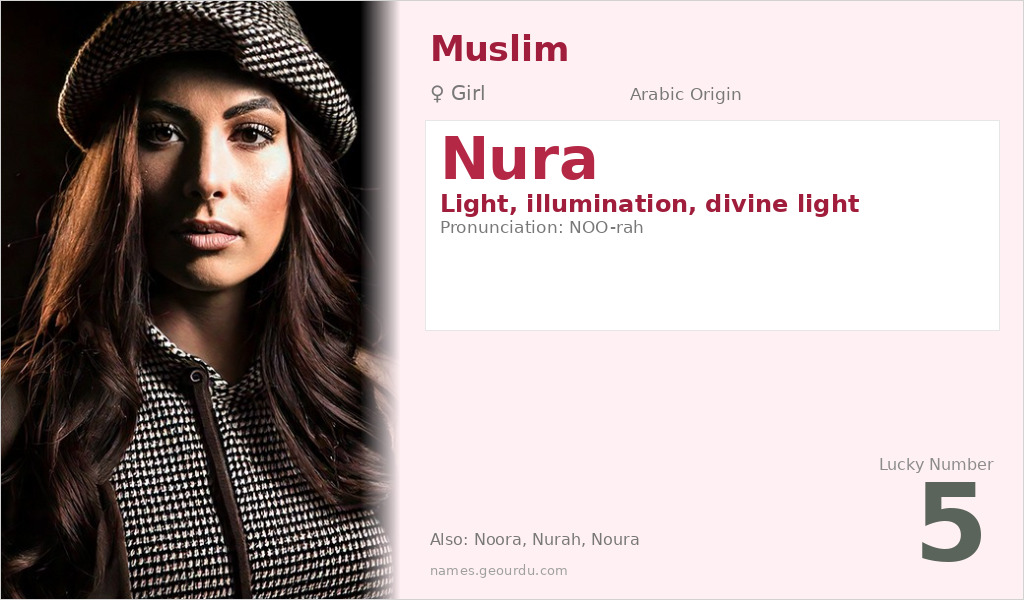
| 📛 Name | Nura |
| 💎 Meaning | Light, illumination, divine light |
| 👤 Gender | Girl |
| 🕌 Religion | Muslim |
| 🌍 Origin | Arabic |
| 🗣 Pronunciation | NOO-rah |
| ✍️ Urdu | نورہ |
| ✍️ Arabic | نورة |
| 🔢 Numerology | 5 |
| ✨ Spellings | Noora, Nurah, Noura, Nuraa |
Origin & Cultural Significance
Originating from Classical Arabic, Nura has been used since early Islamic history, spreading through the expansion of Muslim cultures and the Arabic language. It is prevalent in countries like Saudi Arabia, Egypt, Sudan, Pakistan, and Indonesia, often adapted into local scripts and pronunciations. The name gained prominence due to its religious resonance, as light is a central motif in Islamic theology and mysticism (Sufism). While primarily associated with Islam, variations like Noora are also found in Christian Arab communities, though less commonly. Unlike some names that cross linguistic boundaries, Nura remains closely tied to Arabic and Islamic heritage, without verified origins in Pashto, Balochi, or other regional languages despite thorough research.
Personality Traits
Those named Nura are often seen as beacons of positivity, embodying the name’s luminous essence. They may exhibit traits such as wisdom, compassion, and a calming influence, drawing others toward their enlightened perspective. In social settings, they tend to inspire and uplift, much like a guiding light in darkness. This alignment with light symbolism makes the name a popular choice for parents seeking a meaningful and aspirational identity for their child.
Similar Names
If you like Nura, consider: Nur, Noor, Nuriyah, Anwar, Manal, Zahra, Sana, Amina, Layla, Fatima
Famous People Named Nura
- Nura Al-Said — Iraqi princess and philanthropist known for her charitable work in the mid-20th century
- Nura Habib Omer — Somali singer and cultural activist promoting peace through music
Frequently Asked Questions About Nura
What does Nura mean?
Nura means 'light' or 'illumination' in Arabic, derived from the root n-w-r. It is the feminine form of Nur, symbolizing divine or inner radiance.
Is Nura a boy or girl name?
Nura is exclusively a girl's name in Arabic and Islamic naming traditions, as the feminine variant of the masculine Nur. It is rarely, if ever, used for boys.
What is the origin of Nura?
Nura originates from Arabic, with deep roots in Islamic culture and language. It is widely used across Muslim-majority regions but not typically found in non-Arabic etymologies.