Table of Contents
Nusaybah is a beautiful Arabic feminine name with deep historical roots in Islamic tradition. Unlike many modern names, Nusaybah carries the legacy of one of the most celebrated female figures in early Islamic history. This name represents courage, devotion, and strength, qualities embodied by its most famous bearer from the 7th century. Today, it remains a meaningful choice for parents seeking a name with both linguistic elegance and historical significance.
Meaning of Nusaybah
The name Nusaybah (نصيبة) originates from classical Arabic and is derived from the triliteral root ن-ص-ب (n-ṣ-b), which conveys meanings related to ‘setting up’, ‘erecting’, or ‘establishing’. Historically, before becoming a personal name, Nusaybah referred to a specific type of tree or plant in pre-Islamic Arabian culture, though the exact botanical identification has been lost to time. As a proper name, it gained prominence through Nusaybah bint Ka’ab, also known as Umm ‘Umarah, who was among the early converts to Islam and participated in the Battle of Uhud. The name’s evolution from a botanical reference to a celebrated personal name reflects the rich linguistic and cultural heritage of Arabic nomenclature.
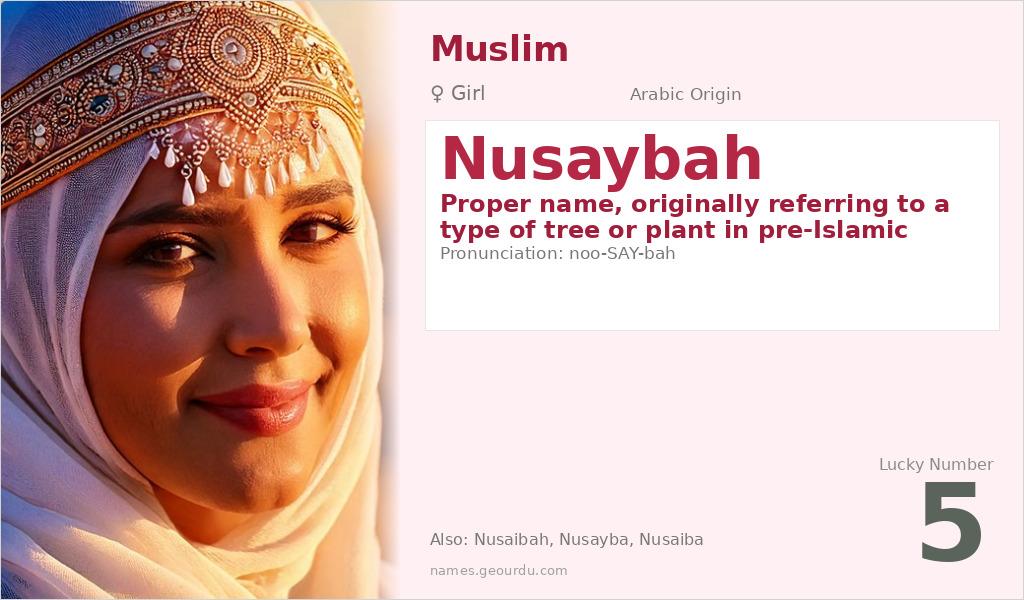
| 📛 Name | Nusaybah |
| 💎 Meaning | Proper name, originally referring to a type of tree or plant in pre-Islamic Arabia; historically associated with a famous female companion of Prophet Muhammad |
| 👤 Gender | Girl |
| 🕌 Religion | Muslim |
| 🌍 Origin | Arabic |
| 🗣 Pronunciation | noo-SAY-bah |
| ✍️ Urdu | نصیبہ |
| ✍️ Arabic | نصيبة |
| 🔢 Numerology | 5 |
| ✨ Spellings | Nusaibah, Nusayba, Nusaiba, Nusaybah |
Origin & Cultural Significance
Nusaybah has its origins in pre-Islamic Arabian culture, where it initially referred to botanical elements before transitioning to personal use. The name gained significant Islamic historical importance through Nusaybah bint Ka’ab, one of the early female companions of Prophet Muhammad. She is remembered for her extraordinary bravery during the Battle of Uhud, where she defended the Prophet and fought alongside male warriors. This historical association has made the name particularly cherished in Muslim communities, symbolizing feminine strength and religious devotion. While primarily used in Arabic-speaking regions, the name has spread to various Muslim cultures worldwide through Islamic history and literature.
Personality Traits
Those named Nusaybah are often perceived as strong, principled individuals with deep convictions. Inspired by the historical figure Nusaybah bint Ka’ab, they tend to exhibit courage in adversity and loyalty to their beliefs and communities. The name carries an aura of resilience and protective strength, suggesting someone who stands firm for justice and supports those in need. These personality associations make Nusaybah a name that conveys both inner fortitude and compassionate dedication.
Similar Names
If you like Nusaybah, consider: Nusrat, Nusayr, Naseeba, Nasiba, Naseebah
Famous People Named Nusaybah
- Nusaybah bint Ka'ab (Umm 'Umarah) — Early Muslim convert and female companion of Prophet Muhammad who fought in the Battle of Uhud, celebrated for her bravery and devotion
- Nusaybah Al-Ruwaili — Modern Saudi Arabian journalist and media personality
Frequently Asked Questions About Nusaybah
What does Nusaybah mean?
Nusaybah is an Arabic feminine name that originally referred to a type of tree or plant in pre-Islamic Arabia. As a proper name, it is historically associated with Nusaybah bint Ka'ab, a famous female companion of Prophet Muhammad known for her bravery.
Is Nusaybah a boy or girl name?
Nusaybah is exclusively a feminine name in Arabic and Islamic naming traditions. All historical and contemporary usage records show it as a girl's name, most famously borne by Nusaybah bint Ka'ab in early Islamic history.
What is the origin of Nusaybah?
Nusaybah originates from classical Arabic language and culture. It derives from the Arabic root ن-ص-ب (n-ṣ-b) and was originally a botanical reference in pre-Islamic Arabia before becoming a personal name with significant Islamic historical associations.