
Table of Contents
Olaf is a classic Germanic name with deep roots in Scandinavian history and culture. Derived from Old Norse elements meaning ‘ancestor’s descendant’, this name carries centuries of royal and saintly associations. From Viking warriors to modern leaders, Olaf has maintained its traditional appeal across Northern Europe. Discover the rich etymology and cultural significance of this enduring name.
Meaning of Olaf
The name Olaf originates from the Old Norse name ‘Áleifr’, which combines two Proto-Germanic elements: ‘anu’ meaning ‘ancestor’ and ‘laibō’ meaning ‘heir’ or ‘descendant’. This creates the literal meaning ‘ancestor’s descendant’ or ‘heir of the ancestors’. The name evolved through various Germanic languages, appearing as ‘Óláfr’ in Old Norse, ‘Olaf’ in modern Scandinavian languages, and ‘Olave’ in medieval English. The name’s etymology reflects the importance of lineage and inheritance in Germanic cultures, particularly among Scandinavian nobility who used it to emphasize their ancestral connections and rightful succession.
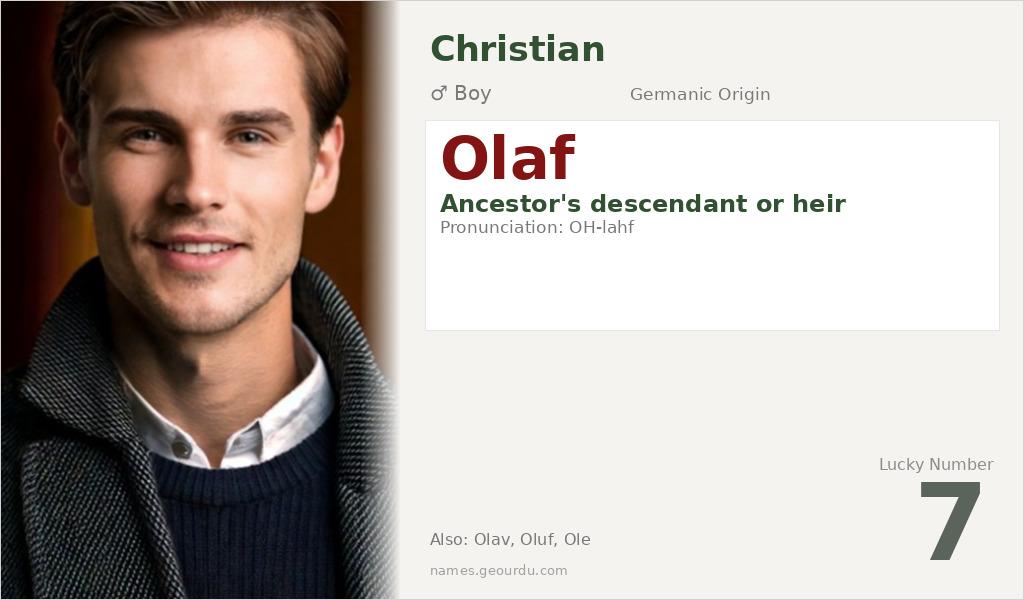
| 📛 Name | Olaf |
| 💎 Meaning | Ancestor's descendant or heir |
| 👤 Gender | Boy |
| 🕌 Religion | Christian |
| 🌍 Origin | Germanic |
| 🗣 Pronunciation | OH-lahf |
| ✍️ Urdu | اولاف |
| ✍️ Arabic | أولاف |
| 🔢 Numerology | 7 |
| ✨ Spellings | Olav, Oluf, Ole, Olof, Áleifr |
Origin & Cultural Significance
Olaf has its origins in Germanic languages, specifically emerging from Old Norse during the Viking Age. The name gained prominence through Scandinavian royalty, most notably with Olaf II of Norway (Saint Olaf), who ruled in the 11th century and played a crucial role in Norway’s Christianization. After his death and subsequent canonization, the name became widely popular throughout Scandinavia and spread to other parts of Europe. The name’s Christian associations developed primarily in Norway and Sweden, where Saint Olaf became a national patron saint. While the name has Scandinavian roots, it has been adopted in various forms across Germanic-speaking regions.
Personality Traits
People named Olaf are often associated with strength, tradition, and reliability. The name’s meaning suggests someone who values heritage and family connections, potentially showing respect for traditions and ancestral wisdom. Many Olafs are perceived as practical, grounded individuals with a strong sense of responsibility. The historical associations with kings and saints contribute to perceptions of leadership qualities and moral integrity.
Similar Names
If you like Olaf, consider: Olav, Oliver, Oscar, Leif, Thor
Famous People Named Olaf
- Olaf II of Norway — King of Norway from 1015 to 1028, later canonized as Saint Olaf, patron saint of Norway
- Olaf Scholz — Current Chancellor of Germany (as of 2024)
Frequently Asked Questions About Olaf
What does Olaf mean?
Olaf means 'ancestor's descendant' or 'heir of the ancestors', derived from the Old Norse name Áleifr combining 'anu' (ancestor) and 'laibō' (heir).
Is Olaf a boy or girl name?
Olaf is exclusively a masculine name with historical usage as a boy's name throughout its Germanic and Scandinavian history.
What is the origin of Olaf?
Olaf originates from Germanic languages, specifically Old Norse, and was popularized through Scandinavian royalty and Christian saints, particularly in Norway.





