
Table of Contents
Oliver is a classic boy’s name with roots stretching back to ancient Rome. Meaning ‘olive tree’ or ‘olive branch,’ it carries centuries of symbolism representing peace, wisdom, and victory. From medieval knights to modern celebrities, this name has maintained enduring popularity across English-speaking countries and beyond. Its gentle sound and positive associations make it a timeless choice for parents worldwide.
Meaning of Oliver
The name Oliver originates from the Latin word ‘olivarius,’ meaning ‘olive tree planter’ or ‘one who tends olive trees.’ This derives from ‘oliva,’ the Latin term for olive. Through Norman French influence after the 1066 conquest, the name entered English as Olivier, later simplified to Oliver. The olive tree has profound symbolic meaning in Mediterranean cultures—its branches represented peace in ancient Greece and Rome, while the tree itself symbolized wisdom, fertility, and victory. Contrary to some folk etymologies, Oliver has no connection to ‘elf army’ (which would be from Old English ‘ælf’ and ‘here’)—this is a modern misinterpretation.
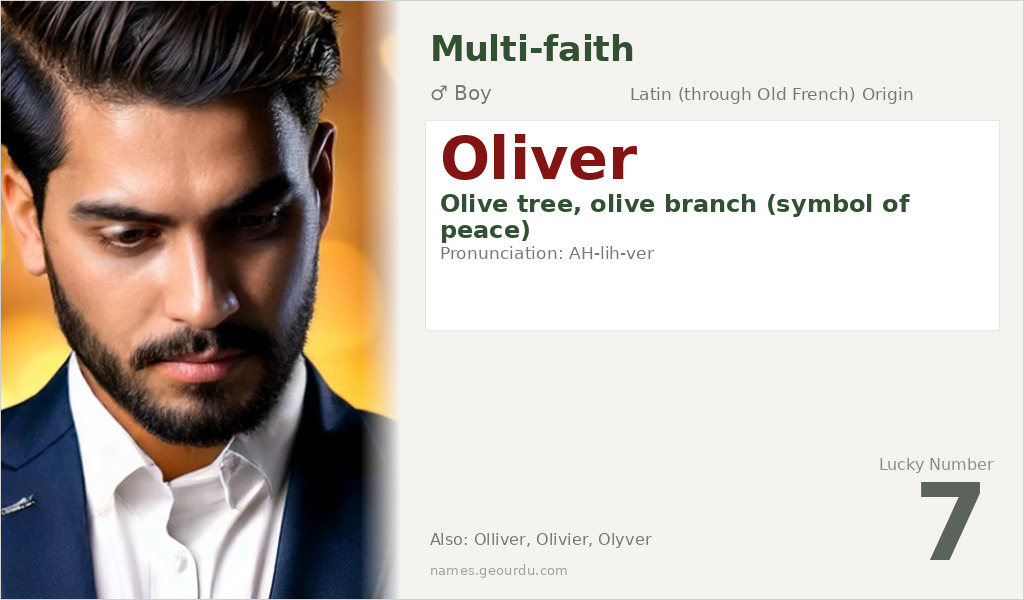
| 📛 Name | Oliver |
| 💎 Meaning | Olive tree, olive branch (symbol of peace) |
| 👤 Gender | Boy |
| 🕌 Religion | Multi-faith |
| 🌍 Origin | Latin (through Old French) |
| 🗣 Pronunciation | AH-lih-ver |
| ✍️ Urdu | اولیور |
| ✍️ Arabic | أوليفر |
| 🔢 Numerology | 7 |
| ✨ Spellings | Olliver, Olivier, Olyver, Olifer |
Origin & Cultural Significance
Oliver first gained prominence in England through the Norman French name Olivier, brought by William the Conqueror’s followers. It appears in the 12th-century French epic ‘The Song of Roland,’ where Olivier is the loyal companion of Roland. The name spread throughout Europe during the Middle Ages and became particularly popular in England after the Protestant Reformation. While often associated with English-speaking countries today, Oliver has variants across Europe: Olivier (French), Oliviero (Italian), and Olivér (Hungarian). Its multi-faith appeal comes from the olive’s significance in Christianity, Judaism, and Islam as a symbol of peace and divine blessing.
Personality Traits
Those named Oliver are often perceived as balanced, thoughtful individuals who value harmony in their relationships. The olive branch symbolism suggests diplomatic qualities and a preference for peaceful resolution over conflict. Many Olivers exhibit a blend of traditional values and modern adaptability, with a natural curiosity that drives lifelong learning. Their calm demeanor often makes them reliable friends and effective mediators in challenging situations.
Similar Names
If you like Oliver, consider: Olivier, Olivia, Oscar, Owen, Alistair
Famous People Named Oliver
- Oliver Cromwell — English military and political leader (1599-1658)
- Oliver Twist — Fictional character from Charles Dickens' novel
Frequently Asked Questions About Oliver
What does Oliver mean?
Oliver means 'olive tree' or 'olive branch,' deriving from the Latin 'olivarius.' The olive symbolizes peace, wisdom, and victory in Mediterranean cultures.
Is Oliver a boy or girl name?
Oliver is traditionally a boy's name, though the feminine form Olivia is more common for girls. In recent years, Oliver has remained overwhelmingly masculine in usage across cultures.
What is the origin of Oliver?
Oliver originates from Latin through Old French. It entered English via Norman French after the 1066 conquest, evolving from Olivier to the modern Oliver.





