
Table of Contents
Oliver is a classic name with rich historical roots that has maintained popularity across centuries and cultures. From medieval French epics to modern birth charts, this name carries both botanical and ancestral significance. Its dual etymology offers parents meaningful options when choosing this timeless name for their child.
Meaning of Oliver
The name Oliver has two well-documented meanings from different linguistic traditions. Primarily, it derives from the Latin word ‘olivarius’, meaning ‘olive tree’ or ‘olive tree planter’, connecting it to the Mediterranean region where olive trees symbolize peace, wisdom, and prosperity. Alternatively, it traces back to Old Norse through the name Áleifr (later Ólafr), composed of ‘anu’ (ancestor) and ‘leifr’ (heir), giving the meaning ‘descendant of the ancestor’. This Germanic connection explains its popularity in Scandinavian countries. The name entered English through Norman French as Olivier, and both meanings have been preserved in different cultural contexts.
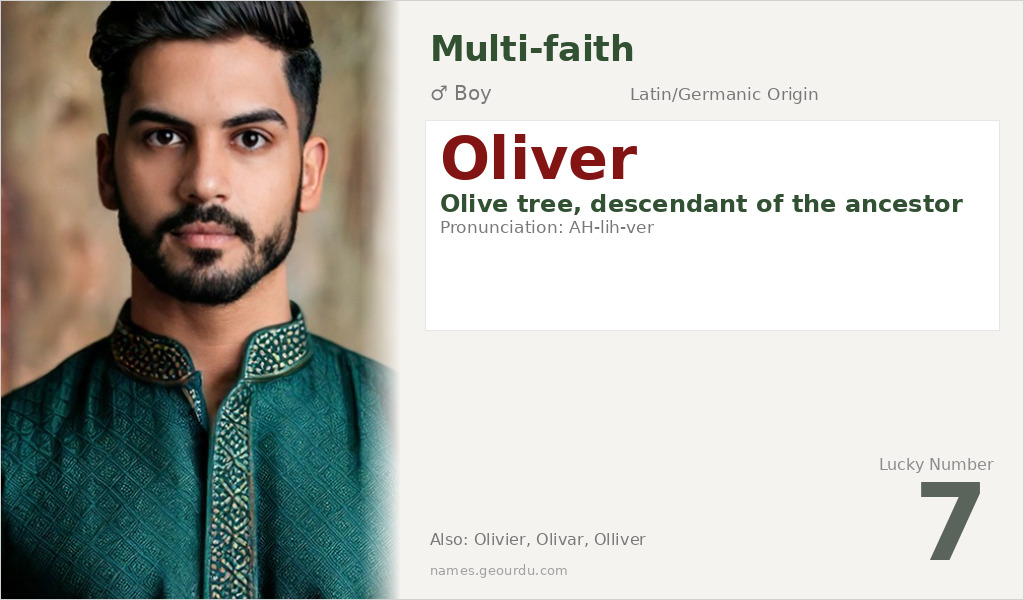
| 📛 Name | Oliver |
| 💎 Meaning | Olive tree, descendant of the ancestor |
| 👤 Gender | Boy |
| 🕌 Religion | Multi-faith |
| 🌍 Origin | Latin/Germanic |
| 🗣 Pronunciation | AH-lih-ver |
| ✍️ Urdu | اولیور |
| ✍️ Arabic | أوليفر |
| 🔢 Numerology | 7 |
| ✨ Spellings | Olivier, Olivar, Olliver, Olafur, Ólafur |
Origin & Cultural Significance
Oliver originated in medieval Europe with dual linguistic roots in Latin and Old Norse. It gained widespread popularity through the 11th-century French epic ‘La Chanson de Roland’, where Olivier was portrayed as the wise and loyal companion to the hero Roland. The name spread throughout Europe during the Middle Ages and was reinforced by Saint Oliver Plunkett, an Irish martyr canonized in 1975. While commonly used in Christian-majority countries, Oliver is not exclusively Christian and appears in secular contexts and across various faith traditions worldwide, including among Muslim communities in South Asia and the Middle East.
Personality Traits
People named Oliver are often associated with traits of wisdom, peace, and heritage. The olive tree connection suggests qualities of resilience, growth, and tranquility, while the ancestral meaning implies a strong connection to family and tradition. Many Olivers are perceived as thoughtful, analytical individuals who value knowledge and have a natural curiosity about the world around them.
Similar Names
If you like Oliver, consider: Olivia, Oscar, Owen, Leo, Oliverio
Famous People Named Oliver
- Oliver Cromwell — English military and political leader
- Oliver Twist — Fictional character from Charles Dickens' novel
- Oliver Stone — American film director
- Oliver Kahn — German football goalkeeper
Frequently Asked Questions About Oliver
What does Oliver mean?
Oliver has two primary meanings: 'olive tree' from Latin origins and 'descendant of the ancestor' from Old Norse/Germanic roots.
Is Oliver a boy or girl name?
Oliver is traditionally a masculine name, though the feminine form Olivia is extremely popular. In some modern contexts, Oliver is occasionally used for girls, but this remains uncommon.
What is the origin of Oliver?
Oliver has dual origins: from Latin 'olivarius' (olive tree) and from Old Norse Áleifr/Ólafr (ancestor + heir). It entered English through Norman French during the medieval period.





