
Table of Contents
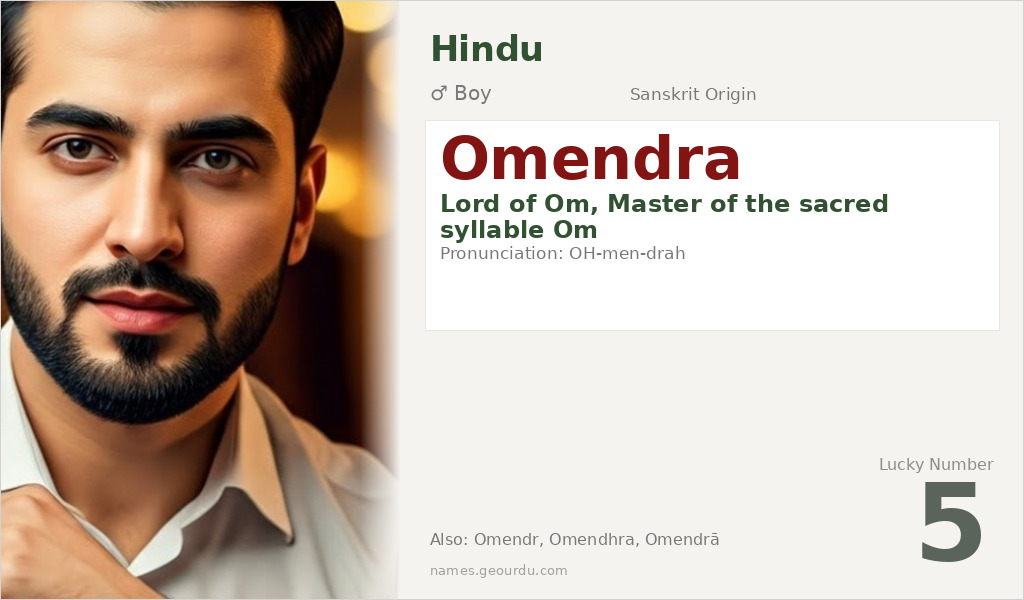
Omendra is a profound Sanskrit name with deep spiritual resonance in Hindu tradition. Meaning ‘Lord of Om’ or ‘Master of the sacred syllable Om’, this name carries the vibration of cosmic consciousness and divine authority. Popular among Hindu families seeking names with spiritual significance, Omendra represents a connection to the primordial sound that underlies all creation. This comprehensive guide explores the etymology, cultural context, and modern usage of this meaningful name.
Meaning of Omendra
Omendra derives from the Sanskrit compound of ‘Om’ (ॐ) and ‘Indra’ (इन्द्र). The syllable ‘Om’ is considered the most sacred sound in Hinduism, Buddhism, and Jainism, representing the essence of the ultimate reality, consciousness, and the universe itself. ‘Indra’ means ‘lord’, ‘king’, or ‘master’, originally referring to the chief deity in the Vedic pantheon. When combined, Omendra literally translates to ‘Lord of Om’ or ‘Master of Om’, indicating one who has sovereignty over or embodies this fundamental cosmic vibration. This name appears in various Hindu texts and traditions as an epithet for deities and spiritual masters associated with sound, mantra, and divine knowledge. The name suggests not just rulership but deep understanding and embodiment of spiritual truth.
| 📛 Name | Omendra |
| 💎 Meaning | Lord of Om, Master of the sacred syllable Om |
| 👤 Gender | Boy |
| 🕌 Religion | Hindu |
| 🌍 Origin | Sanskrit |
| 🗣 Pronunciation | OH-men-drah |
| ✍️ Urdu | اومیندرا |
| ✍️ Arabic | أوميندرا |
| 🔢 Numerology | 5 |
| ✨ Spellings | Omendr, Omendhra, Omendrā |
Origin & Cultural Significance
Omendra originates from classical Sanskrit, the ancient liturgical language of Hinduism. As a compound name, it follows the traditional Sanskrit naming pattern where meaningful elements are combined to create names with specific spiritual connotations. The name is deeply rooted in Hindu philosophy, particularly in traditions that emphasize the importance of mantras and sacred sounds. While primarily used in Hindu communities across India and the diaspora, the name’s components (‘Om’ and ‘Indra’) have influenced spiritual terminology across South and Southeast Asia. Historical usage shows Omendra appearing in religious texts and as given names for spiritual figures, though it remains less common than simpler Om-based names like Omkar or Om.
Personality Traits
Those named Omendra are often perceived as spiritually aware individuals with a natural inclination toward philosophical inquiry and self-discovery. The name’s association with the sacred syllable Om suggests qualities of harmony, inner peace, and connection to universal consciousness. People with this name may exhibit leadership qualities combined with spiritual depth, making them effective guides or teachers. Their personality often reflects the name’s meaning—seeking mastery over inner states and understanding life’s deeper truths.
Similar Names
If you like Omendra, consider: Omkar, Omveer, Indra, Om, Omansh, Omprasad, Omkarnath, Omswaroop, Indrajit, Omkant
Famous People Named Omendra
- Omendra Singh — Indian politician and social activist from Madhya Pradesh
- Omendra Ratnu — Indian film and television actor known for roles in Hindi cinema
Frequently Asked Questions About Omendra
What does Omendra mean?
Omendra means 'Lord of Om' or 'Master of the sacred syllable Om'. It is a Sanskrit compound name combining 'Om' (the primordial sound) and 'Indra' (meaning lord or master).
Is Omendra a boy or girl name?
Omendra is exclusively a boy's name in Hindu naming tradition. The '-endra' suffix is masculine in Sanskrit grammar, and historical usage consistently shows it as a male name.
What is the origin of Omendra?
Omendra originates from Sanskrit, the ancient language of Hindu scriptures. It is specifically Hindu in religious context and derives from the sacred syllable 'Om' combined with 'Indra' meaning lord or master.





