
Table of Contents
Osman is a powerful masculine name with deep historical roots, most famously associated with the founder of the Ottoman Empire. While commonly perceived as a Turkish name, its origins trace back to Arabic, creating a rich linguistic and cultural heritage. This name carries centuries of imperial history while remaining popular in modern naming traditions across multiple regions.
Meaning of Osman
The name Osman has complex etymological layers. Primarily, it’s the Turkish form of the Arabic name Uthman (عثمان), which derives from the Arabic root meaning ‘baby bustard’—a type of desert bird. In Turkish cultural context, however, the name developed additional associations, sometimes linked to words for ‘snake’ or ‘serpent’ (yılan), particularly through folk etymology surrounding Osman I’s legendary dream. The name appears in various forms across languages: as Uthman in Arabic, Osman in Turkish and Balkan languages, and Usman in South Asian contexts, demonstrating its widespread adaptation while maintaining core phonetic elements.
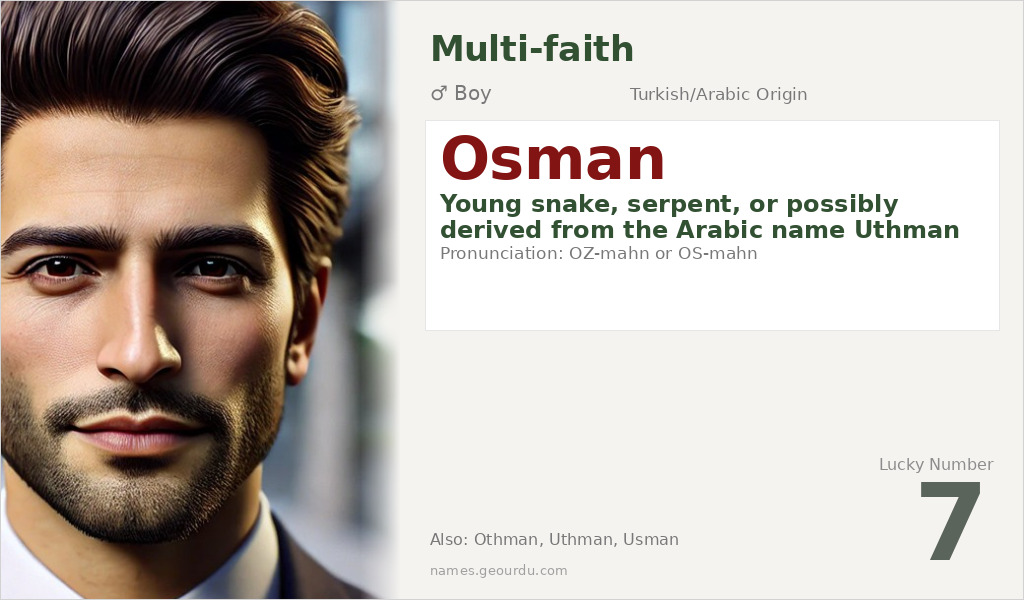
| 📛 Name | Osman |
| 💎 Meaning | Young snake, serpent, or possibly derived from the Arabic name Uthman meaning 'baby bustard' (a bird) |
| 👤 Gender | Boy |
| 🕌 Religion | Multi-faith |
| 🌍 Origin | Turkish/Arabic |
| 🗣 Pronunciation | OZ-mahn or OS-mahn |
| ✍️ Urdu | عثمان |
| ✍️ Arabic | عثمان |
| 🔢 Numerology | 7 |
| ✨ Spellings | Othman, Uthman, Usman, Osmán, Osmane |
Origin & Cultural Significance
Osman originated as the Turkish adaptation of the Arabic name Uthman, gaining prominence through Osman I, who founded the Ottoman Empire in the late 13th century. The name became dynastic, borne by 36 Ottoman sultans, spreading through the empire’s vast territories across Southeast Europe, Western Asia, and North Africa. While predominantly used in Muslim communities, particularly among Turks, Arabs, and Balkan Muslims, it also appears among some Christian populations in the Balkans due to Ottoman historical influence. The name’s usage extends to Persian, Urdu, and other languages within the Islamic cultural sphere, though with varying frequency and cultural associations.
Personality Traits
Those named Osman often embody leadership qualities and historical gravitas, reflecting the name’s imperial associations. They’re frequently perceived as strategic thinkers with strong traditional values, yet adaptable to changing circumstances. The name suggests someone with organizational ability and determination, capable of building lasting structures whether in personal, professional, or community contexts.
Similar Names
If you like Osman, consider: Omar, Omer, Okan, Orhan, Osama
Famous People Named Osman
- Osman I — Founder of the Ottoman Empire (1258-1326)
- Osman Hamdi Bey — Renowned Ottoman painter and archaeologist (1842-1910)
Frequently Asked Questions About Osman
What does Osman mean?
Osman primarily means 'young snake' or 'serpent' in Turkish folk etymology, though it derives from the Arabic name Uthman meaning 'baby bustard' (a type of bird).
Is Osman a boy or girl name?
Osman is exclusively a masculine name across all cultures where it's used, with no feminine variants in common usage.
What is the origin of Osman?
Osman originates from Turkish adaptation of the Arabic name Uthman, popularized by Osman I, founder of the Ottoman Empire in the 13th century.





