
Table of Contents
Padmapani is a profound Sanskrit name that carries rich spiritual symbolism across Hindu and Buddhist traditions. Meaning ‘lotus-holder’ or ‘one who holds a lotus’, this name evokes images of divine compassion and enlightenment. While primarily used for boys, its celestial associations make it a name of significant cultural depth. Discover the etymology, historical context, and modern relevance of this beautiful name.
Meaning of Padmapani
Padmapani derives from the classical Sanskrit language, combining ‘padma’ (पद्म), meaning lotus, and ‘pani’ (पाणि), meaning hand or holder. The lotus in Indian spiritual traditions symbolizes purity, spiritual awakening, and divine beauty—rising pristine from muddy waters. Thus, Padmapani literally translates to ‘lotus-holder’, representing one who carries or embodies these enlightened qualities. In Buddhist contexts, particularly in Mahayana Buddhism, Padmapani is a key epithet for Avalokiteśvara, the bodhisattva of compassion. The name’s linguistic roots are firmly established in Sanskrit literature and religious texts, making its meaning well-documented and consistent across sources.
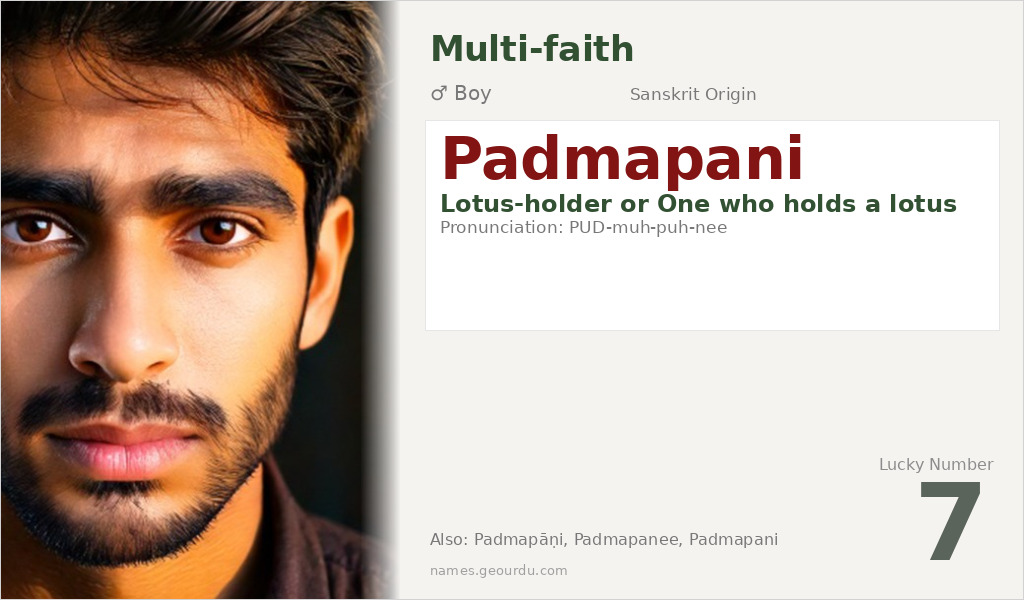
| 📛 Name | Padmapani |
| 💎 Meaning | Lotus-holder or One who holds a lotus |
| 👤 Gender | Boy |
| 🕌 Religion | Multi-faith |
| 🌍 Origin | Sanskrit |
| 🗣 Pronunciation | PUD-muh-puh-nee |
| ✍️ Urdu | پدماپنی |
| ✍️ Arabic | بادماباني |
| 🔢 Numerology | 7 |
| ✨ Spellings | Padmapāṇi, Padmapanee, Padmapani |
Origin & Cultural Significance
The name Padmapani originates from ancient Sanskrit, the liturgical language of Hinduism and early Buddhism. It appears prominently in Buddhist art and scripture, most famously in the Ajanta Caves of Maharashtra, India, where murals from the 5th-6th centuries CE depict Padmapani as a compassionate bodhisattva. While the name has Hindu associations—sometimes connected to Vishnu as Padmanabha (lotus-naveled)—its strongest cultural presence is in Buddhist tradition. The name spread through Buddhist texts and art across Asia, though as a personal name it remains relatively rare and deeply spiritual. Its usage reflects India’s syncretic religious heritage where symbols like the lotus transcend specific sectarian boundaries.
Personality Traits
Those named Padmapani are often thought to embody the lotus’s symbolic qualities: purity, resilience, and spiritual elegance. They may possess a calm, compassionate demeanor with a natural inclination toward artistic or philosophical pursuits. The name suggests someone who navigates life’s challenges with grace, maintaining inner peace and clarity. Such individuals might be perceived as thoughtful, empathetic, and spiritually attuned, drawing inspiration from the name’s divine associations.
Similar Names
If you like Padmapani, consider: Padmanabha, Padmasana, Kamalapani, Avalokiteśvara, Padmavati
Famous People Named Padmapani
- Padmapani (Bodhisattva) — A central figure in Buddhist art and scripture, particularly in the Ajanta Caves murals where Padmapani is depicted as a compassionate bodhisattva holding a lotus
- Padmapani (historical figures) — Various Indian scholars and religious figures have borne this name, though specific documented historical individuals are less commonly recorded in mainstream sources
Frequently Asked Questions About Padmapani
What does Padmapani mean?
Padmapani means 'lotus-holder' or 'one who holds a lotus' in Sanskrit, combining 'padma' (lotus) and 'pani' (hand/holder).
Is Padmapani a boy or girl name?
Padmapani is traditionally a masculine name, primarily used for boys in Hindu and Buddhist contexts, though its spiritual nature makes it theoretically unisex.
What is the origin of Padmapani?
Padmapani originates from Sanskrit and is significant in both Hindu and Buddhist traditions, most notably as an epithet for the bodhisattva Avalokiteśvara in Buddhism.





