
Table of Contents
Paramahamsa is a profound Sanskrit name that carries immense spiritual weight in Hindu tradition. Unlike ordinary names, it represents the highest stage of spiritual realization and enlightenment. This title has been bestowed upon some of India’s most revered saints and mystics throughout history. Understanding Paramahamsa requires delving into ancient Hindu philosophy and the symbolism of the spiritual journey.
Meaning of Paramahamsa
Paramahamsa is a compound Sanskrit word with deep philosophical significance. Breaking it down, ‘parama’ (परम) means ‘supreme, highest, or ultimate,’ while ‘hamsa’ (हंस) translates to ‘swan’ or ‘goose.’ In Hindu symbolism, the swan represents the pure soul (atman) that possesses the discriminative wisdom to separate milk from water—metaphorically distinguishing eternal truth from temporary illusion. The term specifically denotes the fourth and highest stage of ascetic life in Advaita Vedanta philosophy, where a sage has achieved complete self-realization (moksha) and lives in constant awareness of Brahman (ultimate reality). This is not merely a name but an honorific title reserved for those who have attained the pinnacle of spiritual enlightenment.
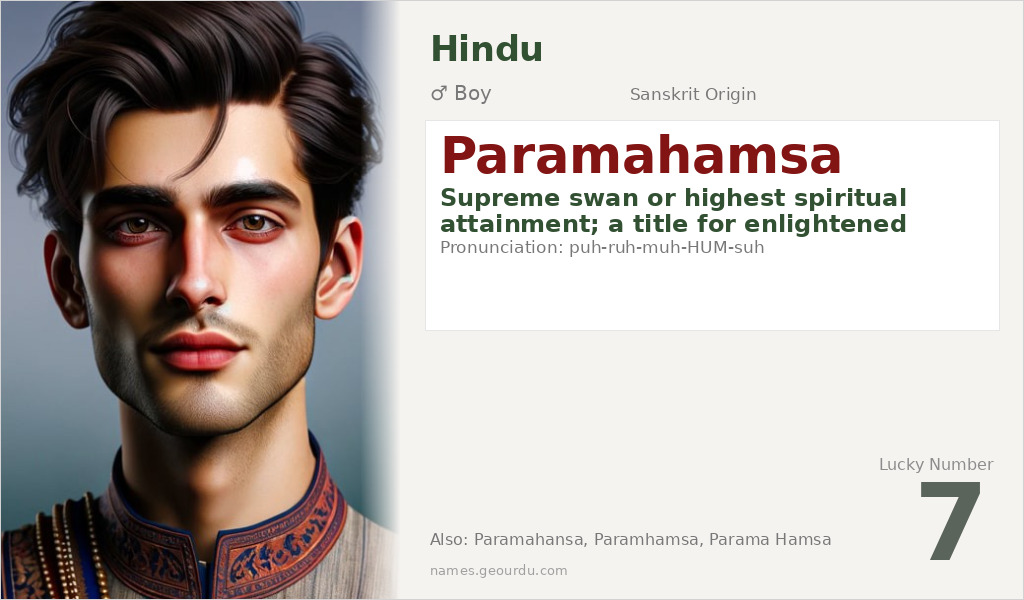
| 📛 Name | Paramahamsa |
| 💎 Meaning | Supreme swan or highest spiritual attainment; a title for enlightened sages in Hinduism |
| 👤 Gender | Boy |
| 🕌 Religion | Hindu |
| 🌍 Origin | Sanskrit |
| 🗣 Pronunciation | puh-ruh-muh-HUM-suh |
| ✍️ Urdu | پرم ہنس |
| ✍️ Arabic | باراماهانسا |
| 🔢 Numerology | 7 |
| ✨ Spellings | Paramahansa, Paramhamsa, Parama Hamsa |
Origin & Cultural Significance
Paramahamsa originates from ancient Sanskrit texts and Hindu spiritual traditions, particularly within Advaita Vedanta philosophy. The concept appears in classical Hindu scriptures where it describes ascetics who have transcended all worldly attachments and dualities. Historically, it evolved from the Vedic and Upanishadic traditions that used avian symbolism for spiritual concepts. The title gained prominence through medieval Hindu saints and was popularized in modern times by figures like Sri Ramakrishna Paramahamsa in 19th century Bengal. While primarily used as an honorific rather than a common given name, it reflects the deep spiritual heritage of India and continues to be associated with the highest ideals of Hindu monastic life and enlightenment.
Personality Traits
Those named or titled Paramahamsa are typically associated with profound spiritual wisdom and discernment. They embody qualities of purity, detachment, and deep introspection, often serving as guides on spiritual paths. Their personality reflects the swan’s mythical ability to separate essence from non-essence—showing clarity of thought and purpose in all endeavors. Such individuals are perceived as having transcended ordinary concerns to focus on eternal truths and higher consciousness.
Similar Names
If you like Paramahamsa, consider: Hamsa, Paramesh, Param, Hans, Paramartha, Paramananda, Hamsananda, Parampada, Paramatma, Hamsaroopa
Famous People Named Paramahamsa
- Sri Ramakrishna Paramahamsa (1836-1886) — Renowned Bengali mystic and saint, central figure in the Ramakrishna Movement
- Paramahansa Yogananda (1893-1952) — Indian yogi and guru who introduced Kriya Yoga to the West through his book 'Autobiography of a Yogi'
Frequently Asked Questions About Paramahamsa
What does Paramahamsa mean?
Paramahamsa means 'supreme swan' in Sanskrit, representing the highest stage of spiritual enlightenment in Hindu philosophy where a sage has attained complete self-realization and liberation.
Is Paramahamsa a boy or girl name?
Paramahamsa is traditionally a masculine name and title in Hindu culture, though it's primarily used as an honorific for enlightened male sages rather than as a common given name.
What is the origin of Paramahamsa?
Paramahamsa originates from Sanskrit, the ancient language of Hindu scriptures, specifically from Advaita Vedanta philosophy where it denotes the highest level of spiritual asceticism and realization.





