
Table of Contents
Paran is a name steeped in ancient Biblical history and Hebrew tradition. While sometimes used in various cultures today, its roots trace back to the wilderness regions mentioned in sacred texts. This name carries the powerful symbolism of mountains, spiritual journey, and endurance through challenging landscapes. Discover the rich heritage behind this distinctive name that has traveled through millennia.
Meaning of Paran
The name Paran derives directly from the Hebrew word ‘פָּארָן’ (Paran), which refers to a specific desert mountainous region mentioned extensively in the Hebrew Bible. Etymologically, it comes from the Hebrew root ‘פרא’ (para) meaning ‘to be fruitful’ or ‘to bear fruit,’ though in geographical context it describes a rugged wilderness area. In Biblical references, Paran appears as both a place name and personal name, most notably as one of the sons of Eliphaz in Genesis. The literal meaning translates to ‘place of caverns’ or ‘region of caves,’ but as a personal name it signifies ‘mountain dweller’ or ‘one from the mountainous region.’ This connection to wilderness and mountains gives the name connotations of resilience, spiritual testing, and journey.
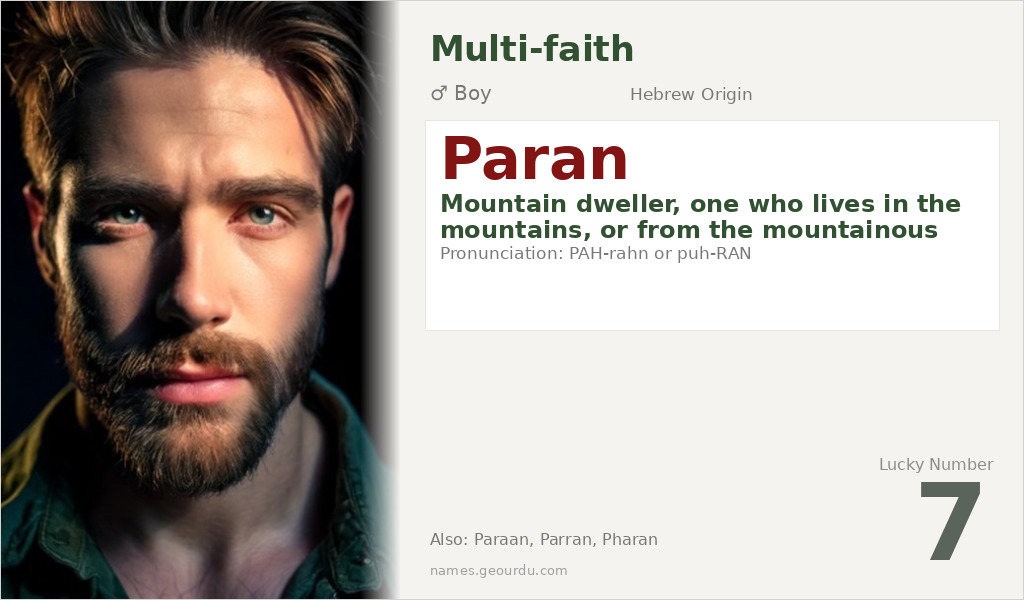
| 📛 Name | Paran |
| 💎 Meaning | Mountain dweller, one who lives in the mountains, or from the mountainous region |
| 👤 Gender | Boy |
| 🕌 Religion | Multi-faith |
| 🌍 Origin | Hebrew |
| 🗣 Pronunciation | PAH-rahn or puh-RAN |
| ✍️ Urdu | پاران |
| ✍️ Arabic | فاران |
| 🔢 Numerology | 7 |
| ✨ Spellings | Paraan, Parran, Pharan |
Origin & Cultural Significance
Paran originates from ancient Hebrew culture and appears multiple times in the Tanakh (Hebrew Bible). The Wilderness of Paran is described as the area where Hagar and Ishmael wandered, and where the Israelites spent time during their Exodus from Egypt. As a personal name, it first appears in Genesis 36 as Paran, son of Eliphaz and grandson of Esau. While the name has Hebrew/Biblical origins, it has been adopted in various cultures including some Muslim communities (particularly in regions with Biblical history), and occasionally in Hindu contexts through cultural exchange, though without the original Hebrew meaning. The name maintains strongest association with Jewish and Christian traditions due to its prominent Biblical references.
Personality Traits
Those named Paran often embody characteristics associated with mountains and wilderness: strength, endurance, and a contemplative nature. They tend to be independent thinkers who value personal growth and spiritual exploration. The Biblical connection suggests someone who navigates life’s challenges with resilience, much like travelers through the ancient Wilderness of Paran. Their personality often reflects both the solitude of mountain dwellers and the wisdom gained through life’s journeys.
Similar Names
If you like Paran, consider: Parnab, Parag, Parvez, Parvaz
Famous People Named Paran
- Paran — Biblical figure, son of Eliphaz and grandson of Esau mentioned in Genesis 36
- Paran — Region and place name frequently mentioned in the Hebrew Bible/Old Testament
Frequently Asked Questions About Paran
What does Paran mean?
Paran means 'mountain dweller' or 'one from the mountainous region' in Hebrew. It originates from the Biblical Wilderness of Paran mentioned in the Hebrew Bible.
Is Paran a boy or girl name?
Paran is traditionally a masculine name, used for boys. In its original Hebrew/Biblical context, it appears exclusively as a male name, though some modern uses might be more flexible.
What is the origin of Paran?
Paran originates from Hebrew language and Biblical tradition. It comes from the Hebrew word for a specific wilderness mountainous region mentioned in the Tanakh (Hebrew Bible) and has been used as a personal name since ancient times.





