Table of Contents
Parijatham is a beautiful and culturally rich name of Sanskrit origin that carries deep mythological significance in Hindu tradition. Unlike ordinary flower names, it specifically refers to the celestial Parijata tree, known for its fragrant night-blooming flowers. This name evokes imagery of divine beauty, transient perfection, and spiritual connection. Popular in South India, it represents both natural elegance and sacred heritage.
Meaning of Parijatham
Parijatham derives from the Sanskrit word ‘पारिजात’ (pārijāta), which specifically denotes the Nyctanthes arbor-tristis tree, commonly called night-flowering jasmine or coral jasmine. The etymology breaks down to ‘pari’ meaning ‘around’ or ‘about’ and ‘jāta’ meaning ‘born’ or ‘produced,’ suggesting something of extraordinary or divine origin. In Hindu scriptures, the Parijata is a heavenly tree that emerged during the churning of the cosmic ocean and became a subject of contention between gods and demons. The flowers are white with orange stems, bloom only at night, and are associated with Lord Krishna and divine gardens. This makes the meaning far more specific than generic ‘flower’—it’s a named sacred tree with distinct characteristics and mythological importance.
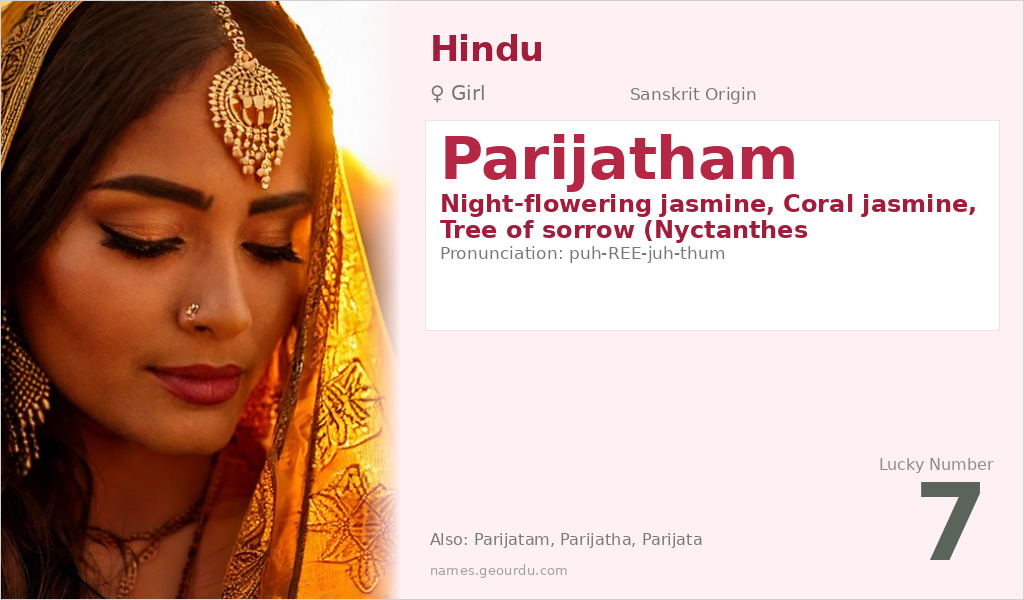
| 📛 Name | Parijatham |
| 💎 Meaning | Night-flowering jasmine, Coral jasmine, Tree of sorrow (Nyctanthes arbor-tristis) |
| 👤 Gender | Girl |
| 🕌 Religion | Hindu |
| 🌍 Origin | Sanskrit |
| 🗣 Pronunciation | puh-REE-juh-thum |
| ✍️ Urdu | پاریجتھم |
| ✍️ Arabic | باريجاتهام |
| 🔢 Numerology | 7 |
| ✨ Spellings | Parijatam, Parijatha, Parijata, Parijat |
Origin & Cultural Significance
The name Parijatham originates from classical Sanskrit literature and Hindu mythology, where the Parijata tree holds significant cultural and religious value. It appears in texts like the Bhagavata Purana and Vishnu Purana as a celestial tree in Indra’s paradise, later brought to Earth by Krishna. The name is particularly prevalent in South Indian states like Tamil Nadu, Andhra Pradesh, and Telangana, where it’s commonly given to girls. While primarily Hindu in association, the botanical reference (Nyctanthes arbor-tristis) grows across South Asia and is appreciated in various cultures for its medicinal properties and fragrant flowers. The name represents a connection to nature, divinity, and traditional storytelling that has endured for centuries.
Personality Traits
Those named Parijatham are often perceived as graceful, intuitive, and artistically inclined individuals. Like the night-blooming flower they’re named after, they may possess qualities of quiet strength, blooming in reflective or challenging circumstances. They tend to value beauty, tradition, and emotional depth, often showing sensitivity to their surroundings. Their connection to this mythological tree suggests someone with spiritual awareness and a appreciation for life’s transient yet beautiful moments.
Similar Names
If you like Parijatham, consider: Jasmine, Mallika, Chameli, Yasmin, Pushpa
Famous People Named Parijatham
- Parijatham — Indian actress in Tamil and Telugu films known for roles in 'Kadhal' and other productions
- Parijat — Nepali writer (Bishnu Kumari Waiba) who authored 'Siris Ko Phul'
Frequently Asked Questions About Parijatham
What does Parijatham mean?
Parijatham specifically means 'night-flowering jasmine' or 'coral jasmine tree' (Nyctanthes arbor-tristis) in Sanskrit, not just a generic flower. It refers to a sacred tree in Hindu mythology.
Is Parijatham a boy or girl name?
Parijatham is almost exclusively used as a feminine name, particularly in Hindu communities in South India where it's traditionally given to girls.
What is the origin of Parijatham?
Parijatham originates from Sanskrit and Hindu mythology, specifically referring to the celestial Parijata tree that appears in ancient texts like the Puranas.