
Table of Contents
Parvatha is a distinctive name with deep roots in Indian culture, evoking images of majestic mountains and enduring strength. Primarily used for boys, this name carries a rich linguistic heritage from Sanskrit, symbolizing stability and natural grandeur. In this guide, we explore its true meaning, origins, and cultural context to help you understand this timeless name. Whether you’re considering it for your child or curious about its background, Parvatha offers a connection to ancient traditions and powerful imagery.
Meaning of Parvatha
Parvatha derives from the Sanskrit word ‘parvata’ (पर्वत), which unequivocally means ‘mountain’ or ‘hill’. This term is well-documented in ancient Indian texts such as the Vedas, Mahabharata, and Puranas, where it describes physical landscapes and often metaphorically represents strength, permanence, and spiritual elevation. In Dravidian languages like Tamil, ‘parvatham’ retains the same meaning, showing the name’s widespread usage across the Indian subcontinent. The misconception of ‘Prince of Earth’ likely stems from modern, unverified sources or confusion with names like ‘Prithviraj’. Linguistically, ‘parvata’ is a standalone noun in Sanskrit, not a compound, and its etymology is clear in classical literature.
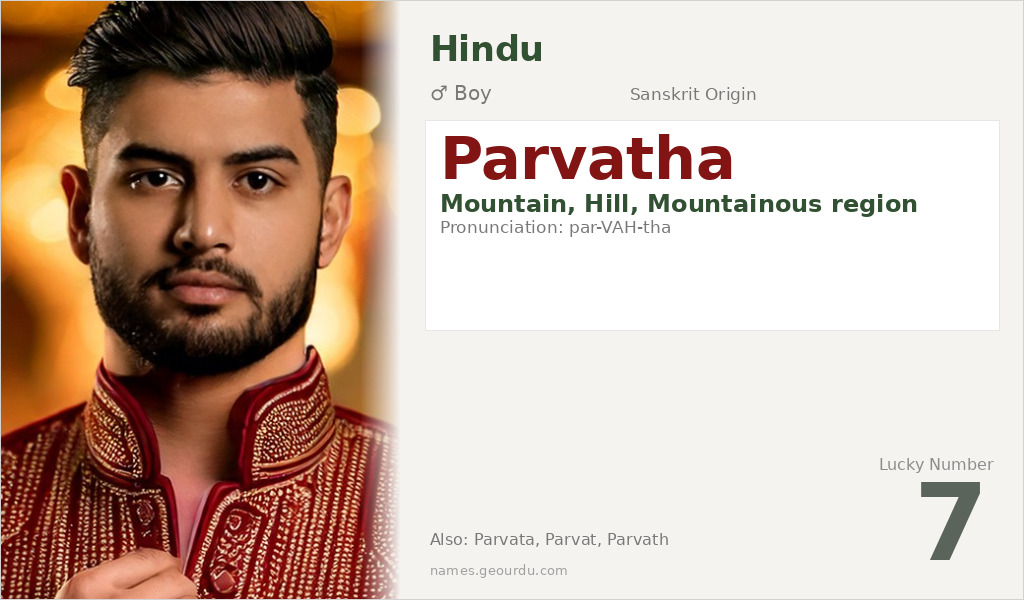
| 📛 Name | Parvatha |
| 💎 Meaning | Mountain, Hill, Mountainous region |
| 👤 Gender | Boy |
| 🕌 Religion | Hindu |
| 🌍 Origin | Sanskrit |
| 🗣 Pronunciation | par-VAH-tha |
| ✍️ Urdu | پروتھا |
| ✍️ Arabic | بارفاتا |
| 🔢 Numerology | 7 |
| ✨ Spellings | Parvata, Parvat, Parvath |
Origin & Cultural Significance
Parvatha originates from Sanskrit, an ancient Indo-Aryan language central to Hindu scriptures and Indian culture. It has been used for centuries in India, particularly within Hindu communities, where mountains are revered in mythology—for example, the Himalayas are considered abodes of gods. The name appears in regional variations across South Asia, reflecting its cultural integration. While primarily associated with Hinduism, it may also be found in Jain or Buddhist contexts due to shared linguistic heritage. Historically, names like Parvatha were chosen to invoke qualities of strength and resilience, mirroring the enduring nature of mountains in Indian philosophy and daily life.
Personality Traits
Those named Parvatha are often seen as resilient and dependable, with a personality that mirrors the steadfastness of a mountain. They may possess a strong sense of duty, leadership abilities, and a calm demeanor even under pressure. This name suggests an individual who values tradition, exhibits natural authority, and provides stability to those around them, making it a meaningful choice for parents seeking a name with profound symbolic weight.
Similar Names
If you like Parvatha, consider: Parvati, Paramesh, Girish, Achal, Shailendra
Famous People Named Parvatha
- Parvatha Vardhini — Indian classical vocalist known for Carnatic music
- Parvatha Reddy — Indian politician from Telangana
Frequently Asked Questions About Parvatha
What does Parvatha mean?
Parvatha means 'mountain' or 'hill', derived from the Sanskrit word 'parvata'. It symbolizes strength and stability in Indian culture.
Is Parvatha a boy or girl name?
Parvatha is traditionally a boy's name in Hindu culture, though names can vary by region; it is rarely used for girls.
What is the origin of Parvatha?
Parvatha originates from Sanskrit, an ancient Indian language, and is deeply rooted in Hindu traditions and mythology.





