
Table of Contents
Patra is a beautiful name rooted in ancient Sanskrit, symbolizing nature’s elegance through its meaning ‘leaf’. Used across Hindu communities, this unisex name carries poetic and spiritual connotations, often associated with growth, beauty, and simplicity. Whether chosen for a boy or girl, Patra connects the bearer to India’s rich linguistic and cultural heritage. Explore its origins, meanings, and modern relevance in this comprehensive analysis.
Meaning of Patra
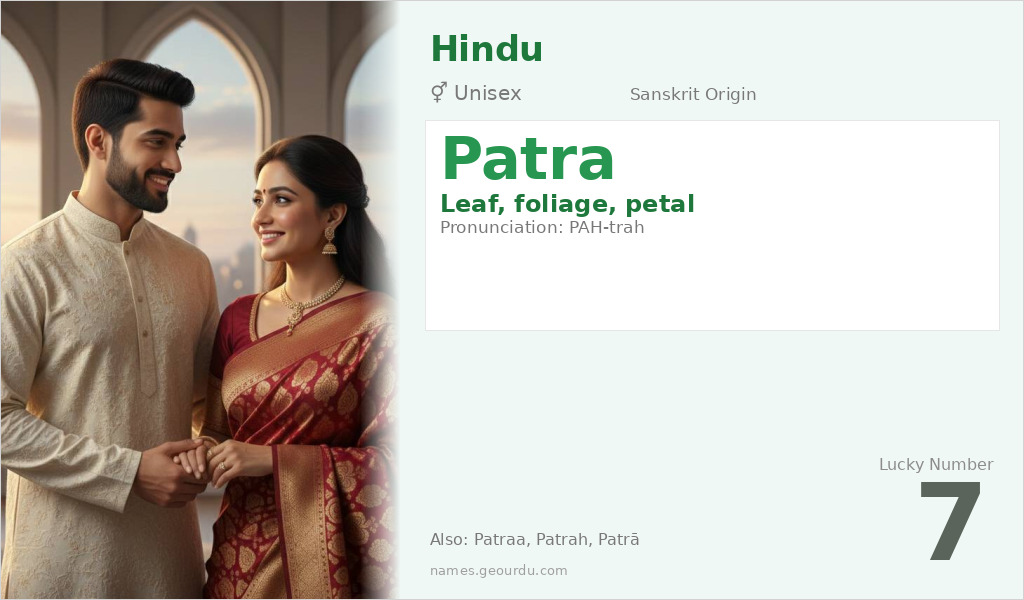
Patra originates from the Sanskrit word ‘पत्र’ (patra), which directly translates to ‘leaf’, ‘foliage’, or ‘petal’. In Sanskrit literature and Hindu traditions, leaves hold symbolic importance—representing life, renewal, and natural beauty, as seen in rituals where leaves like mango or banyan are used. The name is linguistically straightforward, with no compound elements, and is phonetically consistent across Indian languages. It is also used in botanical and literary contexts, such as in the term ‘Patralekha’ for ancient manuscripts written on palm leaves. This meaning is well-documented in Sanskrit dictionaries and etymological sources, making it a clear and verified interpretation.
| 📛 Name | Patra |
| 💎 Meaning | Leaf, foliage, petal |
| 👤 Gender | Unisex |
| 🕌 Religion | Hindu |
| 🌍 Origin | Sanskrit |
| 🗣 Pronunciation | PAH-trah |
| ✍️ Urdu | پترا |
| ✍️ Arabic | باترا |
| 🔢 Numerology | 7 |
| ✨ Spellings | Patraa, Patrah, Patrā |
Origin & Cultural Significance
Patra has its origins in Sanskrit, an ancient Indo-Aryan language foundational to Hindu culture and many Indian languages. It is primarily used within Hindu communities in India, Nepal, and the diaspora, though it is not exclusive to any single region. The name reflects the deep connection to nature in Hindu philosophy, where leaves symbolize purity, growth, and the cycle of life. Historically, names derived from natural elements like Patra have been popular for both genders, emphasizing simplicity and spiritual resonance. While it is most common in Sanskrit-based contexts, similar concepts exist in other cultures, but Patra itself is distinctly Indian in origin.
Personality Traits
People named Patra are often seen as serene, adaptable, and in tune with their surroundings, much like leaves that change with the seasons. They may possess a quiet strength, demonstrating resilience and a growth mindset in personal and professional endeavors. Their connection to nature-inspired meanings can reflect a personality that values harmony, beauty, and simplicity, making them thoughtful and grounded individuals.
Similar Names
If you like Patra, consider: Parna, Palash, Pushpa, Vana, Tara
Famous People Named Patra
- Patralekha Paul — Indian actress known for Bengali and Hindi films
- Patra — Jamaican dancehall singer popular in the 1990s
Frequently Asked Questions About Patra
What does Patra mean?
Patra means 'leaf', 'foliage', or 'petal' in Sanskrit, with roots in ancient Indian languages and Hindu culture.
Is Patra a boy or girl name?
Patra is a unisex name, used for both boys and girls in Hindu communities, though it is more commonly given to girls in modern times.
What is the origin of Patra?
Patra originates from Sanskrit, an ancient language of India, and is associated with Hindu traditions and natural symbolism.