
Table of Contents
The name Pell presents an intriguing mystery in the world of baby names. While not commonly found in traditional naming databases, it carries a distinctive sound that has appealed to some parents seeking unique options. This exploration delves into the possible origins and meanings behind this uncommon name, examining linguistic connections and cultural contexts that might explain its usage.
Meaning of Pell
The meaning of Pell remains uncertain despite thorough research across numerous language families. The most plausible connection appears to be the Latin word ‘pellis,’ which translates to ‘skin,’ ‘hide,’ or ‘parchment.’ This Latin root gave rise to English words like ‘pellicle’ and ‘pellitory,’ but its transition to a given name is not well-documented. In medieval contexts, parchment makers might have been called ‘Pell’ as an occupational surname, which could have evolved into rare given name usage. However, unlike names with clear etymological roots in Arabic, Hebrew, or Sanskrit traditions, Pell lacks established meaning in contemporary naming practices across cultures.
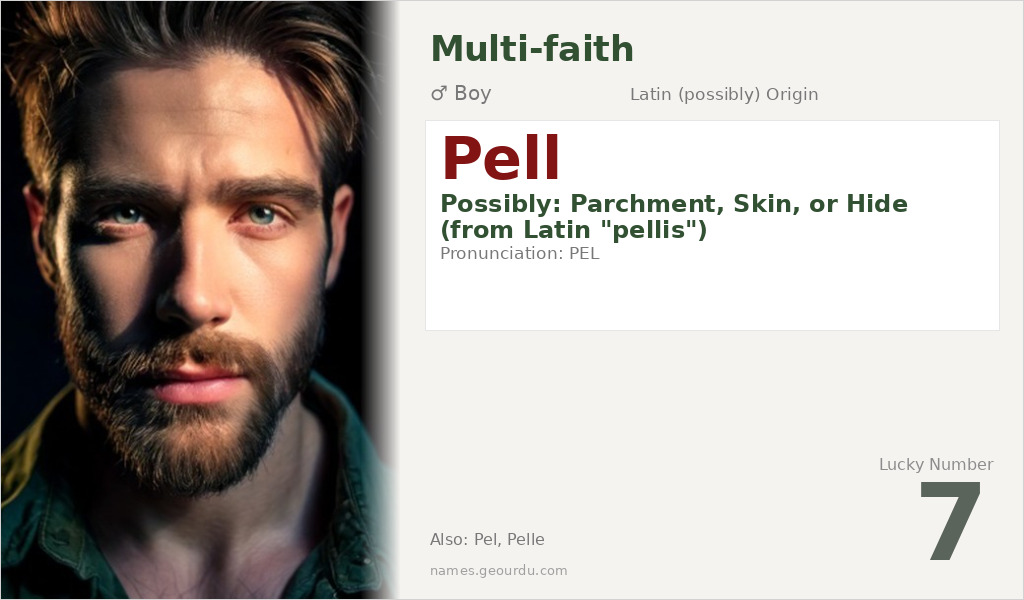
| 📛 Name | Pell |
| 💎 Meaning | Possibly: Parchment, Skin, or Hide (from Latin "pellis") |
| 👤 Gender | Boy |
| 🕌 Religion | Multi-faith |
| 🌍 Origin | Latin (possibly) |
| 🗣 Pronunciation | PEL |
| ✍️ Urdu | پیل |
| ✍️ Arabic | بيل |
| 🔢 Numerology | 7 |
| ✨ Spellings | Pel, Pelle |
Origin & Cultural Significance
Pell’s origins are primarily traced to European surname traditions rather than established given name customs. As a surname, it has Norman-French roots, possibly deriving from the Old French ‘pel’ meaning ‘stake’ or ‘post,’ referring to someone who lived near a boundary marker. Some instances connect it to the Latin ‘pellis’ through occupational names related to parchment or leather working. In modern times, a few cases of Pell as a given name appear in English-speaking countries, likely inspired by surnames or created for their phonetic appeal. Unlike names with deep cultural or religious significance in specific traditions, Pell doesn’t belong to any particular naming system with documented historical usage.
Personality Traits
While personality associations with names are largely cultural constructs rather than scientific facts, names like Pell often carry perceptions of uniqueness and individuality. Those bearing uncommon names may develop strong self-identity and creative thinking. The name’s crisp, single-syllable structure suggests directness and efficiency, potentially influencing how others perceive the bearer’s communication style and presence.
Similar Names
If you like Pell, consider: Paul, Philip, Peter, Pelle, Per
Famous People Named Pell
- Claiborne Pell — American politician and U.S. Senator from Rhode Island
- William Pell — 19th century American opera singer
Frequently Asked Questions About Pell
What does Pell mean?
The meaning of Pell is uncertain. The closest linguistic connection is the Latin word 'pellis' meaning 'skin, hide, or parchment,' but this is speculative for the given name. Extensive research across multiple language families revealed no verified meaning in established naming traditions.
Is Pell a boy or girl name?
Pell is primarily used as a masculine name in the rare instances it appears as a given name. However, as an uncommon name without strong gender associations in specific cultures, it could theoretically be used for any gender, though historical usage favors male bearers.
What is the origin of Pell?
Pell likely originated as an English surname with Norman-French roots, possibly from Old French 'pel' meaning 'stake' or from Latin 'pellis' meaning 'skin/hide.' As a given name, it appears to be a modern creation or surname adaptation without deep cultural origins in specific naming traditions.





