
Table of Contents
Percy is a distinguished name with centuries of aristocratic history, evolving from a Norman French surname to a beloved given name. Carrying echoes of medieval nobility and literary greatness, this name has graced poets, fictional heroes, and real individuals across generations. Its journey from the French countryside to global recognition tells a fascinating story of cultural transmission and adaptation.
Meaning of Percy
The name Percy originates from the Norman French place name ‘Perci,’ referring to a location in Normandy. This toponym combines the Latin personal name ‘Persius’ (meaning ‘from Persia’ or ‘Persian’) with the Old French suffix ‘-acum,’ indicating ‘place of’ or ‘belonging to.’ Thus, the literal meaning is ‘Persius’s place’ or ‘from Perci.’ The Percy family brought this name to England following the Norman Conquest of 1066, where it became a prominent aristocratic surname before transitioning to a given name. The connection to ‘pierce valley’ comes from folk etymology interpreting ‘Perci’ as related to Old French ‘percer’ (to pierce) and ‘val’ (valley), though this is less linguistically direct than the Persius derivation.
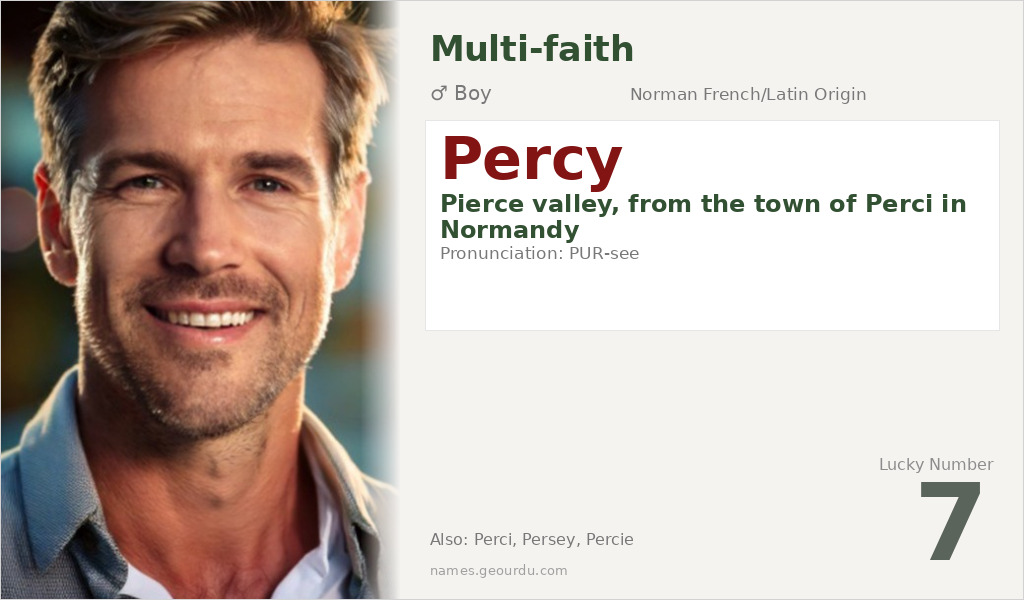
| 📛 Name | Percy |
| 💎 Meaning | Pierce valley, from the town of Perci in Normandy |
| 👤 Gender | Boy |
| 🕌 Religion | Multi-faith |
| 🌍 Origin | Norman French/Latin |
| 🗣 Pronunciation | PUR-see |
| ✍️ Urdu | پرسی |
| ✍️ Arabic | بيرسي |
| 🔢 Numerology | 7 |
| ✨ Spellings | Perci, Persey, Percie |
Origin & Cultural Significance
Percy has its roots in 11th century Normandy, where the de Percy family took their name from their estate near the town of Perci. After William the Conqueror’s invasion of England, the Percys became one of the most powerful noble families in northern England, with Alnwick Castle as their ancestral home. The name gained literary prominence through Percy Bysshe Shelley in the Romantic era and more recently through the popular Percy Jackson book series. While historically associated with English aristocracy, the name has spread globally and is used by people of various religious and cultural backgrounds, transcending its specific Christian associations in the original article.
Personality Traits
Those named Percy often carry an air of thoughtful intelligence and creative spirit. They may exhibit the analytical precision suggested by the ‘pierce’ element of folk etymology, combined with the grounded stability of ‘valley.’ Historical and fictional Percys frequently display loyalty, courage in adversity, and intellectual curiosity, whether in poetic expression or heroic quests. The name suggests someone who values tradition while maintaining independent thinking.
Similar Names
If you like Percy, consider: Pierce, Perceval, Percival, Perry, Perseus
Famous People Named Percy
- Percy Bysshe Shelley — English Romantic poet known for 'Ozymandias' and 'Ode to the West Wind'
- Percy Jackson — Fictional protagonist in Rick Riordan's young adult fantasy series
Frequently Asked Questions About Percy
What does Percy mean?
Percy means 'pierce valley' or 'from Perci,' originating from a Norman French place name that combines the Latin 'Persius' (from Persia) with the Old French suffix for 'place of.'
Is Percy a boy or girl name?
Percy is traditionally a masculine name, though like many surnames-turned-given-names, it could theoretically be used for any gender. Historically and in contemporary usage, it remains predominantly male.
What is the origin of Percy?
Percy originates from Norman French, specifically from the place name Perci in Normandy. It was brought to England as a surname by the aristocratic Percy family after the Norman Conquest and later became a given name.





