
Table of Contents
Perun is a name that echoes with the power of ancient thunderstorms and mythological grandeur. Rooted in pre-Christian Slavic tradition, this name carries the weight of divine authority and natural force. Unlike common modern names, Perun connects directly to a rich pagan heritage that once dominated Eastern Europe. Today, it remains a distinctive choice with profound historical resonance.
Meaning of Perun
The name Perun originates from Proto-Slavic *perunъ, meaning ‘thunder’ or ‘one who strikes.’ This etymological root is connected to the verb *perti (‘to strike, to beat’), reflecting the god’s association with lightning bolts and storms. In Slavic mythology, Perun was the supreme deity who wielded thunder as his weapon, ruling over the sky, war, law, and the oak tree. The name appears consistently across Slavic languages with variations like Polish ‘Piorun’ (lightning) and Czech ‘Perun,’ all maintaining the core meaning of thunderous power. Linguistic evidence shows this name predates Christian influence in Slavic regions, preserved in folklore, toponyms, and historical records.
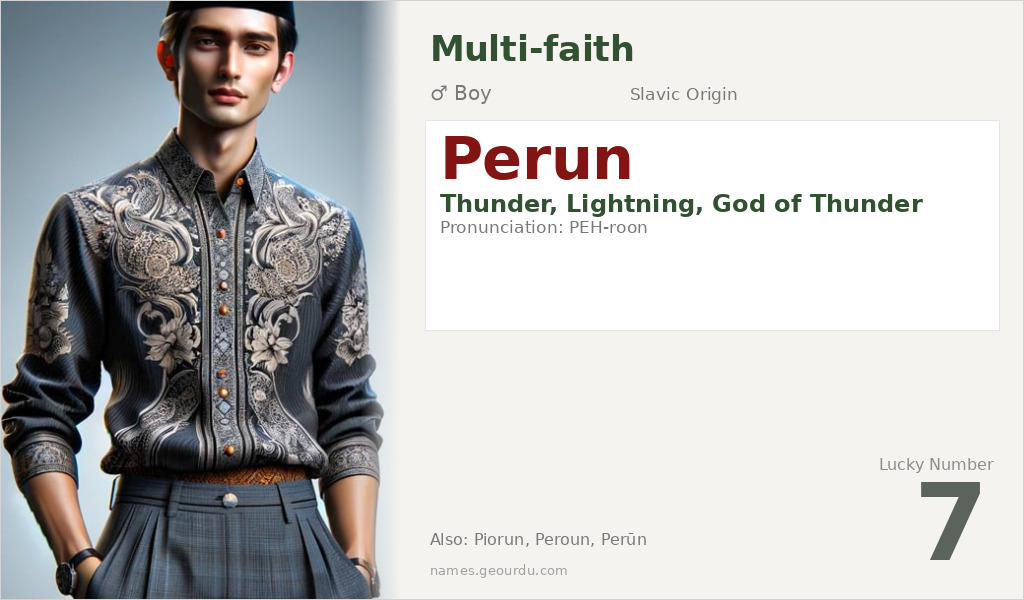
| 📛 Name | Perun |
| 💎 Meaning | Thunder, Lightning, God of Thunder |
| 👤 Gender | Boy |
| 🕌 Religion | Multi-faith |
| 🌍 Origin | Slavic |
| 🗣 Pronunciation | PEH-roon |
| ✍️ Urdu | پیرون |
| ✍️ Arabic | بيرون |
| 🔢 Numerology | 7 |
| ✨ Spellings | Piorun, Peroun, Perūn, Pyerun |
Origin & Cultural Significance
Perun has its origins in the pagan religious traditions of the Slavic peoples, particularly among East Slavs (Russians, Ukrainians, Belarusians) and West Slavs (Poles, Czechs, Slovaks). Historical sources like the Primary Chronicle (12th century) document Perun worship in Kievan Rus’, where wooden idols of the god were erected on hills. The name represents one of the most important deities in the Slavic pantheon, often compared to Norse Thor or Greek Zeus. After Christianization, Perun’s worship was suppressed but survived in folk traditions, fairy tales, and place names across Slavic countries. Today, the name is occasionally used in Slavic nations, particularly among those interested in reviving pre-Christian cultural heritage.
Personality Traits
Those named Perun often embody characteristics associated with the thunder god: strength, protection, and natural authority. They tend to be decisive individuals who aren’t afraid to take charge in difficult situations. With an innate sense of justice and a protective nature, people with this name often become natural leaders who inspire confidence in others through their steadfastness and power.
Similar Names
If you like Perun, consider: Thor, Zeus, Indra, Raijin, Taranis
Famous People Named Perun
- Perun (mythological figure) — Supreme god of thunder in Slavic mythology, worshipped across Eastern Europe before Christianization
- Perun (historical reference) — Name appears in medieval chronicles describing Slavic pagan worship, including the Primary Chronicle
Frequently Asked Questions About Perun
What does Perun mean?
Perun means 'thunder,' 'lightning,' or 'god of thunder' in Slavic mythology. It comes from the Proto-Slavic root *perunъ meaning 'to strike, to thunder.'
Is Perun a boy or girl name?
Perun is exclusively a masculine name. In Slavic mythology, Perun is the male god of thunder, and the name has never been used for females in historical or cultural contexts.
What is the origin of Perun?
Perun originates from pre-Christian Slavic religion and mythology. It was the name of the supreme thunder god worshipped across Slavic regions including modern-day Russia, Ukraine, Poland, and the Balkans before Christianization.





