
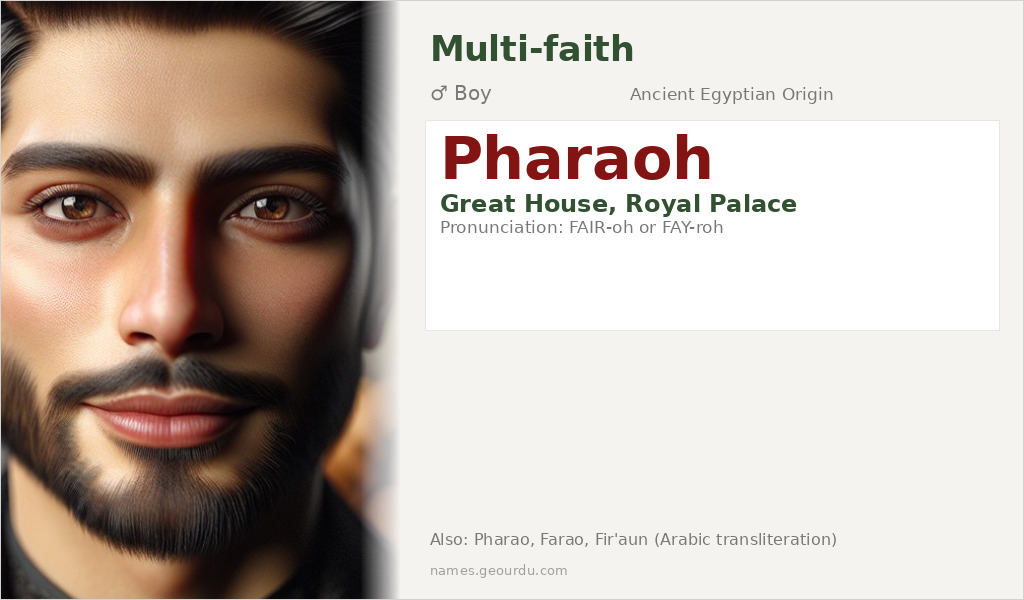
Table of Contents
The name Pharaoh evokes images of ancient pyramids, golden sarcophagi, and powerful rulers who commanded one of history’s greatest civilizations. While not a traditional given name in modern cultures, it carries immense historical weight as the title for the kings of ancient Egypt. This name symbolizes ultimate authority, divine kingship, and architectural grandeur, making it a bold choice for parents seeking a name with profound historical resonance. Its journey from an Egyptian palace reference to a universal symbol of power spans millennia.
Meaning of Pharaoh
The meaning of Pharaoh is definitively traced to the Ancient Egyptian language, where it derives from the compound term ‘pr-ꜥꜣ’ (per-aa), meaning ‘Great House’ or ‘Royal Palace’. Originally, this term referred literally to the pharaoh’s palace as the center of administration and power. Over time, during the New Kingdom period, it became a metonym for the ruler himself, similar to how ‘the White House’ can refer to the U.S. presidency. Linguistically, it entered Western languages through Biblical Hebrew (Parʿōh), then Greek (Pharaō), and Latin (Pharaō), preserving its core meaning. This etymology highlights how the name embodies both physical and symbolic grandeur, representing the institution of kingship in ancient Egypt.
| 📛 Name | Pharaoh |
| 💎 Meaning | Great House, Royal Palace |
| 👤 Gender | Boy |
| 🕌 Religion | Multi-faith |
| 🌍 Origin | Ancient Egyptian |
| 🗣 Pronunciation | FAIR-oh or FAY-roh |
| ✍️ Urdu | فرعون |
| ✍️ Arabic | فرعون |
| 🔢 Numerology | 5 |
| ✨ Spellings | Pharao, Farao, Pharoah |
Origin & Cultural Significance
Pharaoh originates from ancient Egypt, where it was used as a title for monarchs from around the Old Kingdom (c. 2686–2181 BCE) onward. Culturally, pharaohs were considered divine or semi-divine figures, intermediaries between the gods and the people, with names often incorporating theophoric elements like ‘Ra’ or ‘Amun’. Historically, the title appears in numerous ancient texts, including the Hebrew Bible, where it refers to Egyptian rulers in stories like Exodus. While not traditionally used as a personal given name in ancient Egypt—pharaohs had personal names like ‘Ramses’ or ‘Thutmose’—the word has been adopted in modern times as a rare given name, primarily in English-speaking countries, often chosen for its regal and historical connotations rather than religious affiliation.
Personality Traits
Those named Pharaoh are often associated with leadership qualities, confidence, and a commanding presence, reflecting the name’s royal heritage. They may exhibit ambition, strategic thinking, and a natural authority that draws others to follow them. However, this can sometimes manifest as stubbornness or a tendency to be overly traditional. In social settings, they might be seen as charismatic yet reserved, carrying an air of dignity that commands respect.
Similar Names
If you like Pharaoh, consider: Ramses, Tutankhamun, Cleopatra, Nefertiti, Amenhotep
Famous People Named Pharaoh
- Pharaoh Ramses II — Ancient Egyptian pharaoh of the 19th Dynasty, known for his extensive building projects and military campaigns
- Pharaoh Tutankhamun — Egyptian pharaoh of the 18th Dynasty, famous for his intact tomb discovered in 1922
Frequently Asked Questions About Pharaoh
What does Pharaoh mean?
Pharaoh means 'Great House' or 'Royal Palace' in Ancient Egyptian. It was originally a title for the rulers of ancient Egypt, derived from the term for the royal residence.
Is Pharaoh a boy or girl name?
Pharaoh is almost exclusively used as a boy's name, reflecting its historical association with male rulers in ancient Egypt. It is very rarely, if ever, given to girls.
What is the origin of Pharaoh?
Pharaoh originates from Ancient Egyptian culture, specifically from the term 'pr-ꜥꜣ' (per-aa). It entered global usage through Biblical and classical texts, and is not tied to any single modern religion or region.






