
Table of Contents
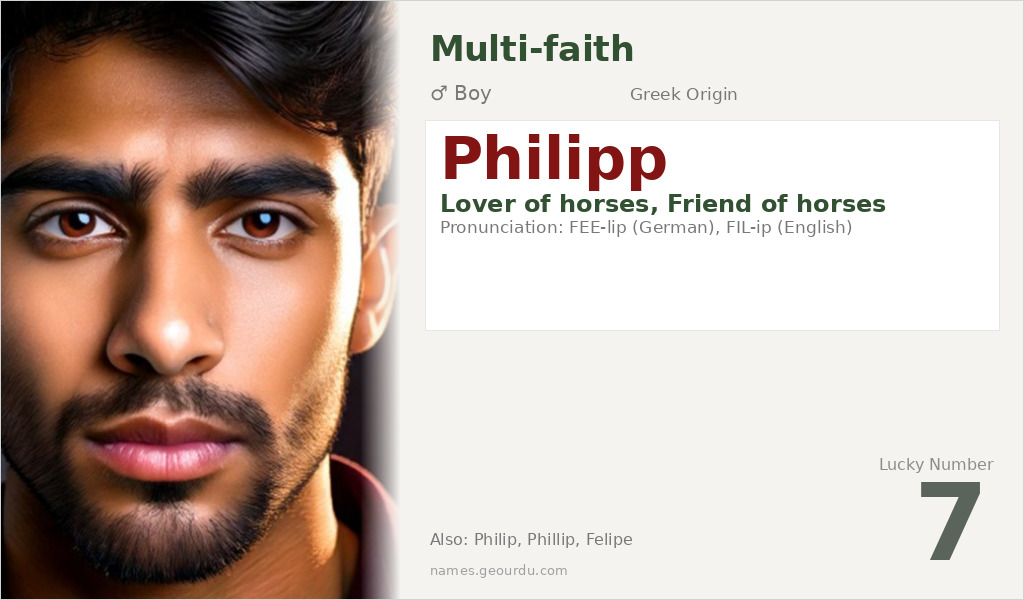
Philipp is a timeless masculine name with roots stretching back to ancient Greece. Meaning ‘lover of horses’, this name carries centuries of royal and religious history while remaining popular today. From Macedonian kings to Christian apostles, Philipp has been borne by influential figures across cultures and eras.
Meaning of Philipp
The name Philipp derives from the Greek Philippos (Φίλιππος), combining ‘philos’ meaning ‘friend’ or ‘lover’ and ‘hippos’ meaning ‘horse’. This literal translation as ‘horse lover’ reflects the importance of horses in ancient Greek society, particularly among the aristocracy and military. The name was notably borne by Philip II of Macedon, father of Alexander the Great, who revolutionized cavalry warfare. Through early Christianity, the name gained religious significance via Saint Philip the Apostle, one of Jesus’s twelve disciples. The name spread throughout Europe in various forms, maintaining its core meaning across languages and cultures.
| 📛 Name | Philipp |
| 💎 Meaning | Lover of horses, Friend of horses |
| 👤 Gender | Boy |
| 🕌 Religion | Multi-faith |
| 🌍 Origin | Greek |
| 🗣 Pronunciation | FEE-lip (German), FIL-ip (English) |
| ✍️ Urdu | فلپ |
| ✍️ Arabic | فيليب |
| 🔢 Numerology | 7 |
| ✨ Spellings | Philip, Phillip, Felipe, Filip, Philippe, Filippo, Filib |
Origin & Cultural Significance
Philipp originated in ancient Greece as Philippos, first documented among Macedonian royalty in the 4th century BCE. The name gained prominence through Philip II, whose military innovations and political achievements made Macedon a dominant power. With the spread of Christianity, the apostle Philip helped establish the name’s religious significance. During the Middle Ages, the name spread throughout Europe via saints’ cults and royal connections, appearing as Philip in English, Philippe in French, Felipe in Spanish, and Filippo in Italian. The German variant Philipp became particularly common in Central Europe and remains popular in German-speaking countries today.
Personality Traits
Those named Philipp often exhibit traits associated with their name’s meaning and historical bearers. The ‘horse lover’ etymology suggests qualities of strength, freedom, and nobility, while the name’s royal and intellectual history points to leadership and analytical abilities. Many Philipps are known for their strategic thinking, curiosity, and philosophical nature. The name’s association with both ancient kings and religious figures creates a balance of worldly ambition and spiritual depth in its personality profile.
Similar Names
If you like Philipp, consider: Alexander, Theodore, Nicholas, Christopher, Andrew
Famous People Named Philipp
- Philipp Lahm — German former professional footballer and World Cup winner
- Philipp Melanchthon — German Lutheran reformer and collaborator of Martin Luther
- Prince Philip, Duke of Edinburgh — husband of Queen Elizabeth II of the United Kingdom
- Philip II of Macedon — King of Macedon and father of Alexander the Great
Frequently Asked Questions About Philipp
What does Philipp mean?
Philipp means 'lover of horses' or 'friend of horses', derived from the Greek words 'philos' (friend/lover) and 'hippos' (horse).
Is Philipp a boy or girl name?
Philipp is exclusively a masculine name in all cultures where it's used, from its ancient Greek origins to modern usage worldwide.
What is the origin of Philipp?
Philipp originates from ancient Greek (Philippos) and is the German variant of the name. It was borne by Macedonian kings and spread through Christian tradition via Saint Philip the Apostle.





