Table of Contents
Phillipp is a classic boy’s name with deep historical roots and a meaning that evokes strength and companionship. Derived from ancient Greek, this name has traveled through centuries and across continents, appearing in royal lineages, religious texts, and modern families worldwide. Its enduring popularity speaks to its timeless appeal and rich cultural heritage.
Meaning of Phillipp
The name Phillipp originates from the Greek Φίλιππος (Philippos), which combines φίλος (philos), meaning ‘friend’ or ‘lover’, and ἵππος (hippos), meaning ‘horse’. Thus, the literal translation is ‘lover of horses’ or ‘friend of horses’. This etymology is firmly established through ancient Greek texts and historical usage, including by Philip II of Macedon in the 4th century BCE. The name’s components reflect values important in Greek society, where horses symbolized nobility, warfare prowess, and status. Over time, Phillipp has evolved into various spellings and forms across languages, but its core meaning remains consistent.
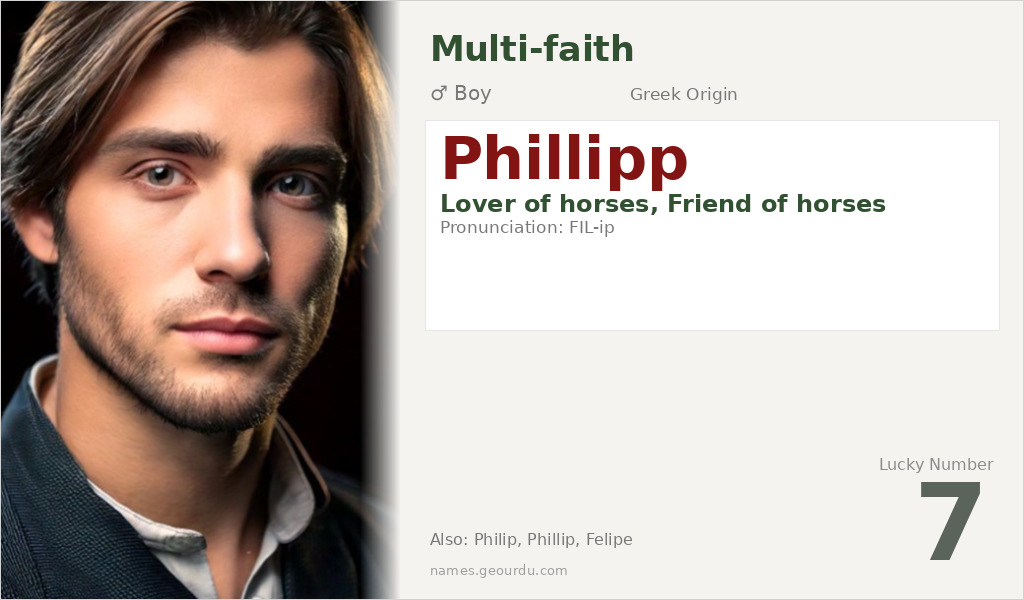
| 📛 Name | Phillipp |
| 💎 Meaning | Lover of horses, Friend of horses |
| 👤 Gender | Boy |
| 🕌 Religion | Multi-faith |
| 🌍 Origin | Greek |
| 🗣 Pronunciation | FIL-ip |
| ✍️ Urdu | فلپ |
| ✍️ Arabic | فيليب |
| 🔢 Numerology | 7 |
| ✨ Spellings | Philip, Phillip, Felipe, Philipp, Filip, Filippo |
Origin & Cultural Significance
Phillipp has its origins in ancient Greece, where it was a common name among nobility and military leaders. It gained prominence through Philip II of Macedon, who expanded the Macedonian kingdom and fathered Alexander the Great. The name entered Christian tradition via Saint Philip, one of the twelve apostles in the New Testament, leading to its adoption in Christian communities. However, it is not exclusively Christian; variants like Felipe are popular in Spanish-speaking countries, Filip in Slavic regions, and Filippo in Italy, showing its multi-faith and cross-cultural appeal. The name has been used by royalty, including multiple kings of France and Spain, cementing its historical significance.
Personality Traits
People named Phillipp are often seen as confident, sociable, and driven, with a natural ability to inspire others. Their Greek roots suggest a love for adventure and loyalty in friendships, mirroring the meaning ‘friend of horses’. They may excel in leadership roles or fields requiring communication and strategy. While personality traits can vary individually, the name’s historical bearers often embody qualities of determination and charisma.
Similar Names
If you like Phillipp, consider: Alexander, Theodore, Christopher, Nicholas, Andrew
Famous People Named Phillipp
- Philip II of Macedon — King of Macedon and father of Alexander the Great
- Prince Philip, Duke of Edinburgh — Husband of Queen Elizabeth II of the United Kingdom
Frequently Asked Questions About Phillipp
What does Phillipp mean?
Phillipp means 'lover of horses' or 'friend of horses', derived from the Greek words philos (friend/lover) and hippos (horse).
Is Phillipp a boy or girl name?
Phillipp is traditionally a boy's name, with origins in ancient Greek culture where it was used for males. Variants like Philippa exist for girls.
What is the origin of Phillipp?
Phillipp originates from ancient Greek, specifically from the name Philippos. It has historical ties to Greek nobility and later spread through Christian and European traditions.