
Table of Contents
Pitt is a distinctive name with roots in medieval England that has gained modern recognition through famous bearers. Originally a topographic surname describing someone who lived near a pit or hollow, it has evolved into a contemporary given name. While not common as a first name, it carries historical weight and simple, earthy meaning. This name connects to English landscape features and has been borne by notable figures across centuries.
Meaning of Pitt
The name Pitt derives directly from the Middle English word “pitt,” which meant a pit, hollow, ditch, or excavation in the ground. In medieval England, this was a practical descriptive term that became a surname for families living near such geographical features. The etymology traces back to Old English “pytt” with the same meaning, related to West Germanic “*puttjaz” and possibly Latin “puteus” (well, pit). As a given name, Pitt maintains this literal meaning of “pit” or “hollow,” representing an English tradition of turning occupational or topographic surnames into first names.
| 📛 Name | Pitt |
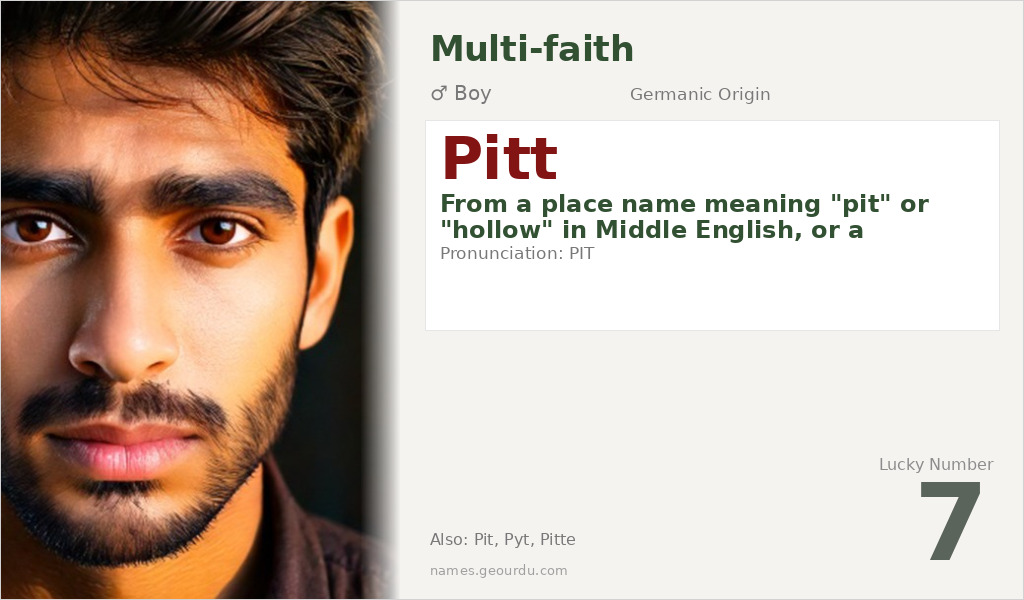
| 💎 Meaning | From a place name meaning "pit" or "hollow" in Middle English, or a topographic surname for someone who lived near a pit or hollow |
| 👤 Gender | Boy |
| 🕌 Religion | Multi-faith |
| 🌍 Origin | Germanic |
| 🗣 Pronunciation | PIT |
| ✍️ Urdu | پٹ |
| ✍️ Arabic | بيت |
| 🔢 Numerology | 7 |
| ✨ Spellings | Pit, Pyt, Pitte |
Origin & Cultural Significance
Pitt originated as an English surname during the Middle Ages, specifically as a topographic name for someone who lived by a pit or hollow. This naming practice was common in medieval England, where people were often identified by their proximity to geographical features. The name gained prominence through the Pitt political dynasty in Britain, particularly William Pitt the Elder and William Pitt the Younger, both Prime Ministers. In modern times, the name has been used as a given name, though it remains relatively uncommon compared to its surname usage.
Personality Traits
Those named Pitt often exhibit characteristics associated with their name’s earthy, grounded origins. They may demonstrate practical intelligence, stability, and a connection to tangible realities. The name suggests someone who is dependable, observant, and capable of deep focus, much like the pits or hollows from which the name derives. While individual personalities vary, the name carries connotations of substance and reliability.
Similar Names
If you like Pitt, consider: Pittman, Pitney, Pitton, Pitkin, Pitcairn
Famous People Named Pitt
- Brad Pitt — American actor and film producer, one of Hollywood's most recognized stars
- William Pitt the Younger — British Prime Minister from 1783-1801 and 1804-1806
Frequently Asked Questions About Pitt
What does Pitt mean?
Pitt means "pit" or "hollow" and originates from Middle English. It began as a topographic surname for people living near a pit or excavation before becoming a given name.
Is Pitt a boy or girl name?
Pitt is traditionally a masculine name, though as a surname-derived name it could theoretically be used for any gender. Historically and in contemporary usage, it is overwhelmingly male.
What is the origin of Pitt?
Pitt has English origins, specifically from Middle English "pitt" meaning pit or hollow. It developed as a topographic surname in medieval England before occasional use as a given name.





