
Table of Contents
Pompey is a distinguished name with ancient Roman roots that carries historical weight and numerical significance. Most famously borne by Pompey the Great, one of Rome’s most celebrated generals and statesmen, this name evokes images of military prowess and political power. While less common today, it remains a name with substantial historical resonance and classical appeal. Understanding its true meaning and origins reveals a fascinating connection to early Italic cultures.
Meaning of Pompey
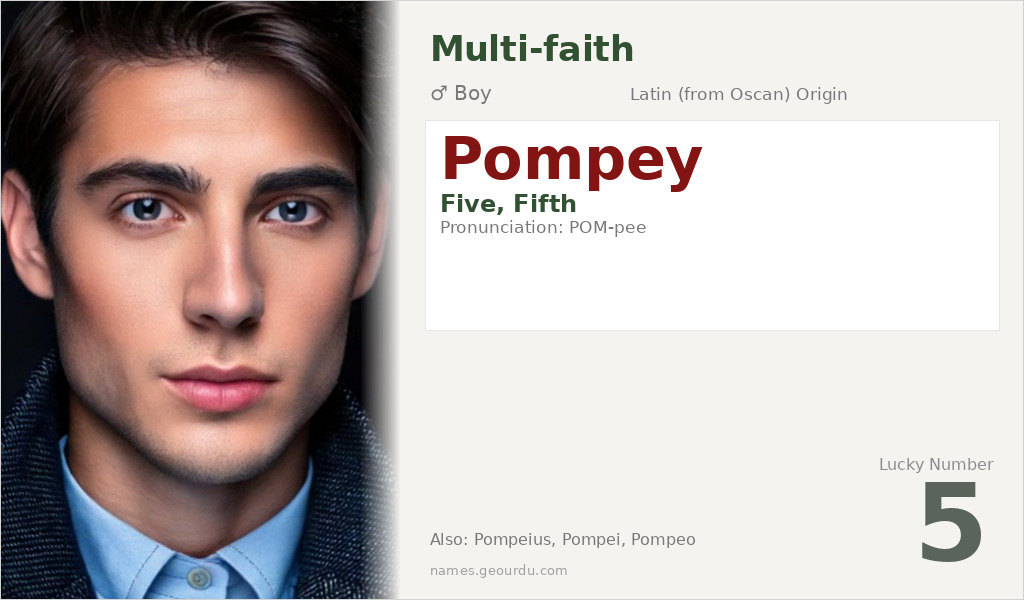
The name Pompey originates from the Latin Pompeius, which derives from the Oscan praenomen Pompo, meaning ‘five’ or ‘fifth’. Oscan was an Italic language spoken in southern Italy before Roman dominance, and this numerical name likely indicated birth order or had ritual significance. The transition from Oscan Pompo to Latin Pompeius occurred as Rome absorbed Oscan territories and names. This etymology is firmly established through comparative linguistics and historical records, distinguishing it from the unrelated English word ‘pomp’ meaning ceremonial splendor.
| 📛 Name | Pompey |
| 💎 Meaning | Five, Fifth |
| 👤 Gender | Boy |
| 🕌 Religion | Multi-faith |
| 🌍 Origin | Latin (from Oscan) |
| 🗣 Pronunciation | POM-pee |
| ✍️ Urdu | پومپی |
| ✍️ Arabic | بومبي |
| 🔢 Numerology | 5 |
| ✨ Spellings | Pompeius, Pompei, Pompeo |
Origin & Cultural Significance
Pompey has its roots in ancient Italy, specifically from the Oscan people who inhabited regions like Campania and Samnium. As Rome expanded, Oscan names like Pompo were Latinized to Pompeius, entering the Roman naming system. The name gained prominence through Gnaeus Pompeius Magnus (Pompey the Great), who lived from 106-48 BCE and became one of Rome’s most powerful figures. While the name has no inherent religious affiliation, its historical usage spans pre-Christian Roman times through various periods, making it a multi-faith name with classical rather than religious significance.
Personality Traits
Those named Pompey often inherit associations with leadership, strategy, and historical grandeur from the famous Roman general. They may exhibit qualities of ambition, organization, and a commanding presence that reflects the name’s martial heritage. The numerical origin (five) might suggest balance, adaptability, or mediation skills. While personality traits vary by individual, the name carries connotations of strength, tradition, and historical significance that may influence perceptions.
Similar Names
If you like Pompey, consider: Pompeius, Pompeo, Pompilius, Pomponius, Pompeianus
Famous People Named Pompey
- Gnaeus Pompeius Magnus (Pompey the Great) — Roman general and statesman, member of the First Triumvirate with Julius Caesar and Crassus
- Sextus Pompeius — Son of Pompey the Great, continued resistance against the Second Triumvirate after his father's death
Frequently Asked Questions About Pompey
What does Pompey mean?
Pompey means 'five' or 'fifth' originating from the Oscan language through Latin. It comes from the Oscan name Pompo, which had numerical significance, not from the English word 'pomp' meaning ceremony.
Is Pompey a boy or girl name?
Pompey is exclusively a boy's name with historical usage only for males, most famously the Roman general Pompey the Great. There are no documented female uses in historical or contemporary contexts.
What is the origin of Pompey?
Pompey originates from ancient Italy, specifically from the Oscan language (Pompo meaning 'five'), which was Latinized to Pompeius as Rome absorbed Oscan territories. It is a classical Roman name with pre-Christian roots.





