
Table of Contents
Porter is a distinctive name with deep historical roots as an occupational surname that has transitioned into modern first name usage. Originally describing someone who guarded gates or carried goods, this name carries connotations of protection, reliability, and service. While most commonly used for boys, its strong, practical sound has made it increasingly popular in English-speaking countries. Discover the fascinating journey of this name from medieval occupation to contemporary given name.
Meaning of Porter
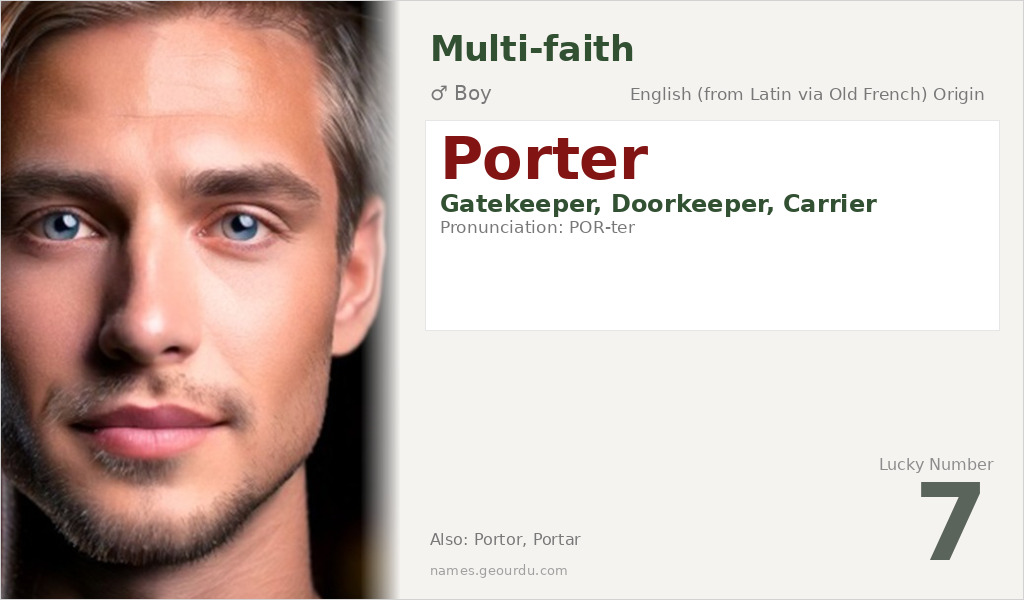
The name Porter has a clear and well-documented meaning derived from occupational terminology. It originates from Middle English ‘portour’ and Old French ‘porteor’, both meaning ‘gatekeeper’ or ‘doorkeeper’. These terms trace back to Latin roots: ‘porta’ meaning ‘gate’ and ‘portare’ meaning ‘to carry’. Historically, a porter was responsible for guarding city gates, castle entrances, or carrying goods and luggage. This occupational background gives the name connotations of protection, security, and reliability that have carried through to its modern usage as a given name.
| 📛 Name | Porter |
| 💎 Meaning | Gatekeeper, Doorkeeper, Carrier |
| 👤 Gender | Boy |
| 🕌 Religion | Multi-faith |
| 🌍 Origin | English (from Latin via Old French) |
| 🗣 Pronunciation | POR-ter |
| ✍️ Urdu | پورٹر |
| ✍️ Arabic | بورتر |
| 🔢 Numerology | 7 |
| ✨ Spellings | Portor, Portar |
Origin & Cultural Significance
Porter has English origins but its linguistic roots extend through Old French to Latin. The name emerged as an occupational surname in medieval England, describing individuals who worked as gatekeepers or carriers. During the Middle Ages, porters held important positions in towns and castles, responsible for security at entrances and transportation of goods. The transition from surname to given name occurred primarily in the 19th and 20th centuries, particularly in English-speaking countries like the United States, United Kingdom, and Australia. Today, it’s recognized as a strong, traditional name without specific religious or cultural exclusivity.
Personality Traits
People named Porter often exhibit traits associated with their name’s meaning of gatekeeping and protection. They tend to be reliable, responsible individuals who take their duties seriously, whether in personal relationships or professional settings. Their practical nature and organizational skills make them excellent at managing responsibilities and creating secure environments for those around them. While they may appear reserved initially, Porters typically prove to be steadfast and trustworthy companions once trust is established.
Similar Names
If you like Porter, consider: Porterfield, Porterman, Porterhouse, Porterhouse, Porterhouse
Famous People Named Porter
- Porter Robinson — American DJ and music producer known for electronic music
- Porter Wagoner — American country music singer and television host
Frequently Asked Questions About Porter
What does Porter mean?
Porter means 'gatekeeper', 'doorkeeper', or 'carrier'. It originates from English occupational terminology derived from Middle English 'portour' and Old French 'porteor', which trace back to Latin 'porta' (gate) and 'portare' (to carry).
Is Porter a boy or girl name?
Porter is primarily a boy's name, though it could theoretically be used for any gender. Historically and in contemporary usage, it is overwhelmingly masculine, with occupational names traditionally being male-dominated in English naming conventions.
What is the origin of Porter?
Porter has English origins as an occupational surname that transitioned to a given name. Its linguistic roots extend through Middle English and Old French to Latin, specifically from 'porta' (gate) and 'portare' (to carry), reflecting the medieval occupation of gatekeeping or carrying goods.





