Table of Contents
Prasheila is an intriguing modern name that has gained some popularity in recent decades, particularly within Hindu communities. While often categorized as a traditional name, its origins reveal a more contemporary story of linguistic creativity. This name represents a fascinating blend of cultural elements, combining sounds and meanings from different linguistic traditions. Let’s explore what makes Prasheila unique and examine its possible components.
Meaning of Prasheila
The name Prasheila appears to be a modern construction rather than a traditional name with ancient roots. The first syllable ‘Pras-‘ likely derives from the Sanskrit word ‘Prasanna’ (प्रसन्न), which means ‘clear, bright, cheerful, pleased, or tranquil’. This element is common in many Indian names like Prasanna, Prashant, and Prashanth. The second part ‘-sheila’ resembles the Celtic/Latin name Sheila, which itself has multiple possible origins: from the Latin ‘Caelia’ meaning ‘heavenly’, or from the Old Irish ‘Síle’ meaning ‘blind’. When combined, Prasheila could be interpreted as ‘cheerful heavenly one’ or ‘bright celestial being’, though this interpretation is speculative rather than documented. The name doesn’t appear in historical Sanskrit texts, classical literature, or traditional naming dictionaries.
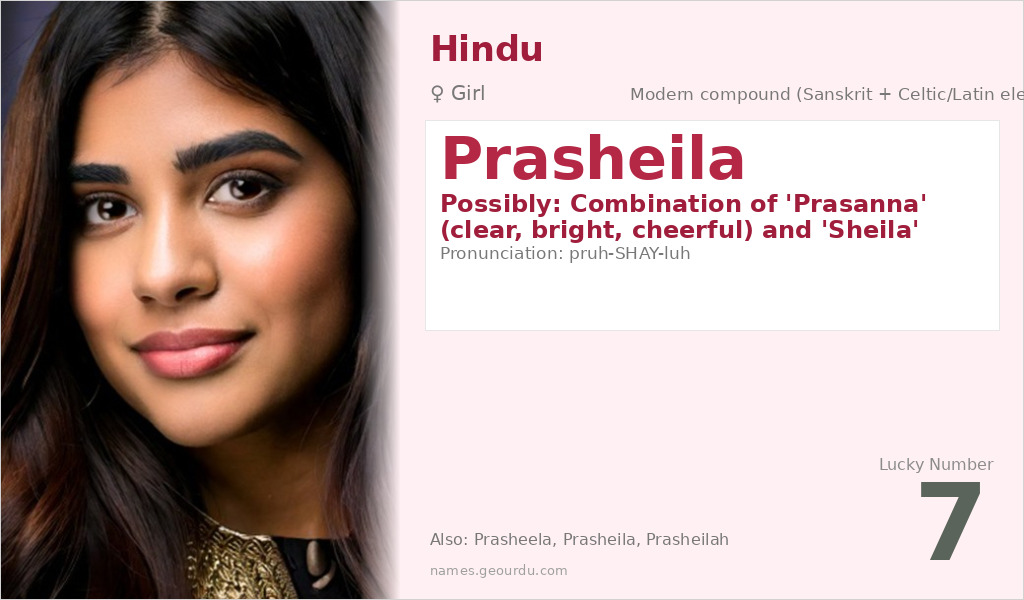
| 📛 Name | Prasheila |
| 💎 Meaning | Possibly: Combination of 'Prasanna' (clear, bright, cheerful) and 'Sheila' (variant of Sheila meaning 'blind' or 'heavenly' in Celtic, or derived from Latin 'Caelia' meaning 'heavenly') |
| 👤 Gender | Girl |
| 🕌 Religion | Hindu |
| 🌍 Origin | Modern compound (Sanskrit + Celtic/Latin elements) |
| 🗣 Pronunciation | pruh-SHAY-luh |
| ✍️ Urdu | پرشیلا |
| ✍️ Arabic | براشيلا |
| 🔢 Numerology | 7 |
| ✨ Spellings | Prasheela, Prasheila, Prasheilah |
Origin & Cultural Significance
Prasheila appears to be a modern invented name that emerged in the late 20th or early 21st century, likely created by parents seeking a unique name that sounds both Indian and international. While often used in Hindu families, the name doesn’t have traditional religious significance in Hinduism. Its creation reflects contemporary naming trends where parents combine elements from different languages to create distinctive names. The name’s structure suggests influence from both Sanskrit naming traditions (through the ‘Pras-‘ prefix) and Western naming patterns (through the ‘-sheila’ suffix). This hybrid origin makes it part of a growing category of modern names that transcend traditional linguistic boundaries while maintaining cultural resonance.
Personality Traits
While personality traits associated with names are largely cultural constructs rather than scientific facts, names like Prasheila that are modern creations often carry expectations of uniqueness and innovation. Those named Prasheila might be perceived as creative individuals who value self-expression and originality. The name’s blended linguistic heritage could suggest someone comfortable bridging different cultural contexts or possessing a global perspective. Like many modern invented names, Prasheila may inspire its bearers to forge their own path rather than follow established traditions.
Similar Names
If you like Prasheila, consider: Prasanna, Sheila, Prasheela, Prasheena
Famous People Named Prasheila
- No notable public figures with this name have been documented in reliable sources
Frequently Asked Questions About Prasheila
What does Prasheila mean?
Prasheila is likely a modern compound name possibly meaning 'cheerful heavenly one', combining Sanskrit 'Prasanna' (cheerful) with Celtic/Latin 'Sheila' (heavenly), though this interpretation is speculative rather than documented.
Is Prasheila a boy or girl name?
Prasheila is exclusively used as a girl's name in all documented cases, though as a modern invented name, its gender association is based on contemporary usage patterns rather than historical tradition.
What is the origin of Prasheila?
Prasheila appears to be a modern invented name created by combining elements from Sanskrit ('Pras-') and Celtic/Latin ('-sheila'). It doesn't have traditional roots in any specific language or culture but represents contemporary naming creativity.