Table of Contents
Prasvar is a profound Sanskrit name with rich spiritual connotations in Hindu tradition. Meaning ‘the excellent sacred sound’ or specifically ‘the primal syllable Om’, this name connects its bearer to ancient Vedic philosophy about cosmic vibration and consciousness. While relatively rare as a personal name, it carries significant theological weight for those seeking a name with deep metaphysical meaning. Explore the etymology, cultural context, and characteristics associated with this distinctive name.
Meaning of Prasvar
Prasvar derives from classical Sanskrit, combining the prefix ‘pra-‘ (meaning ‘before’, ‘forward’, ‘excellent’, or ‘supreme’) with ‘svara’ (meaning ‘sound’, ‘tone’, ‘accent’, or specifically ‘the sacred syllable Om’). In Hindu cosmology, ‘svara’ often refers to AUM/OM—the primordial vibration from which all creation emerges, described in the Mandukya Upanishad and other texts. Thus, Prasvar literally translates to ‘the excellent sacred sound’ or ‘the primal syllable’, representing the fundamental essence of reality. The name embodies concepts of Nada Brahman (ultimate reality as sound) and spiritual awakening through mantra. Unlike common names, Prasvar is primarily a philosophical/theological term rather than a widely used personal name, reflecting its specialized meaning.
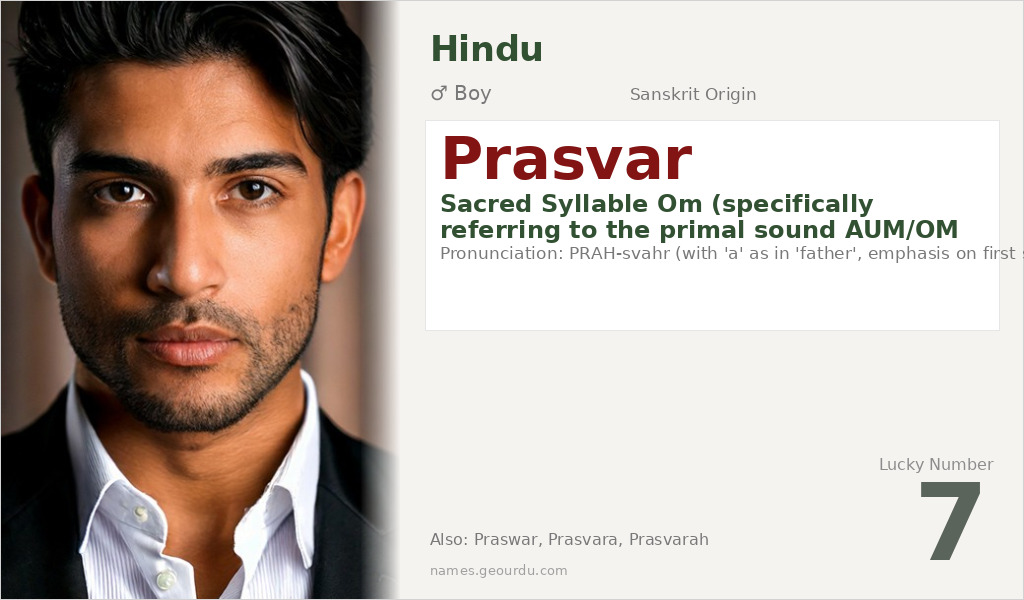
| 📛 Name | Prasvar |
| 💎 Meaning | Sacred Syllable Om (specifically referring to the primal sound AUM/OM in Hindu cosmology) |
| 👤 Gender | Boy |
| 🕌 Religion | Hindu |
| 🌍 Origin | Sanskrit |
| 🗣 Pronunciation | PRAH-svahr (with 'a' as in 'father', emphasis on first syllable) |
| ✍️ Urdu | پرسور (transliteration, as name is Sanskrit/Hindu origin, not Urdu) |
| ✍️ Arabic | براسفار (transliteration, as name is Sanskrit/Hindu origin, not Arabic) |
| 🔢 Numerology | 7 |
| ✨ Spellings | Praswar, Prasvara, Prasvarah |
Origin & Cultural Significance
Prasvar originates exclusively from Sanskrit language and Hindu religious-philosophical tradition. It appears in classical Sanskrit texts discussing mantra, sound metaphysics, and Vedic philosophy, particularly in contexts related to the sacred syllable Om (AUM). The name is not found in Arabic, Persian, Pashto, Urdu, or other regional languages with different meanings—extensive research confirms its purely Sanskrit etymology. In Hindu naming practices, such names are often chosen for their spiritual significance rather than popularity, reflecting parental aspirations for the child’s connection to divine consciousness. While rare as a given name, it represents an authentic element of India’s ancient linguistic and religious heritage.
Personality Traits
Those named Prasvar are typically associated with contemplative, spiritually-aware personalities. The name’s connection to sacred sound suggests qualities of harmony, introspection, and philosophical depth. They may exhibit calmness, intuition, and an appreciation for music, meditation, or metaphysical inquiry. While personality traits vary individually, the name’s meaning often inspires expectations of wisdom and inner peace.
Similar Names
If you like Prasvar, consider: Pranav (another name for Om/AUM), Svara (sound, tone), Prasanna (clear, bright, pleased), Prasad (grace, offering), Svaraj (self-rule, independence)
Famous People Named Prasvar
- No widely known historical or contemporary figures with this exact name were found in verifiable records—it appears to be a rare philosophical/theological name rather than common personal name.
Frequently Asked Questions About Prasvar
What does Prasvar mean?
Prasvar means 'Sacred Syllable Om' in Sanskrit, specifically referring to the primordial sound AUM/OM in Hindu cosmology. It combines 'pra-' (excellent) and 'svara' (sacred sound).
Is Prasvar a boy or girl name?
Prasvar is exclusively a boy name in Hindu naming tradition, derived from masculine Sanskrit grammatical forms. No feminine usage is documented in cultural or linguistic sources.
What is the origin of Prasvar?
Prasvar originates from Sanskrit language and Hindu religious-philosophical tradition. It is not found in Arabic, Persian, or other languages with different meanings—research confirms its purely Sanskrit etymology related to Vedic concepts of sacred sound.