
Table of Contents
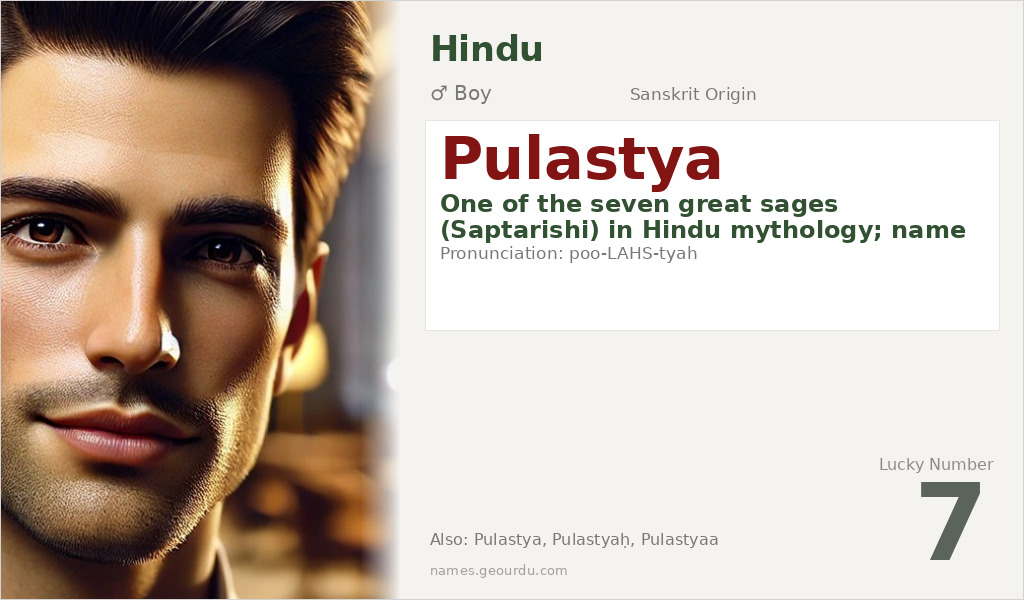
Pulastya is a profound Sanskrit name with deep roots in Hindu mythology and scriptures. This ancient name belongs to one of the seven great sages (Saptarishi) who play significant roles in Hindu cosmology and epics. Choosing Pulastya for a child connects them to a lineage of wisdom, spiritual authority, and mythological significance that spans thousands of years of Indian tradition.
Meaning of Pulastya
The name Pulastya originates from Sanskrit and holds significant mythological importance in Hinduism. It refers specifically to one of the seven great sages (Saptarishi) who are considered the mind-born sons of Brahma, the creator god. The name’s etymology is debated, with some scholars suggesting it comes from ‘pulasti’ meaning ‘to be full of’ or ‘abundant’, while others connect it to the sage’s role as a progenitor. In Hindu scriptures, Pulastya is particularly important as the father of the Rakshasas (demons) and the grandfather of key figures in the Ramayana including Ravana, Kubera, and Vibhishana. The name appears in multiple ancient texts including the Vedas, Puranas, Mahabharata, and Ramayana, establishing its deep cultural and religious significance.
| 📛 Name | Pulastya |
| 💎 Meaning | One of the seven great sages (Saptarishi) in Hindu mythology; name of a Vedic sage and progenitor of the Rakshasas |
| 👤 Gender | Boy |
| 🕌 Religion | Hindu |
| 🌍 Origin | Sanskrit |
| 🗣 Pronunciation | poo-LAHS-tyah |
| ✍️ Urdu | پلستیا |
| ✍️ Arabic | بولاستيا |
| 🔢 Numerology | 7 |
| ✨ Spellings | Pulastya, Pulastyaḥ, Pulastyaa |
Origin & Cultural Significance
Pulastya has its origins in ancient Sanskrit literature and Hindu mythology dating back to Vedic times. As one of the ten Prajapatis and seven Saptarishis, Pulastya occupies a central position in Hindu cosmology and genealogy. The name is most prominently featured in the Ramayana, where Pulastya is the grandfather of the main antagonist Ravana and other significant characters. This mythological connection makes the name particularly significant in Hindu naming traditions, especially among families who value connections to ancient sages and spiritual lineages. The name continues to be used in modern times, particularly in India and among Hindu communities worldwide, maintaining its religious and cultural significance.
Personality Traits
Those named Pulastya are often associated with the sage-like qualities of their mythological namesake. They may exhibit wisdom beyond their years, a contemplative nature, and strong intellectual capabilities. The name suggests someone who values tradition, spiritual growth, and philosophical inquiry. Like the sage Pulastya who was a progenitor of both divine and demonic lineages, individuals with this name may demonstrate complex, multifaceted personalities with depth and substance.
Similar Names
If you like Pulastya, consider: Pulaha, Pulika, Pulindra, Puloma, Pulastin
Famous People Named Pulastya
- Pulastya — One of the Saptarishi (seven great sages) in Hindu scriptures, mentioned in the Vedas, Puranas, and epics
- Pulastya — Sage who appears in the Mahabharata and Ramayana as the father of Vishrava and grandfather of Ravana, Kubera, and Vibhishana
Frequently Asked Questions About Pulastya
What does Pulastya mean?
Pulastya means 'one of the seven great sages (Saptarishi)' in Sanskrit. Specifically, it refers to a Vedic sage who is one of the mind-born sons of Brahma and the grandfather of Ravana in Hindu mythology.
Is Pulastya a boy or girl name?
Pulastya is exclusively a boy's name in Hindu tradition, named after the male sage from Hindu mythology. There is no feminine equivalent or usage in historical or contemporary contexts.
What is the origin of Pulastya?
Pulastya originates from Sanskrit and Hindu mythology. It comes from ancient Indian scriptures where Pulastya is one of the seven great sages (Saptarishi) and appears in texts like the Vedas, Puranas, Mahabharata, and Ramayana.





