
Table of Contents
Pushkara is a beautiful and meaningful name of Sanskrit origin, deeply rooted in Hindu culture and mythology. Often given to boys, it evokes images of purity, divinity, and natural beauty. This name carries a rich heritage, symbolizing the blue lotus or sacred waters in ancient texts. Discover the fascinating etymology and cultural significance of Pushkara in this detailed guide.
Meaning of Pushkara
Pushkara originates from the Sanskrit word ‘pushkara’ (पुष्कर), which primarily means ‘blue lotus’—a flower revered in Hinduism for its association with gods like Vishnu and Lakshmi, symbolizing purity, enlightenment, and divine beauty. Additionally, it can mean ‘sacred water’ or ‘a type of aquatic flower’, reflecting its connection to life-giving elements. The name is composed of the roots ‘push’ (to nourish) and ‘kara’ (maker), implying something that nourishes or purifies. In Hindu scriptures, Pushkara is also the name of a sacred lake and a celestial figure, emphasizing its spiritual connotations. This etymology is well-documented in Sanskrit dictionaries and religious texts, making its meaning highly reliable.
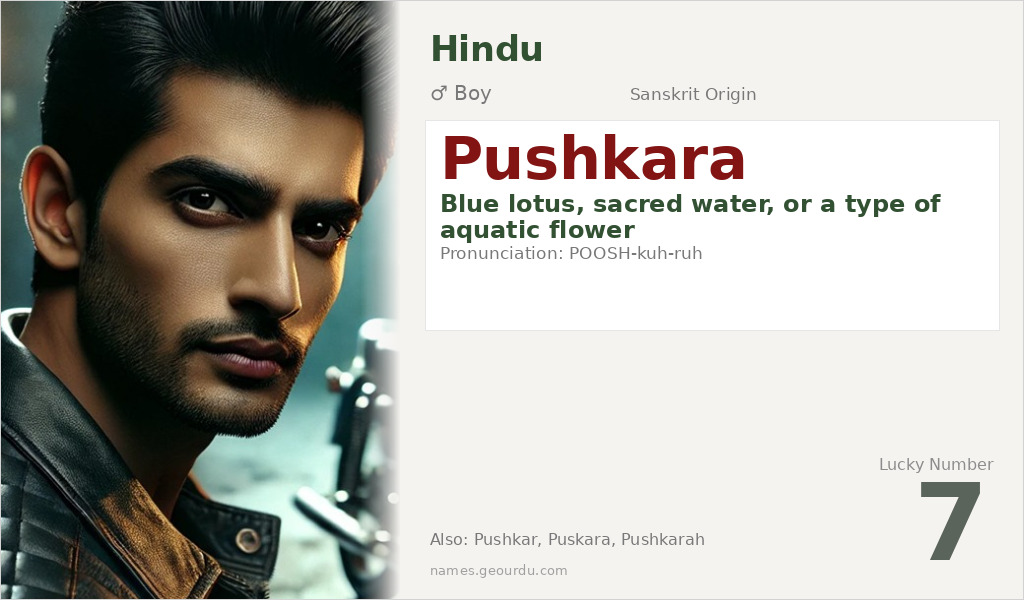
| 📛 Name | Pushkara |
| 💎 Meaning | Blue lotus, sacred water, or a type of aquatic flower |
| 👤 Gender | Boy |
| 🕌 Religion | Hindu |
| 🌍 Origin | Sanskrit |
| 🗣 Pronunciation | POOSH-kuh-ruh |
| ✍️ Urdu | پشکر |
| ✍️ Arabic | بوشكارا |
| 🔢 Numerology | 7 |
| ✨ Spellings | Pushkar, Puskara, Pushkarah |
Origin & Cultural Significance
Pushkara has its origins in ancient Sanskrit, the classical language of India, and is predominantly used in Hindu communities. It appears in epic texts like the Mahabharata, where Pushkara is the brother of King Nala, adding to its historical and cultural depth. The name is closely tied to Hindu mythology and rituals, often associated with pilgrimage sites and natural elements like lakes and flowers. Over time, it has remained a traditional choice for boys in India and among the Hindu diaspora, reflecting enduring cultural values. While not commonly found in other languages like Arabic or Persian, its Sanskrit roots are firmly established, with no significant variations in regional tribal languages such as Pashto or Balochi.
Personality Traits
People named Pushkara are often perceived as serene, introspective, and spiritually aware, mirroring the calmness of a lotus on water. They may possess a creative or philosophical mindset, drawn to arts, nature, or religious pursuits. Their personality tends to emphasize harmony, purity, and a nurturing disposition, making them compassionate and thoughtful individuals in social settings.
Similar Names
If you like Pushkara, consider: Padma, Kamal, Neeraj, Sarovar, Jalaj
Famous People Named Pushkara
- Pushkar — a character in Hindu mythology, brother of Nala in the Mahabharata
- Pushkar Singh Dhami — Indian politician, Chief Minister of Uttarakhand
Frequently Asked Questions About Pushkara
What does Pushkara mean?
Pushkara means 'blue lotus' or 'sacred water' in Sanskrit, symbolizing purity and divinity in Hindu culture.
Is Pushkara a boy or girl name?
Pushkara is traditionally a boy's name in Hindu culture, though it is rarely used for girls.
What is the origin of Pushkara?
Pushkara originates from Sanskrit, an ancient Indian language, and is deeply rooted in Hindu mythology and traditions.





