
Table of Contents
Puskara is a beautiful Sanskrit name with profound spiritual and natural symbolism. Primarily meaning ‘blue lotus’—a sacred flower in Hinduism and Buddhism—it also signifies ‘sacred water body’ or ‘pond’. This name carries centuries of cultural heritage and remains popular among Hindu families seeking names with deep spiritual resonance and connection to nature.
Meaning of Puskara
The name Puskara originates from the Sanskrit word ‘पुष्कर’ (puṣkara), which holds dual significant meanings in ancient Indian tradition. First, it refers specifically to the blue lotus flower (Nelumbo nucifera), a sacred symbol representing purity, enlightenment, and divine beauty in Hindu and Buddhist iconography. Second, it means ‘pond’, ‘lake’, or ‘sacred water body’, as evidenced by the famous Pushkar Lake in Rajasthan, one of Hinduism’s oldest and most revered pilgrimage sites. The term appears in Vedic literature dating back over 3,000 years and has maintained consistent meaning across Sanskrit-derived languages. Etymologically, it may derive from the root ‘puṣ’ (to nourish) combined with ‘kara’ (making), suggesting something that nourishes or sustains life.
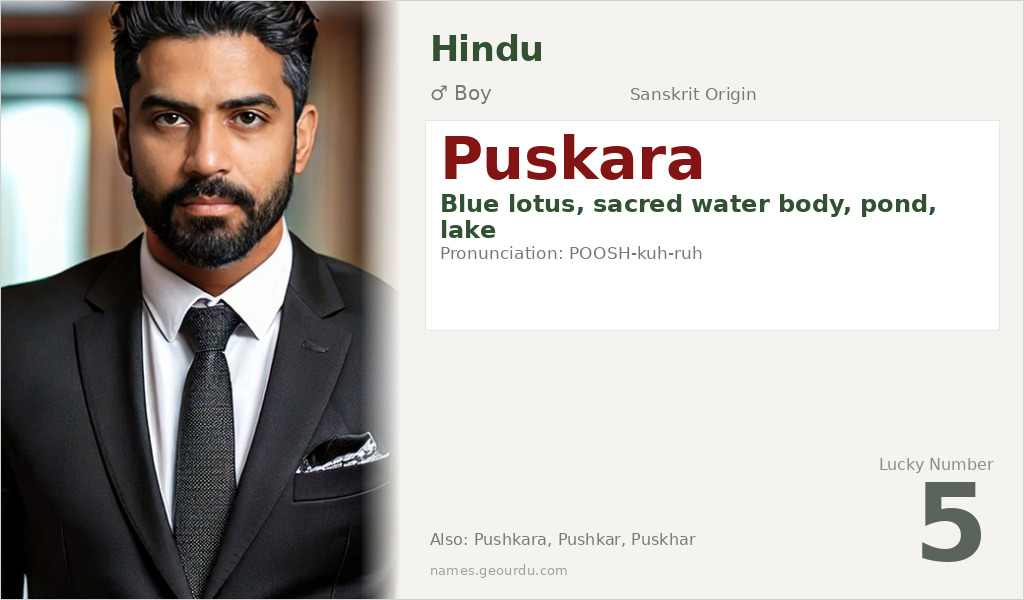
| 📛 Name | Puskara |
| 💎 Meaning | Blue lotus, sacred water body, pond, lake |
| 👤 Gender | Boy |
| 🕌 Religion | Hindu |
| 🌍 Origin | Sanskrit |
| 🗣 Pronunciation | POOSH-kuh-ruh |
| ✍️ Urdu | پشکر |
| ✍️ Arabic | بوشكارا |
| 🔢 Numerology | 5 |
| ✨ Spellings | Pushkara, Pushkar, Puskhar, Puskar |
Origin & Cultural Significance
Puskara has its origins in ancient Sanskrit, the classical language of India, and is deeply embedded in Hindu culture and mythology. The name is particularly associated with the sacred city of Pushkar in Rajasthan, home to one of the few temples dedicated to Lord Brahma and the annual Pushkar Camel Fair. In Hindu tradition, Pushkar Lake was created when Lord Brahma dropped a lotus flower, making it one of the most sacred tirthas (pilgrimage sites). The name appears in numerous Hindu scriptures, including the Mahabharata and Puranas, where it symbolizes both natural beauty and spiritual purity. While primarily used in Hindu communities, the name’s botanical meaning (blue lotus) gives it cross-cultural appeal in regions where the lotus holds symbolic importance.
Personality Traits
Those named Puskara are often perceived as spiritually aware, creative, and adaptable individuals. They tend to have a deep appreciation for beauty, nature, and artistic expression, reflecting the lotus flower’s symbolism of purity rising from murky waters. Their connection to water elements in the name’s meaning often translates to emotional depth and intuitive understanding. Typically, they balance practical wisdom with philosophical curiosity, making them both grounded and intellectually exploratory.
Similar Names
If you like Puskara, consider: Padma, Kamal, Neeraj, Sarovar, Jaladhi
Famous People Named Puskara
- Pushkar Singh Dhami — Current Chief Minister of Uttarakhand, India
- Pushkar — Ancient Hindu pilgrimage city in Rajasthan, India, named after the sacred Pushkar Lake
Frequently Asked Questions About Puskara
What does Puskara mean?
Puskara means 'blue lotus' or 'sacred pond/lake' in Sanskrit. It has dual meanings referring both to the sacred flower and to holy water bodies in Hindu tradition.
Is Puskara a boy or girl name?
Puskara is traditionally a masculine name in Hindu naming conventions, though its botanical meaning could theoretically make it adaptable. In practice, it is overwhelmingly used for boys.
What is the origin of Puskara?
Puskara originates from Sanskrit, the ancient classical language of India. It is deeply rooted in Hindu culture, mythology, and geography, particularly associated with the sacred Pushkar Lake in Rajasthan.





