Table of Contents
Putana is a name steeped in Hindu mythology with a dramatic and cautionary tale. Unlike most baby names that carry positive meanings, Putana represents one of the most famous demonesses in Hindu scriptures. This name comes from ancient Sanskrit and is forever linked to the story of the infant Krishna’s divine protection. Understanding Putana’s mythological significance reveals why this name is virtually never given to children in Hindu tradition.
Meaning of Putana
The name Putana originates from the Sanskrit word ‘पूतना’ (Pūtanā), which has complex etymological roots. Derived from the Sanskrit root ‘pū’ meaning ‘to purify’ or ‘to stink’, combined with the suffix ‘-tana’ indicating agency or doer, the name carries dual connotations. In Hindu mythology, Putana was a rakshasi (demoness) sent by the tyrannical King Kamsa to kill the infant Krishna. She disguised herself as a beautiful woman and offered poisoned breast milk to the baby, but Krishna sucked the life force from her instead, purifying her soul in the process. The name thus represents both foulness (the poison she carried) and purification (through her encounter with divinity), making it a name with profound mythological rather than literal meaning.
| 📛 Name | Putana |
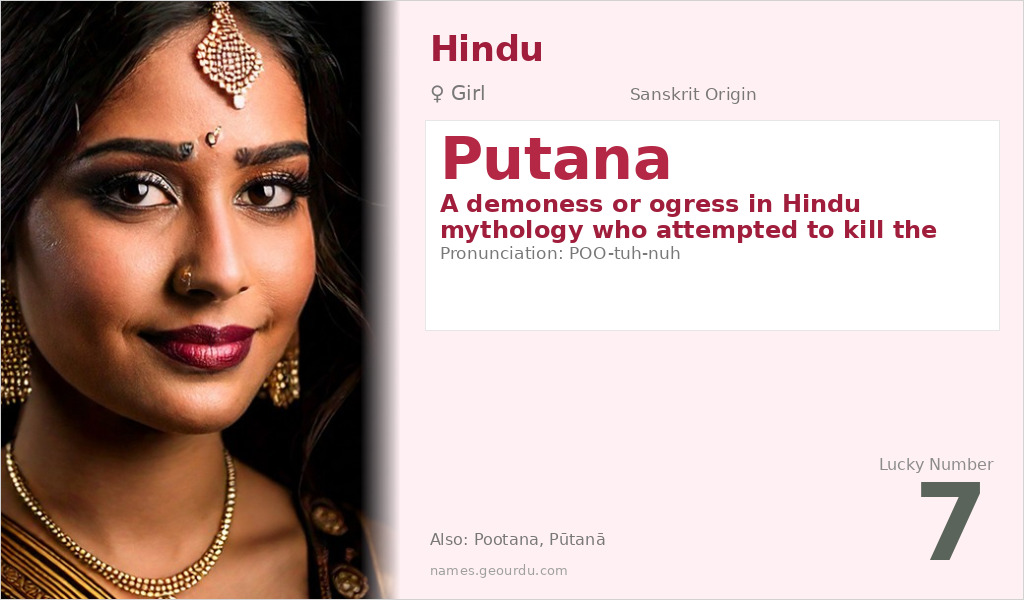
| 💎 Meaning | A demoness or ogress in Hindu mythology who attempted to kill the infant Krishna by poisoning her breast milk |
| 👤 Gender | Girl |
| 🕌 Religion | Hindu |
| 🌍 Origin | Sanskrit |
| 🗣 Pronunciation | POO-tuh-nuh |
| ✍️ Urdu | پوتنا |
| ✍️ Arabic | بوتانا |
| 🔢 Numerology | 7 |
| ✨ Spellings | Pootana, Pūtanā |
Origin & Cultural Significance
Putana’s origin is firmly rooted in Hindu scriptures, particularly the Bhagavata Purana and Vishnu Purana, where her story is detailed. She appears in the Krishna narrative as one of the many assassins sent by Kamsa to eliminate the divine child. The name is exclusively associated with this mythological figure and has no usage as a personal name in contemporary Hindu naming traditions. Culturally, the story of Putana serves as a metaphor for evil disguised as goodness and the ultimate triumph of divinity over malevolence. Unlike names from regional languages like Pashto, Balochi, or Sindhi that might sound similar, Putana is purely a Sanskrit mythological name with no positive connotations in naming practices.
Personality Traits
Given that Putana is not used as a personal name in Hindu tradition, personality traits are not associated with it in the way they are with common baby names. In mythological context, Putana represents deception, malice, and destructive intent masked by a pleasing appearance. Her story serves as a warning about false benevolence and the importance of discernment. The transformation she undergoes—from a demoness to a soul purified by Krishna’s touch—adds a layer of spiritual redemption to her character, though this doesn’t translate to positive personality attributes for namesake purposes.
Similar Names
If you like Putana, consider: Shurpanakha, Tadaka, Hidimba, Simhika, Lankini
Famous People Named Putana
- Putana (mythological figure) — The demoness from Hindu scriptures who attempted to kill infant Krishna by offering poisoned breast milk
- No contemporary famous people bear this name due to its negative mythological associations
Frequently Asked Questions About Putana
What does Putana mean?
Putana is a Sanskrit name meaning a demoness or ogress in Hindu mythology, specifically referring to the figure who attempted to kill the infant Krishna with poisoned breast milk.
Is Putana a boy or girl name?
Putana is exclusively a female name in Hindu mythology, referring to a demoness. However, it is virtually never used as a personal name for children due to its negative connotations.
What is the origin of Putana?
Putana originates from Sanskrit and Hindu mythology, specifically from the Krishna narratives in texts like the Bhagavata Purana. It is not derived from Arabic, Persian, or regional languages despite phonetic similarities to some words in other languages.