
Table of Contents
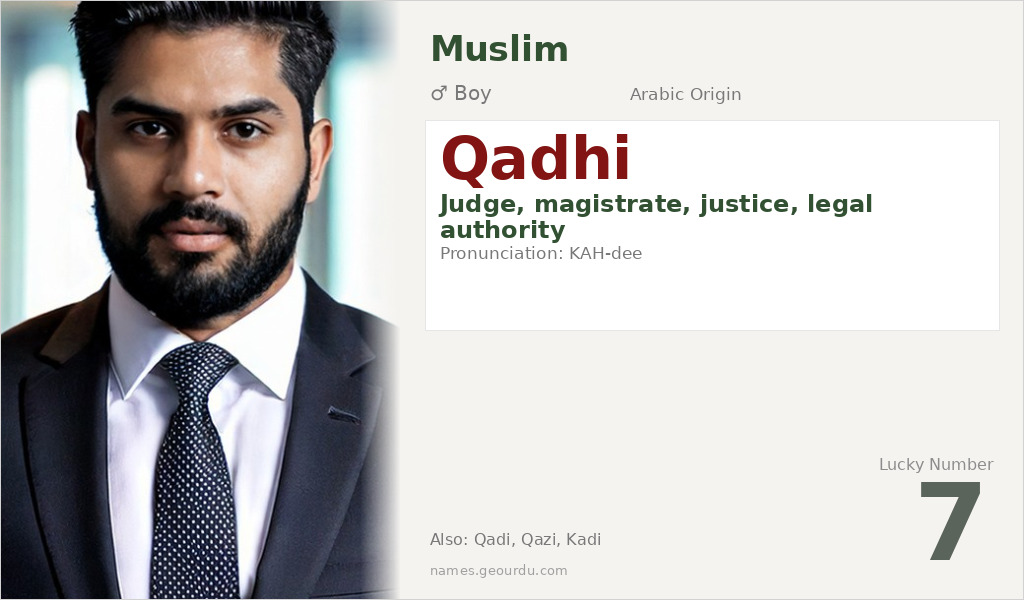
Qadhi is a distinguished Arabic name with deep roots in Islamic legal tradition. Meaning ‘judge’ or ‘magistrate,’ this name carries connotations of wisdom, fairness, and authority. Historically given to boys in Muslim families, Qadhi reflects the importance of justice in Islamic culture. The name has traveled across continents while maintaining its original meaning and significance.
Meaning of Qadhi
Qadhi derives from the Arabic triliteral root ‘q-ḍ-y’ (ق-ض-ي), which conveys the fundamental concepts of judging, deciding, and settling matters. The specific noun form ‘qāḍī’ emerged in early Islamic society to designate religious judges who applied Sharia law. This term appears in classical Arabic texts from the 8th century onward and was institutionalized during the Abbasid Caliphate. Unlike some names that evolve in meaning across languages, Qadhi has maintained its judicial connotation consistently throughout the Islamic world. The name represents not just a profession but the virtues associated with judicial wisdom—fairness, discernment, and moral authority.
| 📛 Name | Qadhi |
| 💎 Meaning | Judge, magistrate, justice, legal authority |
| 👤 Gender | Boy |
| 🕌 Religion | Muslim |
| 🌍 Origin | Arabic |
| 🗣 Pronunciation | KAH-dee |
| ✍️ Urdu | قاضی |
| ✍️ Arabic | قاضي |
| 🔢 Numerology | 7 |
| ✨ Spellings | Qadi, Qazi, Kadi, Kazi, Qadhi, Qadhee |
Origin & Cultural Significance
Qadhi originated in the Arabian Peninsula during the formative period of Islam, when the need for religious judges became essential for Muslim communities. The title was formalized under the Umayyad and Abbasid caliphates, spreading across the expanding Islamic empire from Spain to Central Asia. As Islam reached South Asia through trade and conquest, the name entered languages like Urdu, Punjabi, and Sindhi as ‘Qazi,’ often becoming a hereditary surname for families descended from judges. While the name is predominantly Arabic in origin, similar judicial titles exist in other Semitic languages, though the Arabic ‘qāḍī’ became the standard term in Islamic jurisprudence worldwide.
Personality Traits
Those named Qadhi are often associated with qualities of judgment, integrity, and leadership. They may exhibit a natural ability to assess situations objectively and make balanced decisions. In social contexts, they might be seen as mediators who value fairness and logical reasoning. The name’s historical connection to judicial authority can influence perceptions of the bearer as someone trustworthy and principled.
Similar Names
If you like Qadhi, consider: Hakim, Adil, Munir, Rashid, Sultan
Famous People Named Qadhi
- Qadi Iyad — 12th-century Maliki scholar and judge from Morocco, author of Ash-Shifa
- Qadi al-Fadil — 12th-century Egyptian statesman and chief secretary to Saladin
Frequently Asked Questions About Qadhi
What does Qadhi mean?
Qadhi means 'judge,' 'magistrate,' or 'justice' in Arabic, derived from the root word meaning 'to judge or decide.'
Is Qadhi a boy or girl name?
Qadhi is traditionally a masculine name given to boys in Muslim communities, though in some cultures it can be used as a unisex surname.
What is the origin of Qadhi?
Qadhi originates from classical Arabic and has been used since early Islamic times to refer to religious judges administering Sharia law.





