
Table of Contents
Qaiser is a powerful masculine name with regal connotations that has traveled across civilizations. Derived from the Latin title ‘Caesar’ through Persian mediation, this name carries centuries of imperial history within its syllables. Popular in South Asia and the Middle East, Qaiser evokes images of leadership, authority, and historical grandeur. Understanding its linguistic journey reveals how titles transform into personal names across cultures.
Meaning of Qaiser
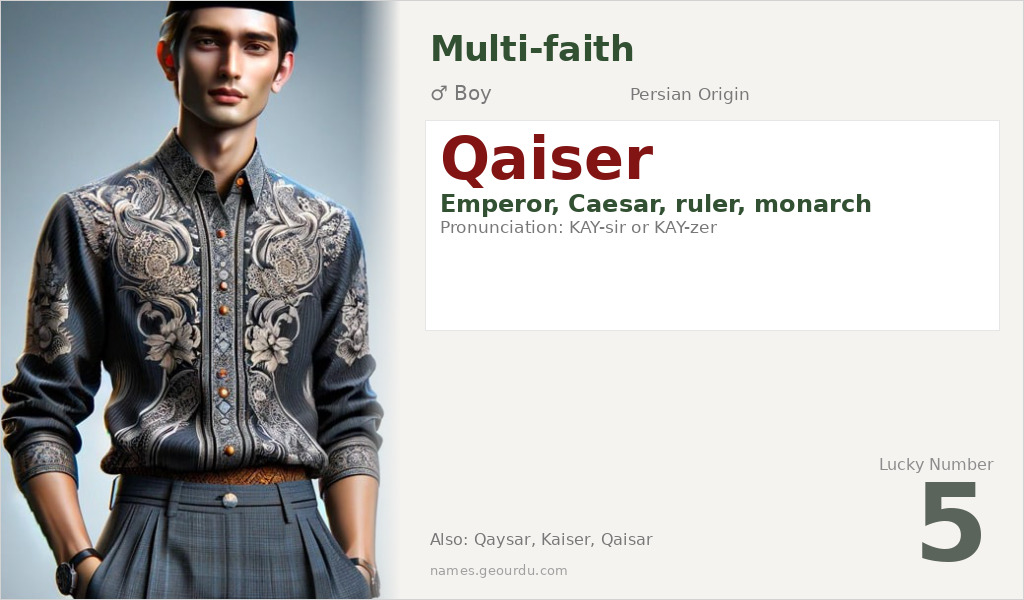
Qaiser unequivocally means ‘Emperor,’ ‘Caesar,’ or ‘ruler.’ Its etymology traces back to the Latin cognomen ‘Caesar,’ famously borne by Julius Caesar, which became a title for Roman emperors. This entered Greek as ‘Kaisar’ and was borrowed into Persian as ‘Qaysar’ during Sassanian interactions with the Byzantine Empire. From Persian, it spread to Arabic, Urdu, and other Islamic languages as an honorific for powerful sovereigns. The name specifically denotes the imperial office rather than any personal characteristics, making it one of the few names directly derived from a political title that has become a common given name.
| 📛 Name | Qaiser |
| 💎 Meaning | Emperor, Caesar, ruler, monarch |
| 👤 Gender | Boy |
| 🕌 Religion | Multi-faith |
| 🌍 Origin | Persian |
| 🗣 Pronunciation | KAY-sir or KAY-zer |
| ✍️ Urdu | قیصر |
| ✍️ Arabic | قيصر |
| 🔢 Numerology | 5 |
| ✨ Spellings | Qaysar, Kaiser, Qaisar, Kaysar, Qesar |
Origin & Cultural Significance
Qaiser originates from Persian, though its ultimate source is Latin. The name gained prominence in Islamic cultures after the Arab conquest of Persia, where Persian administrative and cultural terms were absorbed into Arabic. Historical records show Muslim rulers using ‘Qaysar’ as a title when corresponding with Byzantine emperors. In South Asia, the name became popular during the Mughal era when Persian was the court language. Today, it’s used primarily by Muslims but also by some non-Muslims in regions with Persian cultural influence. The name’s journey from Roman political office to personal name across multiple civilizations represents remarkable linguistic and cultural transmission.
Personality Traits
The imperial meaning of Qaiser naturally associates it with leadership qualities. Those bearing this name are often expected to demonstrate strength, authority, and capability. In many cultures, names are believed to influence personality, and Qaiser suggests someone destined for positions of responsibility. The name carries an expectation of dignity and command, potentially shaping how both the bearer and others perceive their role in social and professional contexts.
Similar Names
If you like Qaiser, consider: Shah, Sultan, Malik, Badshah, Khalifa
Famous People Named Qaiser
- Qaiser Ahmed — Pakistani cricketer who played for Pakistan national team in the 1970s
- Qaiser Abbas — Pakistani field hockey player who competed in the 2004 Summer Olympics
Frequently Asked Questions About Qaiser
What does Qaiser mean?
Qaiser means 'Emperor' or 'Caesar.' It originates from the Persian word 'Qaysar,' which comes from Latin 'Caesar' via Greek 'Kaisar.'
Is Qaiser a boy or girl name?
Qaiser is exclusively a masculine name across all cultures where it's used, reflecting its origin as a title for male rulers.
What is the origin of Qaiser?
Qaiser has Persian linguistic origin, though its ultimate etymology traces back to Latin 'Caesar.' It entered Islamic cultures through Persian mediation and historical contact with the Byzantine Empire.





