Table of Contents
Quddusiyyah is a beautiful and meaningful Arabic name for girls that carries deep spiritual significance in Islamic culture. Derived from one of the divine attributes of Allah, this name embodies concepts of purity, holiness, and sanctity. Parents who choose Quddusiyyah often seek to instill values of spiritual excellence and moral integrity in their daughters. With its rich linguistic roots and cultural resonance, Quddusiyyah remains a cherished choice in Muslim communities worldwide.
Meaning of Quddusiyyah
Quddusiyyah originates from the Arabic root Q-D-S (ق-د-س), which forms words related to holiness, sanctity, and purity. It is the feminine form of Quddus, one of the 99 Names of Allah (Asma ul-Husna) meaning ‘The Holy’ or ‘The Pure.’ In Islamic theology, Al-Quddus describes Allah as free from all defects, imperfections, and impurities. The suffix ‘-iyyah’ feminizes the name, creating a meaning of ‘she who is holy’ or ‘belonging to holiness.’ This name is distinct from similar names like Muqaddas (which means ‘sacred’ as an adjective) and reflects a direct connection to divine attributes. Linguistically, it appears in classical Arabic texts and has been used historically in Muslim naming traditions.
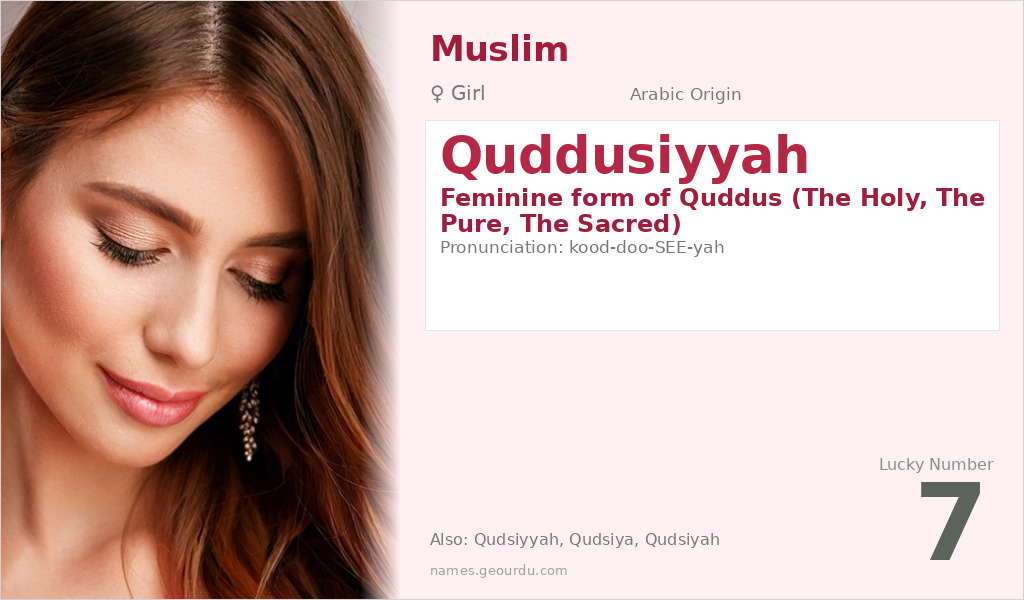
| 📛 Name | Quddusiyyah |
| 💎 Meaning | Feminine form of Quddus (The Holy, The Pure, The Sacred) |
| 👤 Gender | Girl |
| 🕌 Religion | Muslim |
| 🌍 Origin | Arabic |
| 🗣 Pronunciation | kood-doo-SEE-yah |
| ✍️ Urdu | قدسیہ |
| ✍️ Arabic | قدسية |
| 🔢 Numerology | 7 |
| ✨ Spellings | Qudsiyyah, Qudsiya, Qudsiyah, Qudsia |
Origin & Cultural Significance
Quddusiyyah has its origins in classical Arabic and Islamic tradition, emerging from the religious and cultural context of the Muslim world. The name gained popularity particularly in regions influenced by Arabic language and Islamic scholarship, including the Middle East, South Asia, and parts of Africa. Historically, it has been used among Muslim families seeking names with religious significance, often chosen for girls to reflect spiritual virtues. Notable bearers include Qudsia Begum, the 19th century female ruler of Bhopal in India, demonstrating its use in royal and influential families. The name continues to be used today, maintaining its religious and cultural relevance across diverse Muslim communities.
Personality Traits
Those named Quddusiyyah are often associated with qualities of purity, spirituality, and moral integrity. They may exhibit a serene and contemplative nature, valuing principles and ethical conduct in their personal and social lives. Their connection to the concept of holiness can manifest as a desire for meaningful pursuits and a respectful, dignified demeanor. While personality varies individually, the name’s meaning suggests a person who strives for inner and outer purity in their actions and relationships.
Similar Names
If you like Quddusiyyah, consider: Quds, Qudsi, Muqaddas, Tahira, Zakiyyah, Saleema, Mubaraka, Noor
Famous People Named Quddusiyyah
- Qudsia Begum — 19th century ruler of Bhopal State in India, known for her administrative skills and patronage of education
- Qudsia Zaidi — Indian social activist and founder of Hindustani Theatre in post-independence India
Frequently Asked Questions About Quddusiyyah
What does Quddusiyyah mean?
Quddusiyyah means 'holy,' 'sacred,' or 'pure' in Arabic. It is the feminine form of Quddus, one of the 99 Names of Allah, derived from the root Q-D-S meaning holiness.
Is Quddusiyyah a boy or girl name?
Quddusiyyah is exclusively a girl's name. The '-iyyah' suffix makes it feminine in Arabic, while the masculine form is Quddus.
What is the origin of Quddusiyyah?
Quddusiyyah originates from Arabic and Islamic tradition. It comes from the Arabic root Q-D-S and is directly related to the divine attribute Al-Quddus in Islam.