Table of Contents
Qumri is a poetic and melodic name that evokes images of grace and natural beauty. Derived from Arabic, it literally means ‘turtle dove’—a bird celebrated in literature and culture for its gentle nature and symbolic resonance. This name carries centuries of linguistic heritage and continues to be cherished for its elegant sound and meaningful origins. Whether you’re drawn to its avian connection or its cultural depth, Qumri offers a unique choice with rich historical roots.
Meaning of Qumri
Qumri originates from the Arabic word قُمْرِي (qumrī), which specifically refers to the European turtle dove (Streptopelia turtur). The name is derived from the Arabic root ق-م-ر (q-m-r), associated with the moon (qamar) and whiteness, reflecting the dove’s pale plumage. In classical Arabic poetry, the qumri dove symbolizes love, longing, and tenderness, often used metaphorically to describe beloved individuals. The name has been adopted into Persian and Urdu with the same meaning, maintaining its poetic and ornithological significance across these languages. Its usage in literature dates back centuries, appearing in works by poets like Al-Mutanabbi, where it represents beauty and purity.
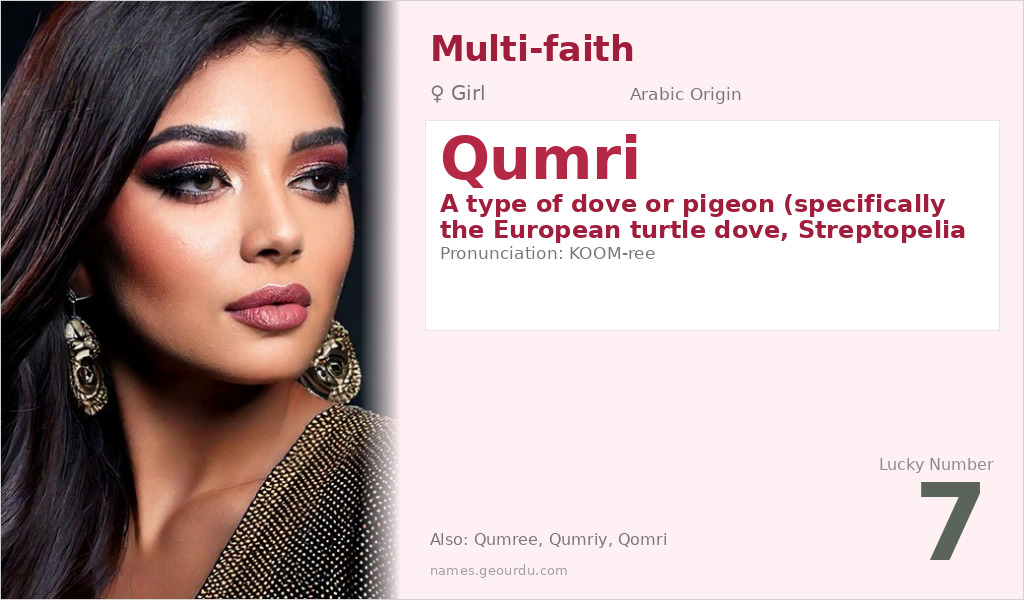
| 📛 Name | Qumri |
| 💎 Meaning | A type of dove or pigeon (specifically the European turtle dove, Streptopelia turtur) |
| 👤 Gender | Girl |
| 🕌 Religion | Multi-faith |
| 🌍 Origin | Arabic |
| 🗣 Pronunciation | KOOM-ree |
| ✍️ Urdu | قمري |
| ✍️ Arabic | قُمْرِي |
| 🔢 Numerology | 7 |
| ✨ Spellings | Qumree, Qumriy, Qomri, Qumry |
Origin & Cultural Significance
Qumri has its roots in classical Arabic language and culture, where it was used both as a common noun for the turtle dove and as a personal name. The name spread through Islamic civilization to Persian, Turkish, and South Asian regions, where it appears in literary and cultural contexts. While commonly used in Muslim communities due to Arabic’s religious significance, it is not exclusively Islamic and appears in multi-faith Arabic-speaking societies. Historical records show its usage in medieval poetry and folklore, often associated with themes of migration, love, and nature. In modern times, it remains a recognizable name in regions like the Middle East, Central Asia, and South Asia, though it is relatively uncommon compared to more traditional names.
Personality Traits
Those named Qumri are often associated with qualities of peace, gentleness, and artistic sensitivity, mirroring the dove’s symbolic traits. They may possess a calm demeanor and a nurturing spirit, valuing harmony in relationships and environments. Their communicative nature and emotional depth make them empathetic friends and creative thinkers, often drawn to expressive pursuits like writing, music, or visual arts.
Similar Names
If you like Qumri, consider: Yamama, Hamama, Ferakh, Bulbul, Tair
Famous People Named Qumri
- Qumri (historical) — A 9th-century Persian poetess known for her lyrical verses
- Qumri (cultural) — A character in classical Arabic love poetry symbolizing grace and beauty
Frequently Asked Questions About Qumri
What does Qumri mean?
Qumri means 'turtle dove' in Arabic, specifically referring to the European turtle dove (Streptopelia turtur). It is derived from the Arabic root ق-م-ر (q-m-r), related to the moon and whiteness.
Is Qumri a boy or girl name?
Qumri is primarily used as a girl's name in Arabic, Persian, and Urdu-speaking cultures, though it can be unisex in some regional contexts due to its nature-inspired meaning.
What is the origin of Qumri?
Qumri originates from Arabic language and culture, where it has been used for centuries as both a term for the turtle dove and a personal name. It has spread to Persian, Urdu, and other languages through historical cultural exchange.