
Table of Contents
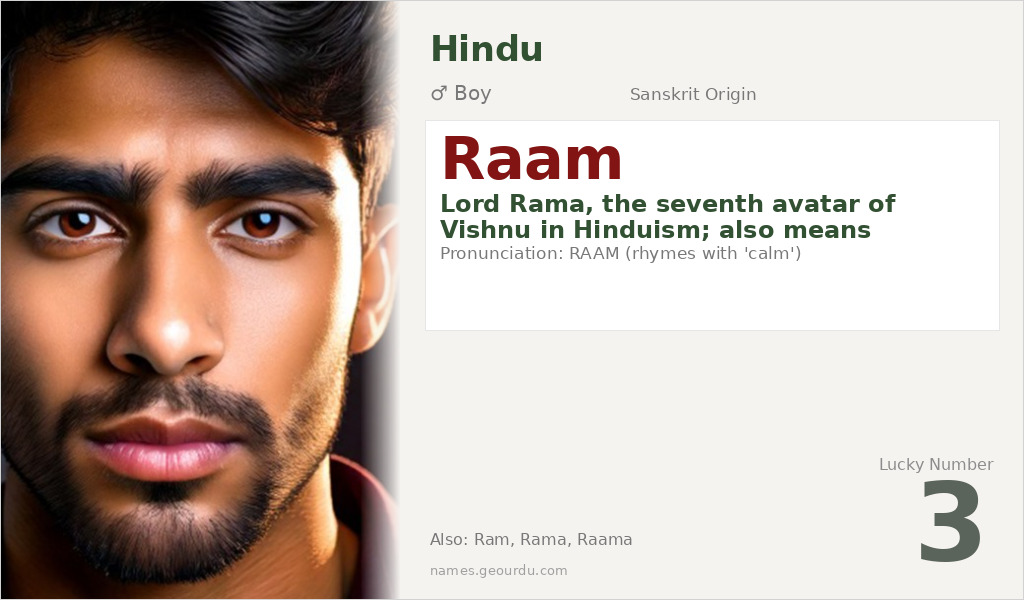
Raam is a profound Sanskrit name that resonates deeply within Hindu culture and spirituality. Primarily known as the name of Lord Rama, the seventh avatar of Vishnu, this name carries centuries of religious and cultural significance. Beyond its divine association, Raam has a beautiful linguistic meaning rooted in ancient Sanskrit. This name continues to be a popular choice for boys in Hindu families, symbolizing both spiritual devotion and admirable personal qualities.
Meaning of Raam
The name Raam originates from the Sanskrit root ‘ram’ (रम्), which means ‘to delight, to please, or to rejoice’. In its most celebrated usage, Raam refers specifically to Lord Rama, the central figure of the Hindu epic Ramayana and the seventh avatar of Vishnu. Linguistically, the name developed from the Sanskrit word ‘rāma’ meaning ‘dark, black’ or ‘pleasing’, with the latter meaning becoming predominant. The name appears in ancient Vedic texts and gained immense popularity through Valmiki’s Ramayana, composed around the 5th-4th century BCE. Today, when parents name their child Raam, they invoke both the divine qualities of Lord Rama and the general meaning of ‘charming’ or ‘delightful’.
| 📛 Name | Raam |
| 💎 Meaning | Lord Rama, the seventh avatar of Vishnu in Hinduism; also means 'pleasing, charming, delightful' in Sanskrit |
| 👤 Gender | Boy |
| 🕌 Religion | Hindu |
| 🌍 Origin | Sanskrit |
| 🗣 Pronunciation | RAAM (rhymes with 'calm') |
| ✍️ Urdu | رام |
| ✍️ Arabic | راما |
| 🔢 Numerology | 3 |
| ✨ Spellings | Ram, Rama, Raama, Raamah |
Origin & Cultural Significance
Raam has its origins in ancient Sanskrit, one of the oldest Indo-European languages. The name’s cultural significance is deeply rooted in Hindu tradition, particularly through the Ramayana epic where Lord Rama’s life story establishes ideals of dharma (righteousness), loyalty, and kingship. Historically, the name spread throughout South and Southeast Asia with the dissemination of Hindu culture and the Ramayana tradition. In modern times, Raam remains predominantly a Hindu name, though its variations appear in some Buddhist and Jain contexts due to cultural exchange. The name’s enduring popularity spans millennia, maintaining its religious and cultural importance across Hindu communities worldwide.
Personality Traits
Those named Raam are often associated with qualities of leadership, integrity, and compassion. Inspired by Lord Rama’s character, they may exhibit strong moral principles, devotion to family, and a sense of responsibility. The name suggests someone who is charming and pleasant in demeanor, living up to the Sanskrit meaning of ‘delightful’. These individuals often inspire trust and respect in others through their consistent character and ethical approach to life.
Similar Names
If you like Raam, consider: Raman, Ramachandra, Ramakrishna, Ramesh, Ravindra
Famous People Named Raam
- Lord Rama — Seventh avatar of Vishnu in Hinduism, central figure of the Ramayana
- Ram Mohan Roy — Indian reformer and founder of Brahmo Samaj (1772-1833)
Frequently Asked Questions About Raam
What does Raam mean?
Raam means 'Lord Rama' (the seventh avatar of Vishnu in Hinduism) and also 'pleasing, charming, or delightful' in Sanskrit.
Is Raam a boy or girl name?
Raam is exclusively a boy's name in Hindu tradition, named after the male deity Lord Rama.
What is the origin of Raam?
Raam originates from Sanskrit, one of the oldest languages of India, with roots in Hindu religious texts and the Ramayana epic.





