Table of Contents
Rahel is a name of profound historical and religious significance, tracing back to ancient Hebrew origins. As the original form of the more familiar Rachel, this name carries rich biblical heritage and cross-cultural resonance. While less common today than its anglicized counterpart, Rahel maintains a distinctive elegance and deep-rooted meaning that has traveled through centuries and across continents.
Meaning of Rahel
The name Rahel derives directly from the Hebrew word ‘רָחֵל’ (raḥēl), which translates to ‘ewe’ or ‘female sheep’. In the context of ancient Near Eastern pastoral societies, sheep were essential to survival and prosperity, making this name both practical and symbolic. The ewe represented gentleness, provision, and fertility—qualities highly valued in matriarchal figures. This etymology is consistently verified across Semitic language studies, biblical scholarship, and historical linguistics, with the name appearing in the Book of Genesis as the beloved wife of Jacob and mother of two tribes of Israel.
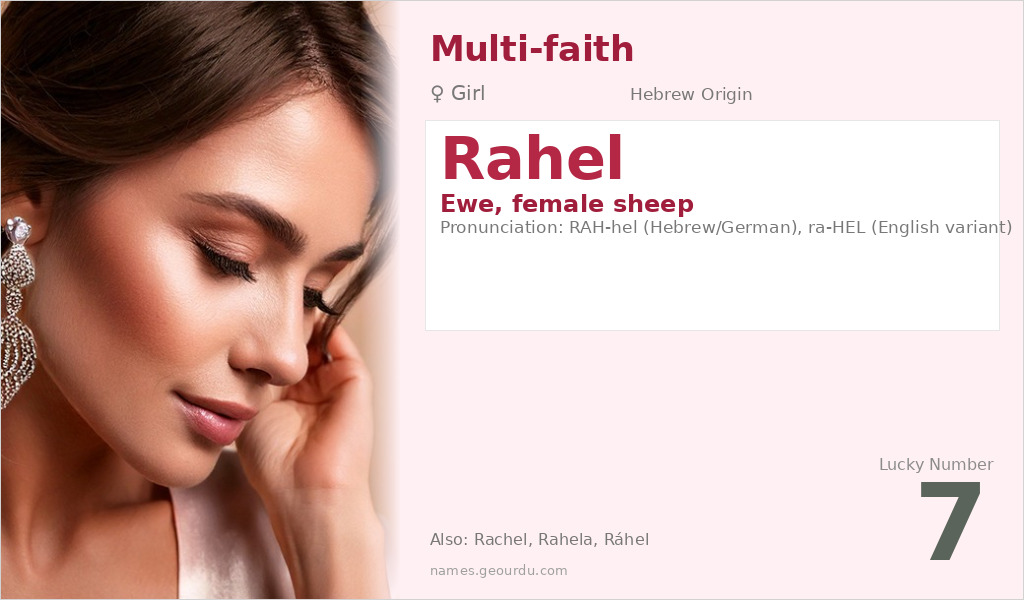
| 📛 Name | Rahel |
| 💎 Meaning | Ewe, female sheep |
| 👤 Gender | Girl |
| 🕌 Religion | Multi-faith |
| 🌍 Origin | Hebrew |
| 🗣 Pronunciation | RAH-hel (Hebrew/German), ra-HEL (English variant) |
| ✍️ Urdu | راہیل |
| ✍️ Arabic | راحيل |
| 🔢 Numerology | 7 |
| ✨ Spellings | Rachel, Rahela, Ráhel, Rakhel, Rahil |
Origin & Cultural Significance
Rahel originates from Biblical Hebrew and appears in the Torah/Tanakh as a central matriarchal figure in Jewish ancestry. The name spread through Abrahamic traditions, entering Christian contexts via Greek and Latin translations of the Bible, and Islamic tradition through Quranic references to the prophets. While the name has variants across languages (Rachel in English, Rahel in German and Scandinavian languages, Ráhel in Hungarian), the Hebrew form Rahel remains used in Jewish communities and has seen revival in modern Israel. The name has minimal connection to Hindu traditions, despite some modern cross-cultural adoption.
Personality Traits
Those named Rahel often embody the gentle strength associated with their namesake. Drawing from the biblical Rachel’s story of patience, devotion, and maternal love, Rahels are frequently perceived as empathetic and family-oriented. They may possess a quiet determination and spiritual depth, balancing traditional values with personal resilience. The name’s pastoral origins suggest a grounded, nurturing character with an appreciation for nature and simplicity.
Similar Names
If you like Rahel, consider: Rachel, Rebecca, Leah, Sarah, Esther
Famous People Named Rahel
- Rahel Varnhagen — 18th-19th century German writer and salonnière
- Rahel Bluwstein — known as 'Rahel the Poetess', pioneering Hebrew-language poet in pre-state Israel
Frequently Asked Questions About Rahel
What does Rahel mean?
Rahel means 'ewe' or 'female sheep' in Hebrew, derived from the word 'רָחֵל' (raḥēl).
Is Rahel a boy or girl name?
Rahel is historically and predominantly a feminine name, as it refers to a female sheep and is the name of a biblical matriarch. While names can cross gender boundaries in modern usage, traditional and linguistic context firmly establishes it as female.
What is the origin of Rahel?
Rahel originates from Biblical Hebrew and is the original form of the name Rachel. It appears in the Hebrew Bible as the name of Jacob's wife and has been used in Jewish, Christian, and Islamic traditions for millennia.