
Table of Contents
Rahul is a distinguished Sanskrit name that has transcended its ancient origins to become a popular choice across South Asia and beyond. With roots in classical Indian literature and strong connections to Buddhist history through Buddha’s son Rāhula, this name carries layers of cultural and spiritual significance. Today, Rahul represents capability, emotional depth, and resilience, making it a meaningful choice for parents seeking a name with historical weight and contemporary relevance.
Meaning of Rahul
The name Rahul originates from the Sanskrit word ‘rāhula,’ derived from the root ‘rah’ meaning ‘to seize, grasp, or hold.’ In its earliest usage, it referred to a ‘fetter’ or ‘bond,’ particularly in the emotional sense of attachment. This meaning gained profound significance through Rāhula, the son of Siddhartha Gautama (the Buddha), whose name symbolized the worldly attachment his father had to overcome on the path to enlightenment. Over centuries, the meaning evolved from ‘bond’ to more positive connotations of ‘efficient,’ ‘capable,’ and ‘conqueror of miseries,’ reflecting how someone who masters attachments becomes effective. The name maintains these dual layers—historical depth and modern aspirational qualities—across Indian languages including Hindi, Bengali, Marathi, and Gujarati.
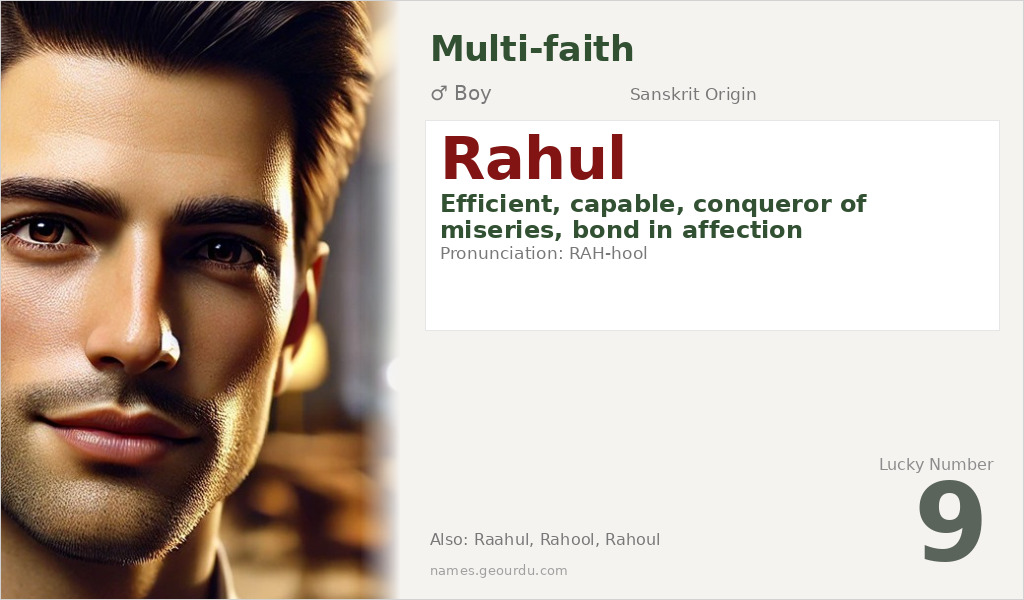
| 📛 Name | Rahul |
| 💎 Meaning | Efficient, capable, conqueror of miseries, bond in affection |
| 👤 Gender | Boy |
| 🕌 Religion | Multi-faith |
| 🌍 Origin | Sanskrit |
| 🗣 Pronunciation | RAH-hool |
| ✍️ Urdu | راہل |
| ✍️ Arabic | راهول |
| 🔢 Numerology | 9 |
| ✨ Spellings | Raahul, Rahool, Rahoul |
Origin & Cultural Significance
Rahul has its origins in classical Sanskrit literature and Buddhist texts dating back to the 5th century BCE. The name first gained prominence through Rāhula, the only son of Gautama Buddha, mentioned in the Pāli Canon and other early Buddhist scriptures. While initially associated with Buddhist communities, the name spread across the Indian subcontinent through cultural exchange and literary works, becoming common among Hindus, Jains, and other religious groups. In contemporary times, Rahul remains particularly popular in India, Nepal, Bangladesh, and among diaspora communities worldwide, celebrated for its cross-cultural appeal and historical resonance beyond any single religious tradition.
Personality Traits
Those named Rahul are often described as balanced individuals who combine practical efficiency with emotional depth. They typically demonstrate strong problem-solving abilities and organizational skills, earning them reputations as reliable and capable in professional settings. At the same time, their name’s historical connection to ‘bonds’ manifests in their capacity for deep, meaningful relationships and loyalty to family and friends. This combination of competence and compassion makes Rahuls natural mediators and trusted advisors in their communities.
Similar Names
If you like Rahul, consider: Rohan, Rahil, Rahman, Rahuldev, Rahulkumar
Famous People Named Rahul
- Rahul Gandhi — Indian politician and former President of the Indian National Congress
- Rahul Dravid — Former Indian cricket captain and coach, known as 'The Wall'
Frequently Asked Questions About Rahul
What does Rahul mean?
Rahul means 'efficient, capable, conqueror of miseries, or bond in affection' in Sanskrit, with historical connections to Buddhist tradition through Buddha's son Rāhula.
Is Rahul a boy or girl name?
Rahul is almost exclusively a masculine name across all cultures where it's used, particularly in South Asian countries like India, Nepal, and Bangladesh.
What is the origin of Rahul?
Rahul originates from Sanskrit, with documented usage dating back to ancient Indian literature and early Buddhist texts from the 5th century BCE.





