Table of Contents
Raisa is an elegant, cross-cultural name with rich historical roots spanning multiple continents. Whether you’re drawn to its Arabic meaning of ‘leader’ or its Slavic connection to the ‘rose,’ this name carries both strength and beauty. Used in Muslim, Christian, and secular contexts, Raisa has been borne by notable figures from Soviet first ladies to Olympic athletes. Let’s explore the fascinating dual heritage of this timeless name.
Meaning of Raisa
Raisa possesses two well-documented meanings from different linguistic traditions. In Arabic, Raisa (رئيسة) is the feminine form of Ra’is (رئيس), meaning ‘leader,’ ‘chief,’ or ‘president,’ derived from the triliteral root R-‘-S (رأس) meaning ‘head.’ This reflects leadership and authority. Simultaneously, in Slavic languages (particularly Russian, Bulgarian, and Ukrainian), Raisa (Раиса) derives from the Greek name ‘Rais’ meaning ‘rose’ or possibly entered Slavic cultures through Byzantine contact with the Arabic world. The name appears in Eastern Orthodox Christian tradition as Saint Raisa (also called Iraida) of Alexandria, a 3rd-century martyr. This dual etymology gives the name both powerful and floral connotations.
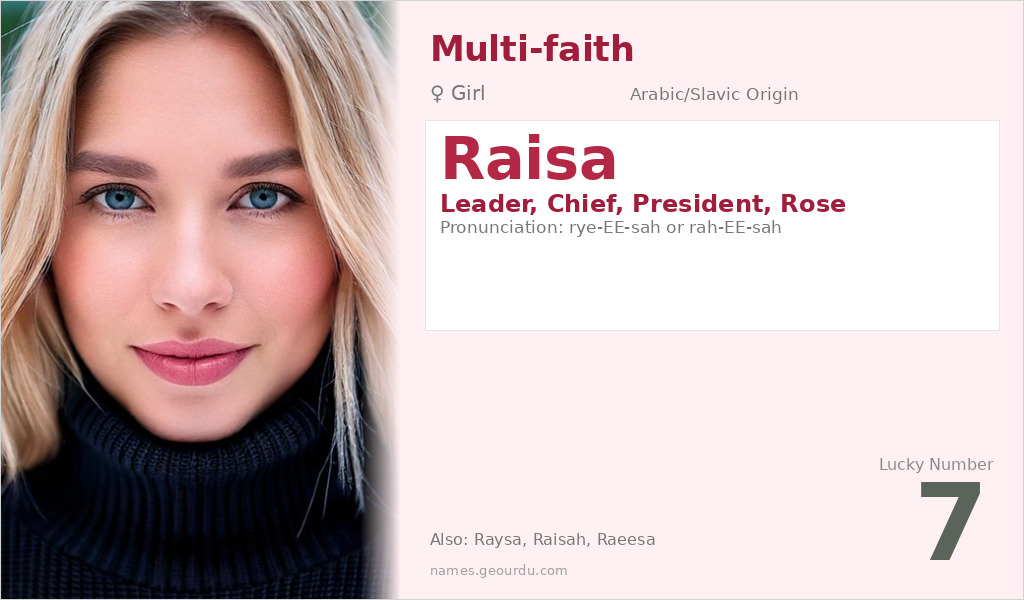
| 📛 Name | Raisa |
| 💎 Meaning | Leader, Chief, President, Rose |
| 👤 Gender | Girl |
| 🕌 Religion | Multi-faith |
| 🌍 Origin | Arabic/Slavic |
| 🗣 Pronunciation | rye-EE-sah or rah-EE-sah |
| ✍️ Urdu | رئیسہ |
| ✍️ Arabic | رئيسة |
| 🔢 Numerology | 7 |
| ✨ Spellings | Raysa, Raisah, Raeesa, Raisaa |
Origin & Cultural Significance
Raisa has a complex geographical and cultural journey. The Arabic version spread through the Islamic world from the Middle East to South Asia and Africa, often used in Muslim communities. The Slavic version entered Eastern Europe through Orthodox Christian tradition and Byzantine influence. In Russia, the name gained popularity in the 19th century and saw renewed interest during the Soviet era, notably with Raisa Gorbacheva. While occasionally used in Hindu contexts in modern India (likely through cultural exchange), it is not traditionally a Hindu name with Vedic or Sanskrit origins. The name appears in various forms across languages, maintaining its core meanings while adapting to local pronunciations.
Personality Traits
Those named Raisa often embody a blend of leadership and grace. The Arabic meaning suggests qualities of authority, intelligence, and organizational ability, while the Slavic connection to roses implies beauty, delicacy, and warmth. This combination frequently results in individuals who are both capable and compassionate, able to lead while maintaining emotional intelligence. They may exhibit strong communication skills and a natural elegance in their demeanor.
Similar Names
If you like Raisa, consider: Rania, Rashida, Rosa, Rais, Raisel, Raisan, Raisia, Raisu, Raisan
Famous People Named Raisa
- Raisa Gorbacheva — Former First Lady of the Soviet Union, wife of Mikhail Gorbachev
- Raisa Smetanina — Soviet/Russian cross-country skier, multiple Olympic gold medalist
Frequently Asked Questions About Raisa
What does Raisa mean?
Raisa has two primary meanings: In Arabic, it means 'leader,' 'chief,' or 'president.' In Slavic languages (from Greek), it means 'rose.'
Is Raisa a boy or girl name?
Raisa is exclusively a feminine name across all cultures where it's used. The Arabic version is specifically the feminine form of Ra'is.
What is the origin of Raisa?
Raisa has dual origins: Arabic (from the root meaning 'head/leader') and Slavic (from Greek meaning 'rose'), with usage in Muslim, Christian, and secular contexts worldwide.