
Table of Contents
Rajanikant is a beautiful Sanskrit name that evokes the serene majesty of the night sky. Primarily used in Hindu communities, this name carries poetic significance as an epithet for the moon. With roots in ancient Indian literature, Rajanikant represents illumination in darkness and celestial rulership. Discover the rich etymology and cultural resonance of this distinctive name.
Meaning of Rajanikant
Rajanikant derives from classical Sanskrit, combining ‘Rājani’ (night) and ‘Kānta’ (beloved/lord). This creates the literal meaning ‘lord of the night’ or ‘delighter of the night.’ In Vedic and post-Vedic literature, this term frequently appears as a kenning for the moon god Chandra, who presides over the nocturnal realm. The name embodies poetic imagery where the moon is personified as a ruler who brings light and beauty to darkness. Unlike solar names, Rajanikant specifically connects to lunar symbolism, reflecting calmness, reflection, and cyclical renewal. Its usage in Sanskrit poetry highlights India’s rich tradition of celestial metaphor in naming.
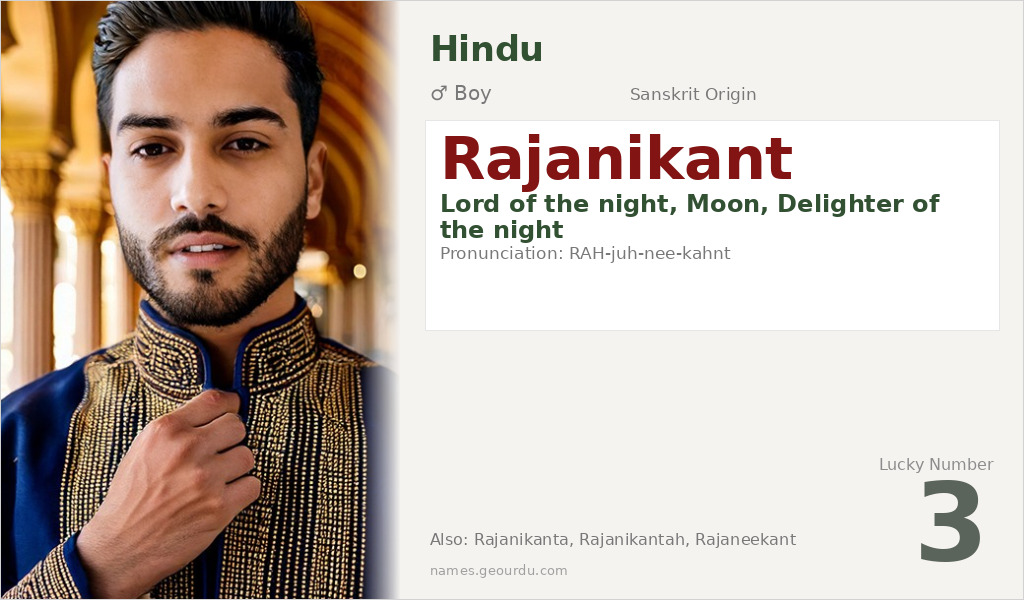
| 📛 Name | Rajanikant |
| 💎 Meaning | Lord of the night, Moon, Delighter of the night |
| 👤 Gender | Boy |
| 🕌 Religion | Hindu |
| 🌍 Origin | Sanskrit |
| 🗣 Pronunciation | RAH-juh-nee-kahnt |
| ✍️ Urdu | راجنیکانت |
| ✍️ Arabic | راجانيكانت |
| 🔢 Numerology | 3 |
| ✨ Spellings | Rajanikanta, Rajanikantah, Rajaneekant |
Origin & Cultural Significance
Rajanikant originates from Sanskrit, the ancient liturgical language of Hinduism, with documented usage in classical Indian texts. As a compound name, it follows traditional Sanskrit naming patterns where elements combine to create descriptive or honorific meanings. The name appears in Hindu mythological references to Chandra (the moon deity) and in poetic works describing night’s beauty. While predominantly used in India, particularly among Hindu families, the name’s linguistic roots connect to broader Indo-European language family through Sanskrit. Its cultural significance lies in Hindu cosmology where celestial bodies are revered and personified, making Rajanikant a name that carries both religious and aesthetic weight.
Personality Traits
Those named Rajanikant are often associated with lunar qualities: calm, intuitive, and emotionally intelligent. They may exhibit a natural magnetism that draws people toward their soothing presence. Like the moon’s phases, they might experience cycles of introspection and expression, showing adaptability and depth. These individuals frequently display creativity and an ability to find light in challenging situations, true to their name’s meaning of ruling over darkness.
Similar Names
If you like Rajanikant, consider: Chandrashekhar, Shashank, Indukant, Nishikant, Rajiv
Famous People Named Rajanikant
- Rajinikanth (born Shivaji Rao Gaekwad) — Legendary Indian film actor known as 'Superstar' in Tamil cinema, though his stage name is a variation
- Rajanikant Arole — Indian social worker and Ramon Magsaysay Award winner for community healthcare work
Frequently Asked Questions About Rajanikant
What does Rajanikant mean?
Rajanikant means 'Lord of the Night' or 'Moon' in Sanskrit, derived from 'Rājani' (night) and 'Kānta' (beloved/lord).
Is Rajanikant a boy or girl name?
Rajanikant is traditionally a masculine name in Hindu naming conventions, though its poetic nature could theoretically be adapted.
What is the origin of Rajanikant?
Rajanikant originates from Sanskrit, the classical language of ancient India, with roots in Hindu mythology and poetry.





