
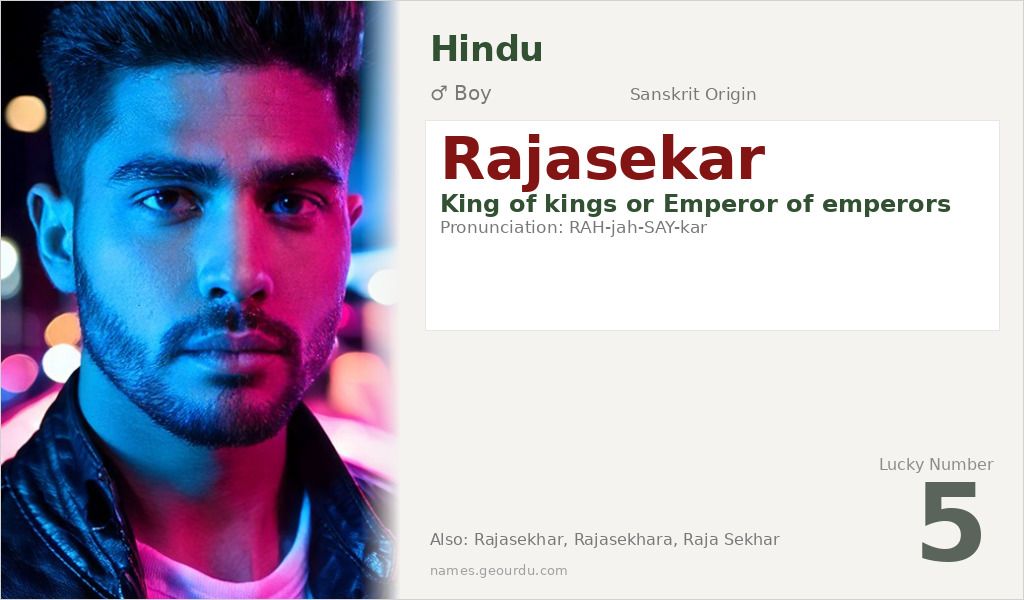
Table of Contents
Rajasekar is a powerful Sanskrit name with deep royal connotations that has been cherished in Hindu communities for centuries. Meaning ‘King of kings’ or ‘Emperor of emperors’, this name carries an aura of authority and leadership. Particularly popular in South Indian states like Tamil Nadu, Andhra Pradesh, and Karnataka, Rajasekar represents both historical significance and contemporary appeal. Parents choosing this name often hope to instill qualities of strength, dignity, and noble character in their child.
Meaning of Rajasekar
Rajasekar derives from classical Sanskrit, combining ‘Raja’ (राज) meaning ‘king’ or ‘ruler’ and ‘Sekar’ (शेखर) meaning ‘crown’, ‘crest’, or ’emperor’. The compound literally translates to ‘king of kings’, indicating supreme sovereignty and highest authority. In Hindu religious context, the name is associated with Lord Shiva as ‘Raja Sekhara’ — the one who wears the crown of kings, symbolizing his supreme status among deities. The name appears in ancient Sanskrit texts and South Indian inscriptions, particularly during the Chola and Vijayanagara periods. Linguistically, it follows standard Sanskrit compound formation rules (samāsa) where ‘raja’ modifies ‘sekar’ to create a meaningful whole.
| 📛 Name | Rajasekar |
| 💎 Meaning | King of kings or Emperor of emperors |
| 👤 Gender | Boy |
| 🕌 Religion | Hindu |
| 🌍 Origin | Sanskrit |
| 🗣 Pronunciation | RAH-jah-SAY-kar |
| ✍️ Urdu | راجاسیکر |
| ✍️ Arabic | راجاسيكار |
| 🔢 Numerology | 5 |
| ✨ Spellings | Rajasekhar, Rajasekhara, Raja Sekhar, Rajasekhar |
Origin & Cultural Significance
Rajasekar originates from Sanskrit, the classical language of ancient India that has influenced numerous South Asian languages. The name has particularly strong roots in South Indian Hindu traditions, where it has been used for centuries by various royal families and communities. Historical records show the name appearing in Tamil and Telugu regions as early as the 9th century CE, with notable bearers including the Sanskrit poet Rajasekhara. The name reflects the cultural importance of royalty and divine sovereignty in Hindu philosophy, where earthly kings were seen as representatives of divine order. While primarily Hindu in association, the name’s Sanskrit origins mean it could theoretically be used across Indian religious communities, though it remains predominantly Hindu in practice.
Personality Traits
Those named Rajasekar are often associated with leadership qualities, confidence, and a natural authority. They tend to be ambitious individuals who set high standards for themselves and others, with a strong sense of responsibility. The name’s royal connotations may influence perceptions, leading others to expect dignity, wisdom, and protective instincts from someone bearing this name. While personality varies by individual, the name’s meaning often creates expectations of someone who can take charge and make decisive decisions.
Similar Names
If you like Rajasekar, consider: Rajendra, Rajashekar, Raja, Sekhar, Rajkumar
Famous People Named Rajasekar
- Rajasekhara Reddy — Former Chief Minister of Andhra Pradesh, India
- Rajasekhara — 9th century Sanskrit poet and dramatist from the Gurjara-Pratihara dynasty
Frequently Asked Questions About Rajasekar
What does Rajasekar mean?
Rajasekar means 'King of kings' or 'Emperor of emperors' in Sanskrit, combining 'Raja' (king) and 'Sekar' (crown/emperor).
Is Rajasekar a boy or girl name?
Rajasekar is exclusively a boy's name in Hindu naming traditions, with no documented usage as a feminine name.
What is the origin of Rajasekar?
Rajasekar originates from Sanskrit, the classical language of ancient India, with particular prevalence in South Indian Hindu communities.





